
Close Menu
  • Home
  • Identity
  • Inventions
  • Future
  • Science
  • Startups
  • Spanish
What's Hot

Anduril has invented a novel drone flying contest where work is the prize

Android smartphones are getting more anti-theft features

Indian states consider Australian-style ban on social media for children

Facebook X (Twitter) Instagram
  • Home
  • About Us
  • Advertise with Us
  • Contact Us
  • DMCA
  • Privacy Policy
  • Terms & Conditions
  • User-Submitted Posts
Facebook X (Twitter) Instagram
Fyself News
  • Home
  • Identity
  • Inventions
  • Future
  • Science
  • Startups
  • Spanish
Fyself News
Home » James Webb Telescope Looks into the ‘Eye of God’ and Finds Clues to the Origin of Life — Space Photo of the Week
Science

James Webb Telescope Looks into the ‘Eye of God’ and Finds Clues to the Origin of Life — Space Photo of the Week

userBy userJanuary 25, 2026No Comments3 Mins Read
Share Facebook Twitter Pinterest Telegram LinkedIn Tumblr Email Copy Link
Follow Us
Google News Flipboard
Share
Facebook Twitter LinkedIn Pinterest Email Copy Link

simple facts

What it is: Helix Nebula (also known as NGC 7293 and Caldwell 63), a planetary nebula

Location: 655 light years away, in the constellation Aquarius

Share date: January 20, 2026

Stunning new images of the Helix Nebula captured by the James Webb Space Telescope (JWST) reveal the death throes of stars like our Sun, and perhaps a harbinger of the fate of our own solar system.

The Helix Nebula, also known as the “Eye of God” or “Eye of Sauron,” is one of the closest, most colorful, and best-studied planetary nebulae in the universe. This famous nearby starscape is destined for JWST’s near-infrared processing, revealing cosmic structures previously hinted at only by other space telescopes.

According to NASA, a planetary nebula is a somewhat confusing name for a cloud of gases (mainly hydrogen and helium) and microscopic cosmic dust that a dying Sun-like star releases as it sheds its outer layers. The star is a dense, hot white dwarf in the center of the cloud that ionizes the surrounding gas, causing it to glow in vivid colors. In this case, when viewed from the solar system, it has a spiral (or corkscrew-like) structure. (These bright, often circular nebulae resembled planets when viewed with early telescopes, hence their name.)

you may like

Amidst this colorful spectacle, important processes are unfolding. The star’s former outer layer is now expanding into interstellar space, seeding the galaxy with carbon, oxygen, and nitrogen, the same elements that make life on Earth possible.

JWST used a near-infrared camera to penetrate deeper into the Helix Nebula than ever before. In this close-up of a small section of the nebula around a white dwarf, thousands of orange and gold comet-like columns stream upward. These features, technically called “comet knots,” separate the fast stellar winds from the dying star and from older, cooler layers of gas that were ejected early in its life.
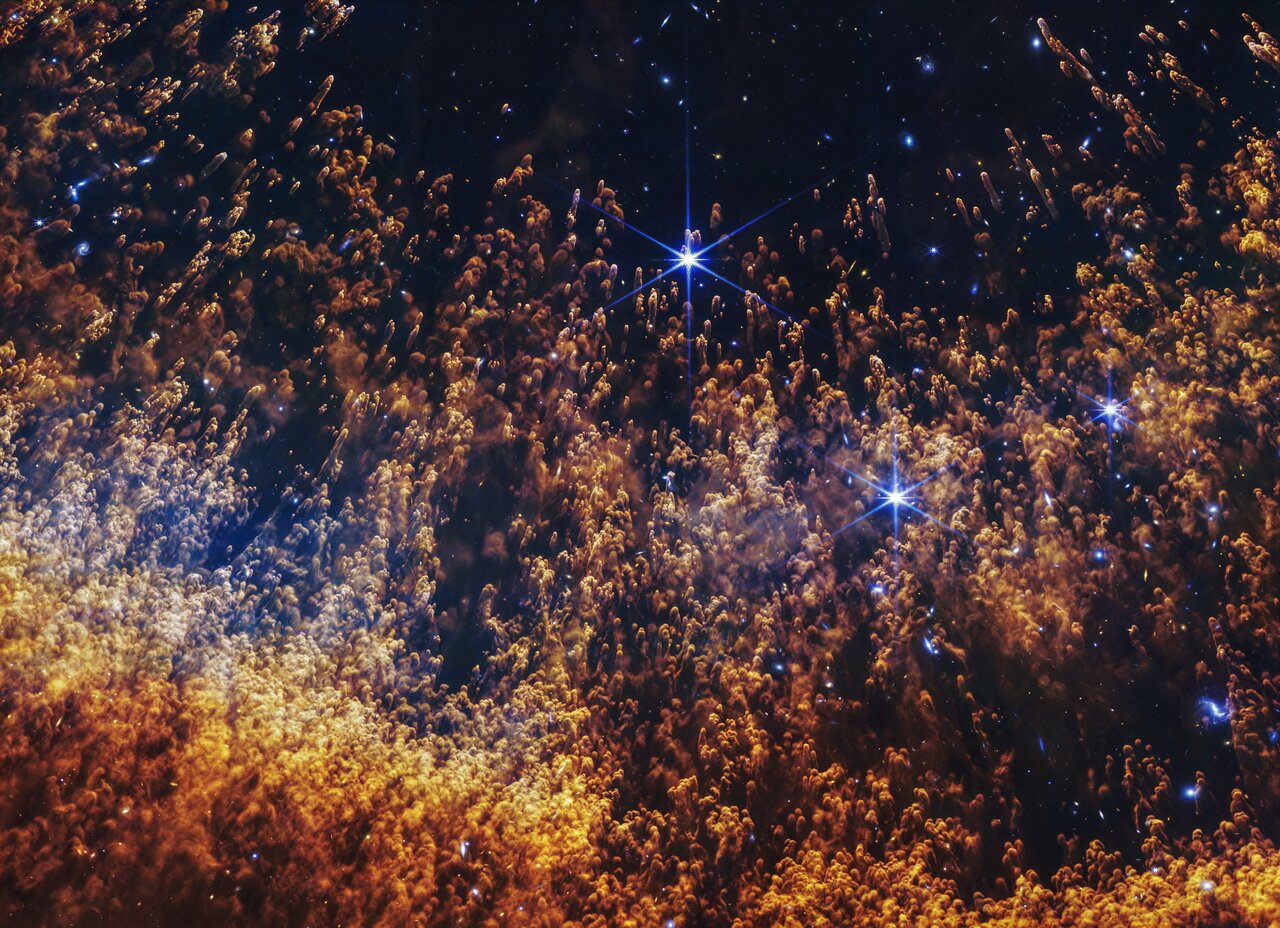
Hundreds of golden, orange and yellow comet-like clouds cover the starry sky.

New images of the Helix Nebula from the James Webb Space Telescope reveal comet-like knots, stellar winds, and dramatic gas transitions. (Image credits: NASA, ESA, CSA, STScI, A. Pagan (STScI))

The orange semicircle at the bottom, where the pillars are more densely packed, is the circumference of the shell. A black universe is floating in the sky, and some stars with a blue background can also be seen.

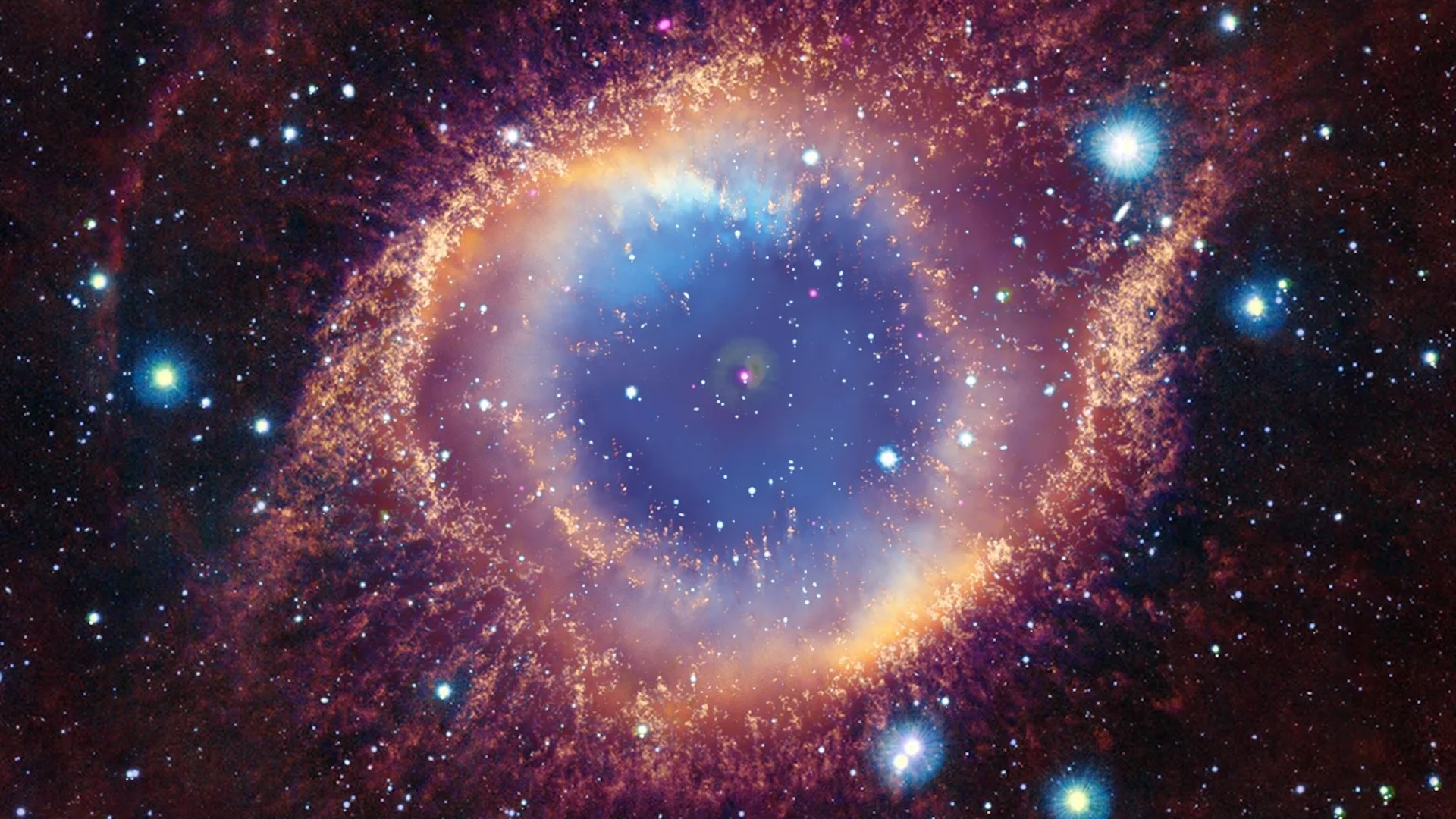
As is common in space telescope images, the filter reveals the nebula’s temperature and chemistry, which change with distance from the white dwarf. Near the star, the blue glow is produced by ultraviolet radiation that ignites hot ionized gas. The further away from the star, the lower the temperature, and farther out hydrogen molecules are marked by yellow and crimson dust.
Get the world’s most fascinating discoveries delivered straight to your inbox.

Image of a rainbow-colored round nebula

Enlarged view of the Helix Nebula taken with multiple telescope observations (Image credit: NASA/CXC/SAO/Univ Mexico/S. Estrada-Dorado et al., ultraviolet: NASA/JPL, optical: NASA/ESA/STScI (M. Meixner)/NRAO (TA Rector), infrared: ESO/VISTA/J. Emerson, image processing: NASA/CXC/SAO/K. Arcand)

Dust, the potential seeds for the next generation of stars and planets, is part of what makes this image so exciting. This image shows the life cycle of matter. Radiation and ejected material from a dying star creates regions where more complex molecules can survive and grow.

Beautiful as it may be, the Helix Nebula is the recycling center of the universe, a blueprint for what will eventually happen to the Sun in about 5 billion years when it expands into a red giant, sheds its outer layers, and leaves behind a white dwarf.

For more sublime space images, check out this week’s space photo archive.


Source link

#Biotechnology #ClimateScience #Health #Science #ScientificAdvances #ScientificResearch
Follow on Google News Follow on Flipboard
Share. Facebook Twitter Pinterest LinkedIn Tumblr Email Copy Link
Previous ArticleWhy does the moon appear larger when it is above the horizon?
Next Article Google Glass has another new lease on life, but is it too late for smart glasses?
user
  • Website

Related Posts

Shark attacks in Hawaii spiked in October, and scientists think they know why.

January 27, 2026

In vitro fertilization hormones could one day be administered via painless ‘microneedle’ patches, early research suggests

January 27, 2026

A 1,400-year-old Zapotec tomb discovered in Mexico has a giant owl sculpture symbolizing death

January 26, 2026
Add A Comment
Leave A Reply Cancel Reply

Latest Posts

Anduril has invented a novel drone flying contest where work is the prize

Android smartphones are getting more anti-theft features

Indian states consider Australian-style ban on social media for children

WhatsApp deploys lockdown-style security mode to protect targeted users from spyware

Trending Posts

Subscribe to News

Subscribe to our newsletter and never miss our latest news

Please enable JavaScript in your browser to complete this form.
Loading

Welcome to Fyself News, your go-to platform for the latest in tech, startups, inventions, sustainability, and fintech! We are a passionate team of enthusiasts committed to bringing you timely, insightful, and accurate information on the most pressing developments across these industries. Whether you’re an entrepreneur, investor, or just someone curious about the future of technology and innovation, Fyself News has something for you.

Castilla-La Mancha Ignites Innovation: fiveclmsummit Redefines Tech Future

Local Power, Health Innovation: Alcolea de Calatrava Boosts FiveCLM PoC with Community Engagement

The Future of Digital Twins in Healthcare: From Virtual Replicas to Personalized Medical Models

Human Digital Twins: The Next Tech Frontier Set to Transform Healthcare and Beyond

Facebook X (Twitter) Instagram Pinterest YouTube
  • Home
  • About Us
  • Advertise with Us
  • Contact Us
  • DMCA
  • Privacy Policy
  • Terms & Conditions
  • User-Submitted Posts
© 2026 news.fyself. Designed by by fyself.

Type above and press Enter to search. Press Esc to cancel.