


Close Menu
  • Home
  • Identity
  • Inventions
  • Future
  • Science
  • Startups
  • Spanish
What's Hot

npm updates and considerations to strengthen your supply chain

New discoveries in biomechanics by highly accurate digital twins

PPPL’s ​​MRI experiment sheds light on planet and star formation

Facebook X (Twitter) Instagram
  • Home
  • About Us
  • Advertise with Us
  • Contact Us
  • DMCA
  • Privacy Policy
  • Terms & Conditions
  • User-Submitted Posts
Facebook X (Twitter) Instagram
Fyself News
  • Home
  • Identity
  • Inventions
  • Future
  • Science
  • Startups
  • Spanish
Fyself News
Home » James Webb Telescope reveals glowing center of iconic galaxy — Space Photo of the Week
Science

James Webb Telescope reveals glowing center of iconic galaxy — Space Photo of the Week

userBy userNovember 2, 2025No Comments2 Mins Read
Share Facebook Twitter Pinterest Telegram LinkedIn Tumblr Email Copy Link
Follow Us
Google News Flipboard
Share
Facebook Twitter LinkedIn Pinterest Email Copy Link

simple facts

What it is: M82, an edge-on spiral starburst galaxy

Location: Ursa Major, 12 million light years away

Share date: October 23, 2025

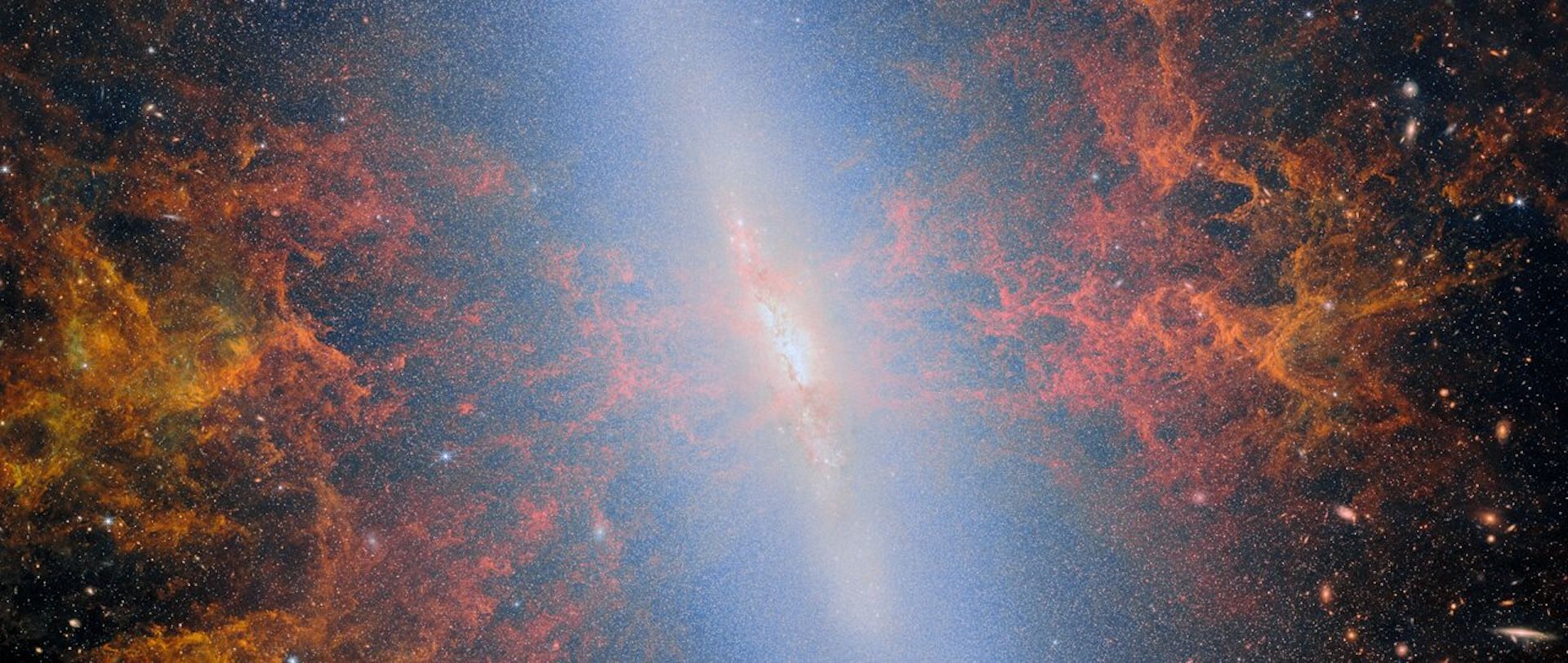
If you have a small telescope in your backyard, there’s a good chance you’ve seen the Cigar Galaxy (M82) with your own eyes. It is relatively close to the Milky Way and is one of the brightest galaxies in the night sky, as well as visible next to the Bode galaxy (M81). M82 is a spiral galaxy that is about four times smaller than the Milky Way, shines five times brighter, and forms stars 10 times faster, which is why it is called a starburst galaxy.

This image from the James Webb Space Telescope (JWST) reveals a glowing core filled with billions of stars. This shot is a follow-up to a close-up image released in 2024. Despite being a side view of M82, the photo shows its bright core, a blue-white glow, with red and orange dust clouds pushed up and down. Gas clouds contain cavities and ridges, details that can only be discovered by JWST’s near-infrared camera (NIRCam), which can see them directly.

The center of M82 is an active site containing more than 100 superclusters, some of which are still being born in dense gas clouds. Each supercluster contains hundreds of thousands of stars. The reason for M82’s burst of star formation is probably its neighbor M81, which may have interacted with its gravity. As a result, gas from M81 invades the center of M82, spurring increased star formation despite the galaxy’s small size.

you may like

Scientists can also see the glow from the plume of organic molecules in this image. This wide plume, 160 light-years in diameter, is made up of polycyclic aromatic hydrocarbons (PAHs) that are swept away from the galactic disk by powerful outflow winds generated by M82’s superstar cluster.

For stargazers in the Northern Hemisphere, M81 and M82 are spectacular sights in the northern skies during fall and winter. Both galaxies can be spotted as small, diffuse specks of light northwest of Dubhe, the bright star that marks the edge of the Big Dipper’s bowl. Through a small backyard telescope, these two neighboring galaxies can be seen together in the same field of view.

For more sublime space images, check out this week’s space photo archive.

Get the world’s most fascinating discoveries delivered straight to your inbox.


Source link

#Biotechnology #ClimateScience #Health #Science #ScientificAdvances #ScientificResearch
Follow on Google News Follow on Flipboard
Share. Facebook Twitter Pinterest LinkedIn Tumblr Email Copy Link
Previous ArticleElon Musk wants you to know Sam Altman received a refund for his Tesla Roadster
Next Article 5,000-year-old ‘cult space’ discovered in Iraq dates back to the time of the world’s first cities
user
  • Website

Related Posts

Surprising research reveals that the oldest black hole in the universe may still exist

February 12, 2026

China’s carbon emissions may have reached a critical tipping point sooner than expected

February 12, 2026

Medieval gold ring with dazzling blue gemstone discovered in Norway is ‘a fantastically beautiful and rare specimen’

February 12, 2026
Add A Comment
Leave A Reply Cancel Reply

Latest Posts

npm updates and considerations to strengthen your supply chain

New discoveries in biomechanics by highly accurate digital twins

PPPL’s ​​MRI experiment sheds light on planet and star formation

Researchers observe real-world exploitation of BeyondTrust CVSS 9.9 vulnerability

Trending Posts

Subscribe to News

Subscribe to our newsletter and never miss our latest news

Please enable JavaScript in your browser to complete this form.
Loading

Welcome to Fyself News, your go-to platform for the latest in tech, startups, inventions, sustainability, and fintech! We are a passionate team of enthusiasts committed to bringing you timely, insightful, and accurate information on the most pressing developments across these industries. Whether you’re an entrepreneur, investor, or just someone curious about the future of technology and innovation, Fyself News has something for you.

Castilla-La Mancha Ignites Innovation: fiveclmsummit Redefines Tech Future

Local Power, Health Innovation: Alcolea de Calatrava Boosts FiveCLM PoC with Community Engagement

The Future of Digital Twins in Healthcare: From Virtual Replicas to Personalized Medical Models

Human Digital Twins: The Next Tech Frontier Set to Transform Healthcare and Beyond

Facebook X (Twitter) Instagram Pinterest YouTube
  • Home
  • About Us
  • Advertise with Us
  • Contact Us
  • DMCA
  • Privacy Policy
  • Terms & Conditions
  • User-Submitted Posts
© 2026 news.fyself. Designed by by fyself.

Type above and press Enter to search. Press Esc to cancel.