

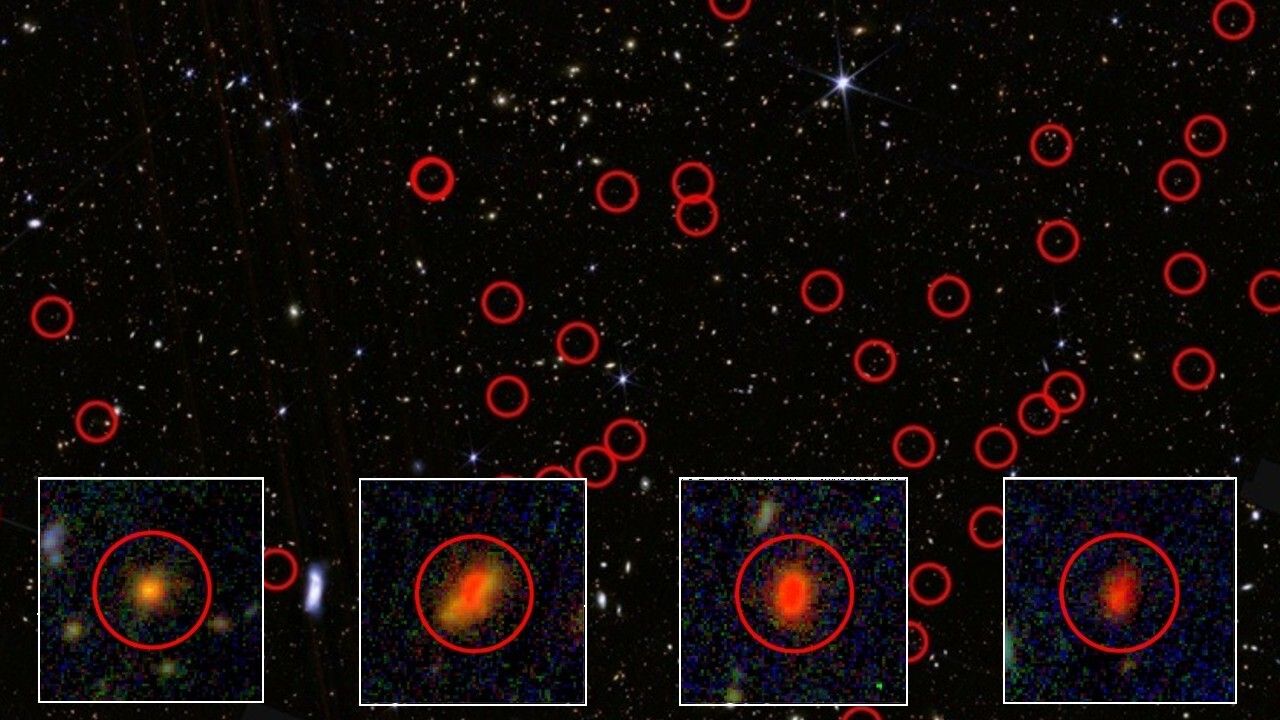
Astronomers may have found evidence that some of the mysterious “little red dots” discovered by the James Webb Space Telescope (JWST) are not black holes as previously proposed, but rather giant stars from the beginning of the universe.
The researchers made this discovery by developing a simplified model of an ancient supermassive star, a potential parent of the universe’s first supermassive black hole.
you may like
But the evidence is not simple. This object is extremely small, smaller than you would expect for a typical galaxy. And so far, no clear X-ray emissions have been seen, which is the main characteristic of an actively feeding black hole. Their spectra also lack strong metallic emission lines beyond hydrogen and helium, suggesting that the surrounding gas may be chemically primordial, unlike the metal-rich regions typically found around actively feeding black holes.
This motivated Devesh Nandal and Abi Loeb of the Harvard-Smithsonian Center for Astrophysics (CfA) to explore other possibilities. What if these compact objects were actually supermassive stars captured just before collapsing into black holes?
“If there are no X-rays and no other metal lines seen in these little red dots, and if supermassive stars can form and exist, then we have demonstrated that such stars naturally produce the signature of these little red dots,” Nandal, a postdoctoral fellow at CfA and lead author of the study, told Live Science. “I don’t think we’re seeing signs of a dead star for the first time.”
The research team’s study was published in The Astrophysical Journal on February 5th.
ancestor of monsters
Supermassive stars (previously called “monster stars” by Nandal and colleagues) are extremely massive stars that formed in the early universe from primordial gases, mainly helium and hydrogen. These are classified as first generation stars, or population III stars. Some models suggest that these early stars could grow to be thousands to a million times more massive than our Sun. When these stars die, they turn into supermassive black holes.
To explain the tiny red dot’s extreme brightness, astronomers developed a detailed model of a metal-free supermassive star with nearly a million solar masses. The research team compared their simulations with the characteristics of two small red dots called MoM-BH*-1 and The Cliff, discovered about 650 million and 1.8 billion years after the Big Bang, respectively. Models of supermassive stars matched not only their extreme brightness, but also some key features of their spectra: the different wavelengths of light they emit.
One of the unique features of the little red dot is its distinctive “V-shaped” dip in its spectrum. Some interpretations believe that this shape occurs because the dust absorbs light, giving the object a reddish appearance.
you may like
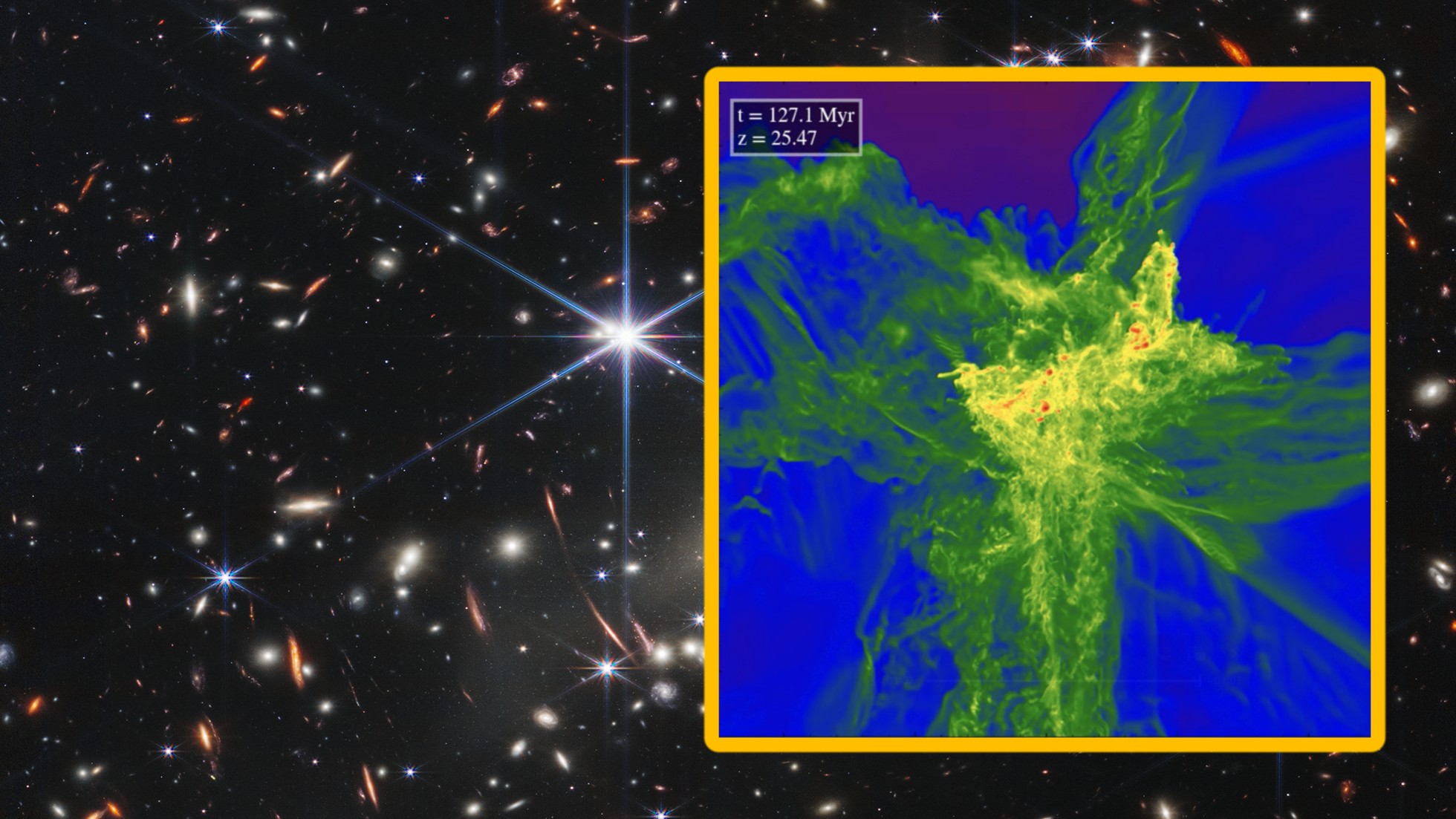
The new model says this shape is created by the star’s atmosphere, or outer layer. So instead of dust changing the light, the star’s own atmosphere creates the effect.
“If supermassive stars are real, which we think is because population III stars should be real, the little red dots would be a perfect place for them to hide,” Nandal said.
He suggested that the V-shaped depression and reddish appearance could also be related to mass loss in the star, somewhat similar to the ejection of coronal mass from the Sun. However, in this scenario, the material ejected from the star forms a compact shell-like structure around it. The mechanism of this mass loss is not completely understood. The research team is working on improving models of the star’s external atmosphere. They are also testing whether pulsations (rhythmic expansion and contraction) could lift material from the star’s surface, creating a separate shell of gas that cools the emitted light and turns it red.
“This study works well as a theoretical exercise,” Daniel Whalen, a senior lecturer at the University of Portsmouth’s Space and Gravity Institute who was not involved in the study, told Live Science. “This shows that supermassive stars can reproduce some features of the spectra of small red dots.”
Astronomers estimate that a star this massive will only remain bright for about 10,000 years. If a star has a small mass, between 10,000 and 100,000 solar masses, it can shine for up to 1 million years. The reason is simple. The more massive the star, the faster the nuclear fuel burns out.
If the little red dot was a supermassive star in its final moments before collapsing into a black hole, the observable period would be even shorter. The researchers noted that the extreme mass and short lifetime requirements are why the new model cannot explain all the little red dots.
“It’s a very short period of time,” Whalen said. “It’s hard to explain how about 400 to 500 small red dots were discovered if they were short-lived.”
That or that?
Another leading explanation for the little red dot involves the accretion of a black hole, which likely formed by the direct collapse of a cloud of hydrogen gas in the early Universe, without first forming a regular star. Whalen is skeptical that the supermassive star model has any advantage over that theory. “I don’t think it offers any clear advantage over the black hole interpretation,” he noted.
“If these objects are accreting black holes, we might expect X-rays to leak out at some point,” Nandal explained. “If clear X-ray activity is detected, it would greatly favor the interpretation of AGN.”
A black hole undergoing chaotic feeding or exploding should exhibit some variation in its light output. However, so far no clear brightness variations among the small red dots have been observed. If a few flickers are detected, AGN activity can be boosted and supermassive stars can be essentially ruled out because they emit more stable light.
Detailed spectroscopic measurements showing an abundance of chemicals around the tiny red dot would help support or rule out the supermassive star interpretation.
“The answer actually lies in the composition. What is this gas made of?” Nandal said. Previous simulations have shown that supermassive stars pollute their surroundings with vast amounts of nitrogen through nuclear reactions. On the other hand, a strong neon line is more suggestive of AGN activity.
Whalen pointed out that if a black hole exists, the X-rays it produces could simply be absorbed by the surrounding dust. However, radio emissions from these black holes can escape into space through dense hydrogen clouds and dust.
This means that sensitive radio observations from facilities such as the Square Kilometer Array and the Next Generation Very Large Array could be the decisive test. “If the little red dot is indeed powered by a cloaked direct-collapse black hole, the radio waves will come out and we will detect it,” Whalen said.
Black Hole Quiz: How vast is your knowledge about the universe?
Source link
