


Researchers have narrowed down the exact route that the interstellar interloper 3I/ATLAS will take as it begins its one-way journey from our solar system.
Thanks to data collected from this alien comet’s recent close encounter with Mars, scientists at the European Space Agency (ESA) have refined the comet’s orbit tenfold. And this could further help researchers unravel its secrets in the coming months, experts say.
you may like
After its closest approach to the Sun on October 29, 3I/ATLAS recently reemerged from the far side of the Sun relative to Earth. The journey around the sun has been eventful. The comet experienced an unexpected brightening event, a temporary color change, and a brief disappearance of its tail.
But prior to this, the comet also approached Mars, coming within 18.6 million miles (30 million kilometers) of the planet on October 3.
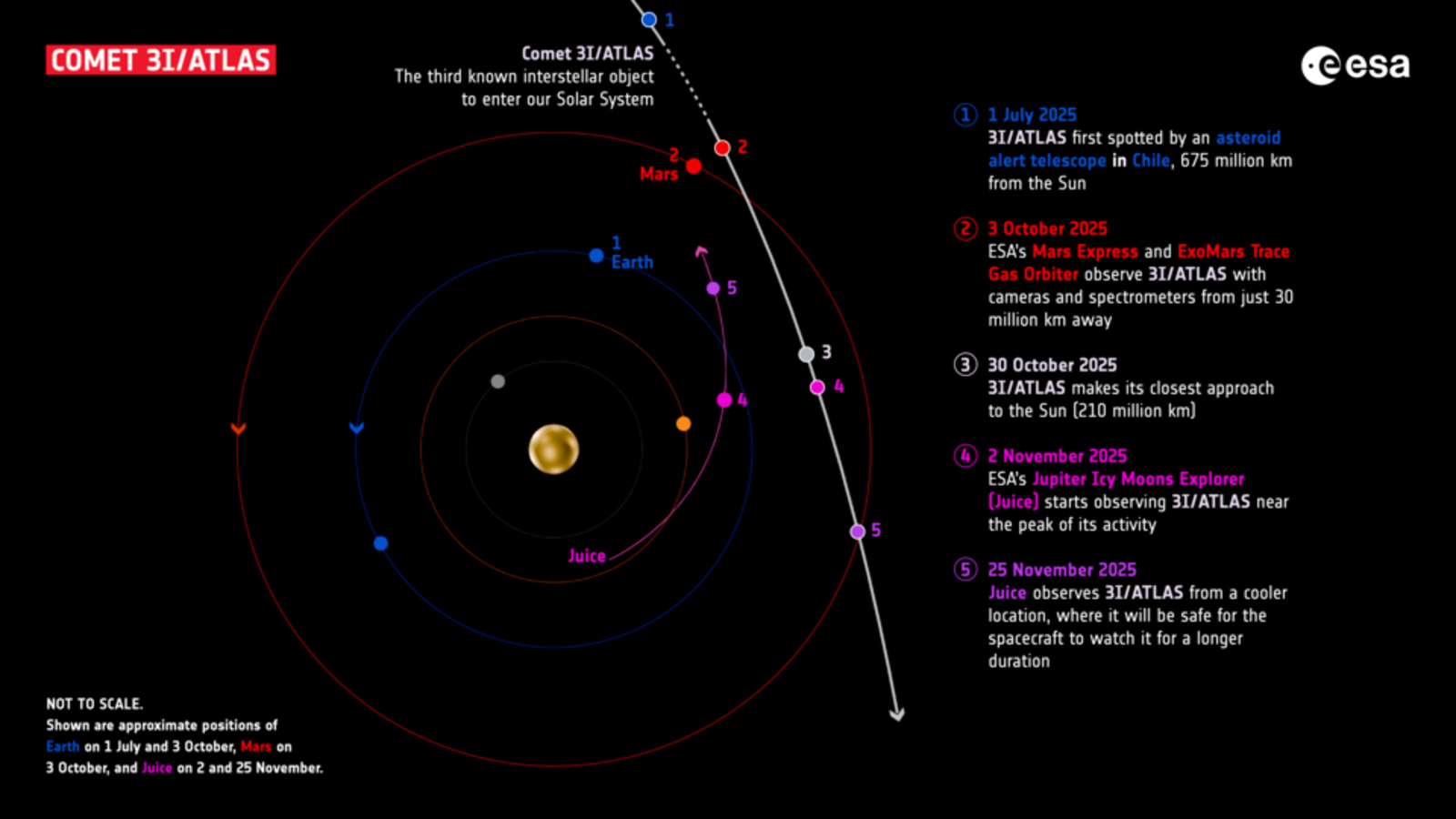
During the Mars flyby, the European Space Agency’s (ESA) ExoMars Trace Gas Orbiter was able to capture highly detailed photos of 3I/ATLAS stretching towards the Sun. By analyzing the orbiter’s data from this encounter, ESA scientists improved their predictions of 3I/ATLAS’ exit trajectory out of the solar system, with a surprising level of success.
“Scientists initially expected only a small improvement, but the results show a tenfold increase in accuracy and reduced uncertainty in the object’s position,” ESA representatives said in a statement. “The improved orbit will allow astronomers to aim their instruments with confidence and enable more detailed science of the third interstellar object detected to date.”
Until now, researchers have relied solely on ground-based observatories or Earth-orbiting spacecraft to track the location of 3I/ATLAS, which provides only specific views of unusual objects. But by using observations from Mars, the ESA team will be able to “triangulate” the comet’s location more precisely, similar to how intelligence agencies use multiple base stations to track cell phones.
However, taking into account the precise movement of orbiting satellites around Mars relative to the comet’s orbit was not an easy task. To make the process more difficult, the spacecraft’s Color Stereo Surface Imaging System (CaSSIS) is designed to image the Red Planet’s surface rather than objects in space, the researchers wrote.
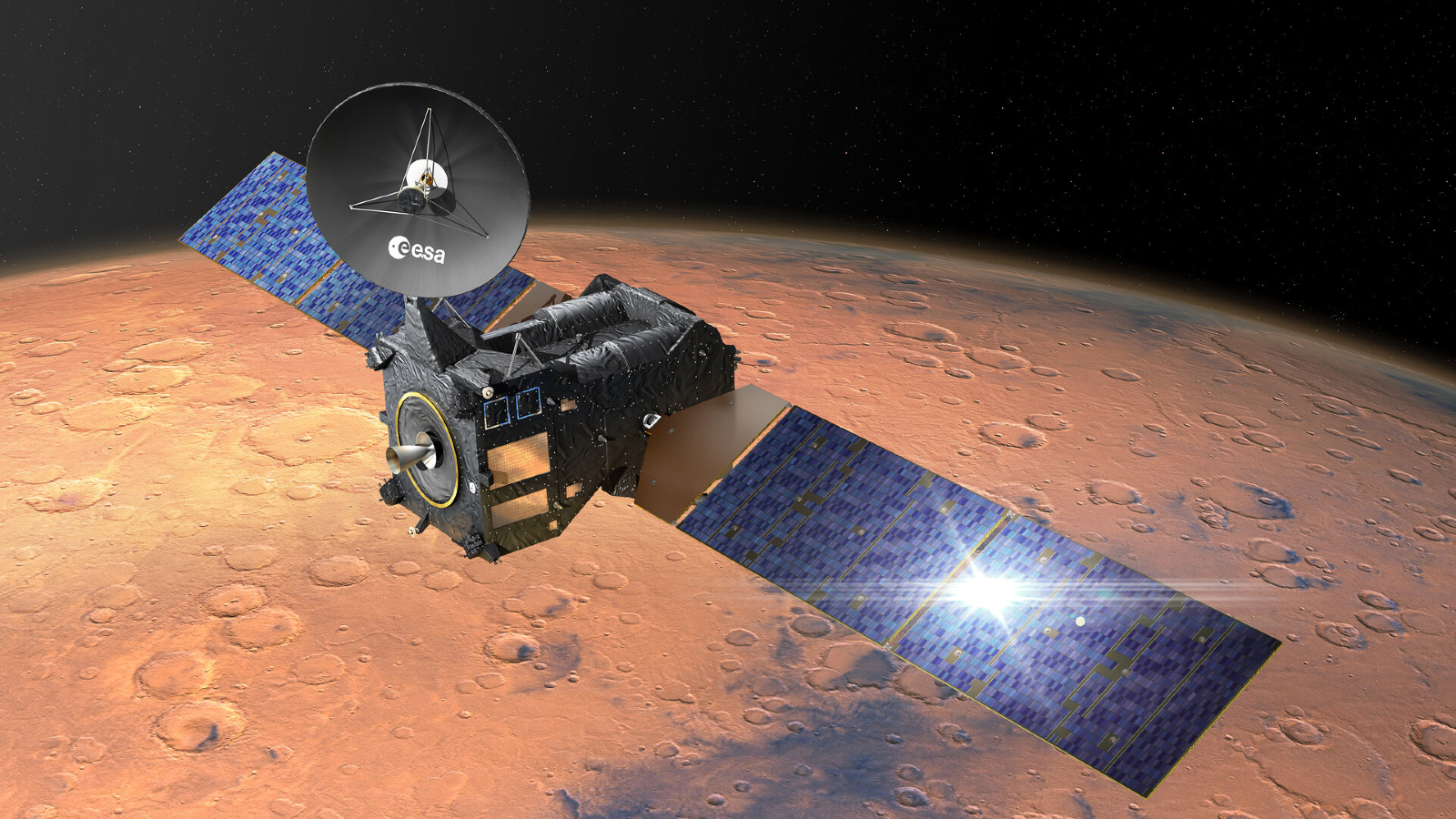
In fact, imaging space objects with planetary orbiters is so difficult that this is the first time data from these probes has been accepted into the database of the International Astronomical Union’s Minor Planet Center, which tracks the movements of all celestial objects near Earth, the researchers wrote.
ESA now hopes to repeat the trick with the Jupiter Icy Moons Explorer (JUICE), which is scheduled to take a closer look at 3I/ATLAS later this month, the researchers write. The agency’s researchers have previously suggested that two other spacecraft, Hera and Europa Clipper, may also pass through the comet’s tail as they move away from the sun.
During a recent Mars flyby, NASA’s Mars Reconnaissance Orbiter also captured what could be the best ever image of 3I/ATLAS. Some researchers predict that this could reveal more about its characteristics. Due to the recent government shutdown, NASA has not yet released these images to the public. However, recent reports suggest that these images could be released at any time.
3I/ATLAS will make its closest approach to Earth on December 19th, reaching a minimum distance of 168 million miles (270 million km) from Earth.
Source link
