

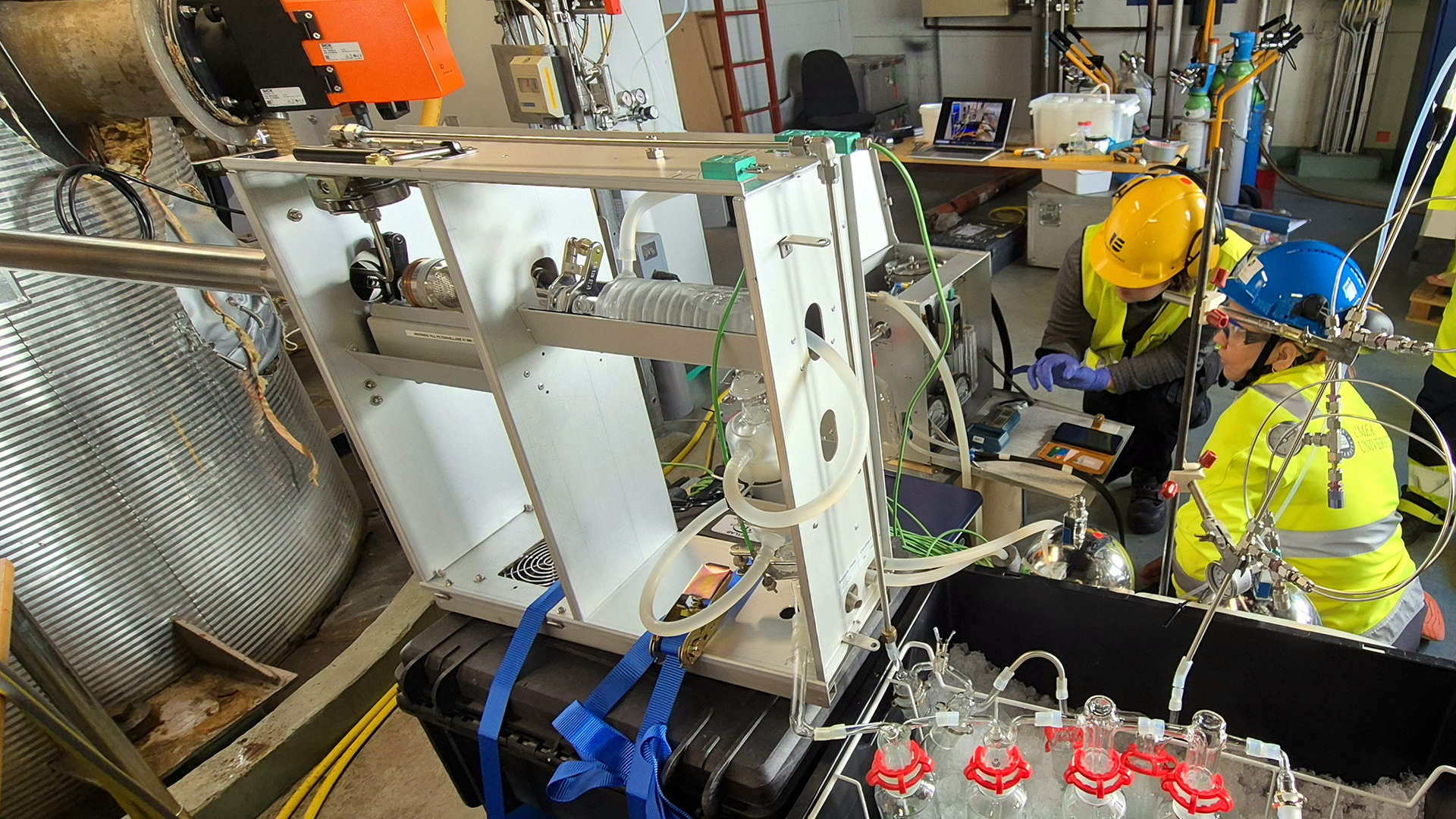
Advances in exhaust gas sampling have enabled comparative evaluation of PFAS detection and analysis methods.
For decades, waste incineration has been considered a reliable way to deal with problematic materials, such as those containing per- and polyfluoroalkyl substances (PFAS). High-temperature combustion was expected to destroy these so-called “eternal chemicals.” But persistent questions remain. Are PFAS really destroyed, or do some survive and escape down the smokestack?
Until recently, I had no idea the answer. Measuring PFAS in exhaust gases was long considered technically impossible. The temperature, chemistry, and diversity of PFAS have created a blind spot in environmental monitoring. However, that image is now changing. Researchers across Europe and the United States are testing new sampling and analysis methods, and the first comparable datasets are emerging.
The challenge behind the smoke
PFAS are not one substance but thousands of substances, some ionic, others volatile, and many unstable at high temperatures. No single method can capture them all. The exhaust gas matrix itself makes matters worse. It is highly reactive at high temperatures and contains a lot of particles and water. PFAS that survive combustion can be deformed, adsorbed, or slip through before someone can capture them.
For many years, most studies focused only on ash and scrubber water. What left the stack gaseous remained a mystery. That changed when the U.S. Environmental Protection Agency (EPA) applied a new, proprietary sampling protocol to full-scale incineration testing.
2 methods, 1 stack
In 2024, the IVL Swedish Environmental Research Institute conducted one of the first comparisons of two semi-volatile PFAS sampling methods. The revised EN 1948-1 settings, the European standard for sampling dioxins and furans in stationary source emissions, and EPA’s OTM-45 method, a standardized approach for measuring targeted PFAS compounds in stack emissions.
Both were run simultaneously on the same flue gas stack, a deliberate choice to eliminate differences caused by operating conditions. The goal was not to prove which method is “better” but to understand how each method behaves under identical circumstances.
Samples were analyzed by GC-MS/MS gas chromatography-tandem mass spectrometry targeting semi-volatile PFAS and selected precursors. This comparison provided valuable insight into capture efficiency, blank stability, and breakthrough behavior, data that was previously missing.
Window to volatile parts
At the same time, IVL established the OTM-50 method for volatile PFAS. OTM-50 is still new to the world, but the Gothenburg lab was one of the first to set up a complete analytical chain for all 30 target compounds included in the method.
These substances are more volatile than common PFASs measured in water or solids and require specialized sampling equipment and careful temperature control to prevent loss. To ensure that the results were traceable and comparable, each step from sample collection to quantification had to be verified.
What the results show
The findings highlighted both advances and complexities.
Semi-volatile PFAS can be reproducibly captured and analyzed using established trains, but the choice of method influences what is retained and with what efficiency. Although volatile PFAS can be quantified for a defined set of compounds, the availability of calibration standards remains limited. Parallel sampling is important. Running the methods simultaneously under the same conditions revealed differences that could be mistaken for plant-specific variation. Uncertainty remains. A thorough comparison between studies is in progress due to sampling artifacts, adsorbent interactions, and challenges in quantifying trace levels.
From first measurements to deeper understanding
These new measurements do not claim that incineration has failed or been completely successful. What they show is that it is now possible to measure PFAS in exhaust gases, and the choice of method has a significant impact on what is detected.
Johan Strandberg, Project Manager at IVL, says: “The real result is comparability. We have shown that different methods can be run in parallel and we can begin to understand the strengths and weaknesses of each. This is an important step if regulators and operators need reliable monitoring data.”
Towards harmonious practice
Next is harmonization. As countries begin to adopt or adapt these methods, the challenge will be to ensure that measurements are reproducible, transparent, and meaningful. Comparisons between laboratories, reference materials, and consistent reporting standards are all needed to define emission factors and regulatory values.
“For the first time, we can examine PFAS in the gas phase in a comparative and validated manner under real-world incineration conditions. This provides us with the foundation we need to make informed decisions, both technically and politically,” added Strandberg.
Looking to the future
The ability to measure PFAS in exhaust gases represents an important change. Incineration may still prove to be an effective route of destruction under the right conditions, but only if we can see what remains of the chimney. Each reliable measurement adds a new piece to the puzzle, helping regulators, operators and researchers move from speculation to evidence.
The story of PFAS in exhaust gases is not over yet. But for the first time you can measure it, and that’s where real understanding begins.
PFAS in the stack: From blind spot to breakthrough
“The real achievement is comparability. We have shown that different methods can be run in parallel and evaluated systematically.” – Johann Strandberg, IVL.
why is it important
• For decades, PFAS emissions from incinerators have been a blind spot.
It was thought that high-temperature combustion would destroy PFAS, but this has never been proven. New sampling and analysis techniques are turning hypotheses into data.
An unprecedented comparison
• In 2024, IVL ran EN 1948-1 (EU) and OTM-45 (US EPA) in parallel on the same stack.
Parallel testing shows how the choice of method changes what is detected. Volatile PFAS were captured using OTM-50 targeting 30 compounds.
key insights
• Reliably captures semi-volatile PFAS.
Although volatile PFAS can be measured, calibration standards remain limited. Parallel sampling is essential to separate method effects from plant effects. Although uncertainties remain, the oversight gap is rapidly closing.
What’s next?
• Comparisons between laboratories, harmonized reports, and shared protocols.
An important step toward reliable PFAS emissions data and future regulation.
Source link
