
Close Menu
  • Home
  • Identity
  • Inventions
  • Future
  • Science
  • Startups
  • Spanish
What's Hot

GlassWorm supply chain attack exploits 72 open VSX extensions to target developers

‘Wasn’t built right from the start’ — Musk’s xAI starts all over again

AI mental illness lawyer warns of risk of mass casualties

Facebook X (Twitter) Instagram
  • Home
  • About Us
  • Advertise with Us
  • Contact Us
  • DMCA
  • Privacy Policy
  • Terms & Conditions
  • User-Submitted Posts
Facebook X (Twitter) Instagram
Fyself News
  • Home
  • Identity
  • Inventions
  • Future
  • Science
  • Startups
  • Spanish
Fyself News
Home » Monster black hole “resurrected” after 100 million years of silence “It’s like watching a cosmic volcano erupt”
Science

Monster black hole “resurrected” after 100 million years of silence “It’s like watching a cosmic volcano erupt”

userBy userJanuary 20, 2026No Comments3 Mins Read
Share Facebook Twitter Pinterest Telegram LinkedIn Tumblr Email Copy Link
Follow Us
Google News Flipboard
Share
Facebook Twitter LinkedIn Pinterest Email Copy Link

Scientists have observed a supermassive black hole wake up from a nap of about 100 million years.

A black hole is located at the center of a huge galaxy and emits extremely strong radio waves. New analysis of these radio emissions reveals that black holes once spewed giant jets of plasma hundreds of thousands of light-years into space, but that they suddenly ceased to be active at some point in the distant past. These jets are now active again and are interacting with the surrounding superheated gas in complex and chaotic ways, according to a new study.

“It’s like watching a cosmic volcano erupt again after years of calm, except this volcano is large enough to carve out a structure that stretches nearly a million light-years through space,” study co-author Shobha Kumari, an astronomer at India’s Midnapore City University, said in a statement.

you may like

galactic engine trouble

Only 10% to 20% of supermassive black holes have jets that emit radio signals. In these galaxies, rotating disks of dust and plasma swirl around the black hole, periodically feeding it with large amounts of material. This falling material could generate entangled magnetic fields that could propel material away from the black hole in giant jets. In rare cases, disk changes can turn these radio jets off and on.

In the new study, published January 15 in Monthly Notices in the journal Monthly Notices of the Royal Astronomical Society, researchers used the Low Frequency Array, a network of radio telescopes located primarily in the Netherlands, to discover more than 20 galaxy clusters housing radio galaxies with irregularly shaped jets. They focused on one galaxy called J1007+3540, which had a particularly unusual footprint.
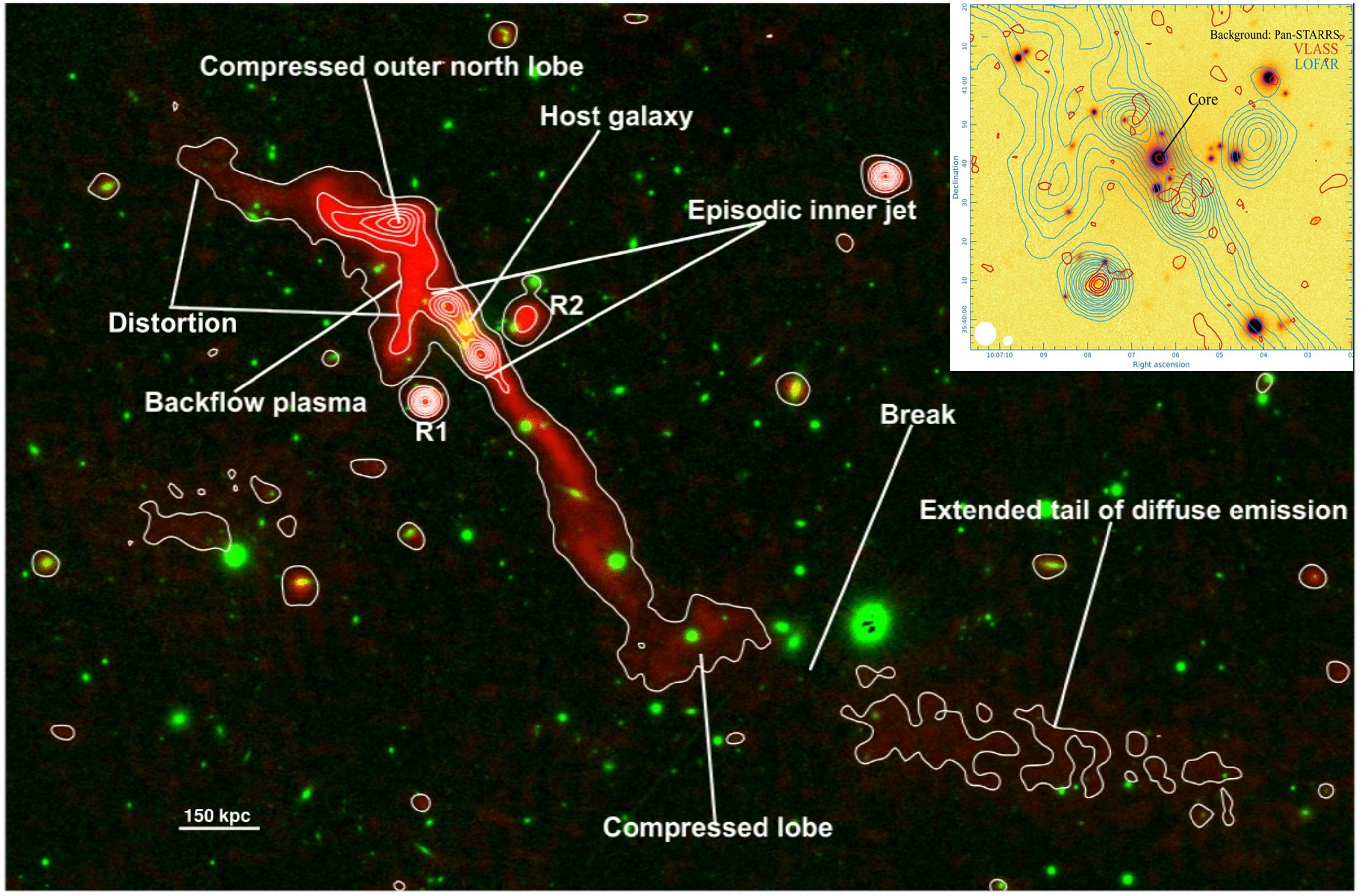
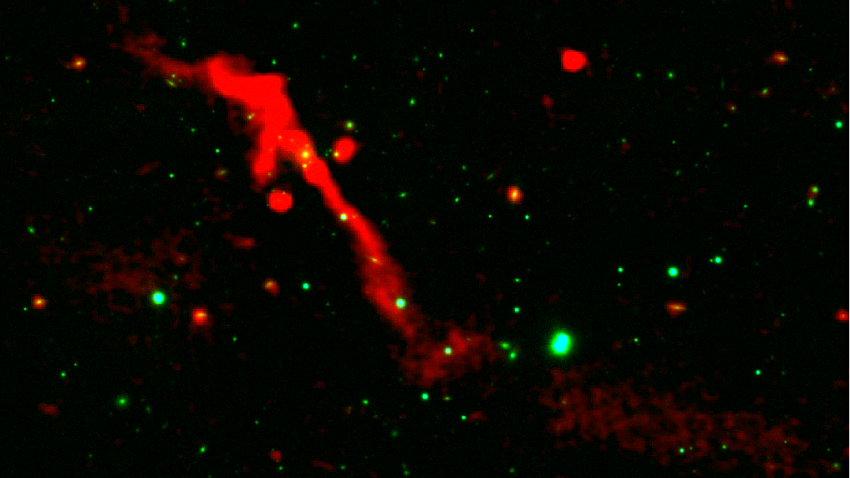
Labeled image showing a black hole at the center of two lobes of radio energy

An active black hole (at the center of the region marked “host galaxy”) and its twin lobes of high-energy radio jets. (Image credit: LOFAR/Pan-STARRS/S. Kumari et al.)

This massive galaxy has large, diffuse lobes of plasma, indicating past jet activity dating back about 240 million years. But inside those lobes, the researchers discovered, are smaller, brighter plasma jets that were born just 140 million years ago. This suggests that active galactic nuclei (AGNs) – the central regions of galaxies where supermassive black holes reside – have resumed activity after a period of silence.

“The dramatic layering of young jets within old, tired lobes is characteristic of episodic AGNs, galaxies whose central engines cycle on and off over cosmic timescales,” Kumari said.

Get the world’s most fascinating discoveries delivered straight to your inbox.

The space between galaxies in the cluster containing J1007+3540 is filled with superheated gas known as the intracluster medium. That gas interacts with the radio jet, bending and shaping it as it extends from the AGN. One of the two older lobes is crushed sideways by the surrounding gas and then returns toward its source. The other lobe has a long, twisted tail, suggesting that intracluster material is interacting with the jet in a different way.

“J1007+3540 is one of the clearest and most spectacular examples of episodic AGN with jet-cluster interactions, where the surrounding hot gas bends, compresses and distorts the jet,” study co-author Surajit Pal, a physicist at India’s Manipal Center for Natural Sciences, said in a statement.

Observing J1007+3540 will help researchers determine how often the AGN turns on and off, and how the old jet interacts with its surroundings. In future work, the team will collect high-resolution observations of the galaxy and map how the jets propagate through the intracluster medium, the statement said.


Source link

#Biotechnology #ClimateScience #Health #Science #ScientificAdvances #ScientificResearch
Follow on Google News Follow on Flipboard
Share. Facebook Twitter Pinterest LinkedIn Tumblr Email Copy Link
Previous ArticleLuminar founder Austin Russell agrees to accept subpoena in bankruptcy case
Next Article Why bowel pain may be more severe in women than in men, according to preclinical research
user
  • Website

Related Posts

Children wearing bronze ‘warrior’ belts discovered in 2,500-year-old cemetery in Italy

March 12, 2026

Congo Basin’s ‘blackwater’ lakes and rivers are now releasing ancient carbon into the atmosphere

March 12, 2026

Scientists use ‘negative light’ to send secret messages hidden in heat

March 12, 2026
Add A Comment
Leave A Reply Cancel Reply

Latest Posts

GlassWorm supply chain attack exploits 72 open VSX extensions to target developers

‘Wasn’t built right from the start’ — Musk’s xAI starts all over again

AI mental illness lawyer warns of risk of mass casualties

Digg lays off staff and closes app as company reorganizes

Trending Posts

Subscribe to News

Subscribe to our newsletter and never miss our latest news

Please enable JavaScript in your browser to complete this form.
Loading

Welcome to Fyself News, your go-to platform for the latest in tech, startups, inventions, sustainability, and fintech! We are a passionate team of enthusiasts committed to bringing you timely, insightful, and accurate information on the most pressing developments across these industries. Whether you’re an entrepreneur, investor, or just someone curious about the future of technology and innovation, Fyself News has something for you.

Castilla-La Mancha Ignites Innovation: fiveclmsummit Redefines Tech Future

Local Power, Health Innovation: Alcolea de Calatrava Boosts FiveCLM PoC with Community Engagement

The Future of Digital Twins in Healthcare: From Virtual Replicas to Personalized Medical Models

Human Digital Twins: The Next Tech Frontier Set to Transform Healthcare and Beyond

Facebook X (Twitter) Instagram Pinterest YouTube
  • Home
  • About Us
  • Advertise with Us
  • Contact Us
  • DMCA
  • Privacy Policy
  • Terms & Conditions
  • User-Submitted Posts
© 2026 news.fyself. Designed by by fyself.

Type above and press Enter to search. Press Esc to cancel.