

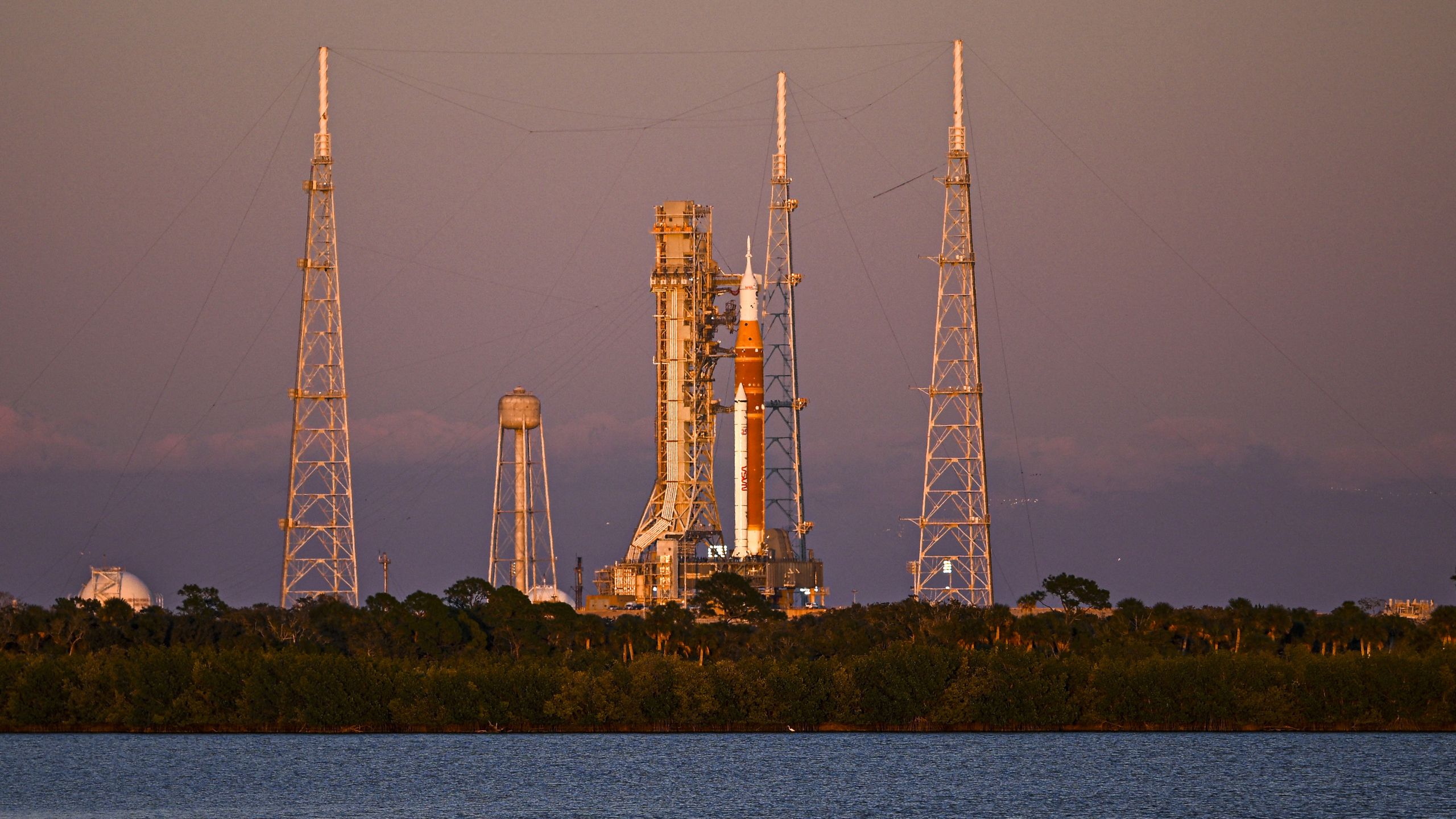
Editor’s note: This article has been updated to include NASA’s announcement that Artemis II’s target rollback will be Wednesday (February 25), one day later than originally scheduled due to windy weather.
NASA has postponed its historic Artemis II moon exploration mission again after the space agency’s lunar rocket encountered a helium flow problem on Friday night (February 20-21).
you may like
To resolve the issue, NASA announced that it would remove the rocket and Orion spacecraft from the launch pad at Kennedy Space Center (KSC) in Florida and return them to KSC’s vehicle assembly building on Wednesday (February 25).
“We will need to return to Kennedy’s Vehicle Assembly Building to determine and resolve the cause of the problem,” a NASA spokesperson said in a statement.
The Artemis program has experienced numerous problems and setbacks, including a series of hydrogen leaks. Still, this latest delay will be especially disappointing for space enthusiasts who were hoping for the flight of Artemis II, which appeared to have completed a crucial refueling rehearsal on Thursday (February 19).
NASA said the SLS system operated successfully during Thursday’s wet dress rehearsal, where staff demonstrated the system’s ability to safely fuel more than 700,000 gallons (2.6 million liters) of cryogenic propellant (cryogenic liquid hydrogen fuel and liquid oxygen oxidizer) and completed a mock launch. The success of the experiment prompted an enthusiastic press conference from NASA on Friday (February 20).
“Every night when we look up at the moon, we see it, and it’s really exciting because it makes us feel like the moon is calling us and it’s ready,” Lori Glaze, NASA’s Moon-Mars program manager, said at a briefing. “The excitement for ‘Artemis II’ is really, really starting to build. We’re really starting to feel it. It’s just around the corner.”
However, Artemis’ wings were quickly clipped the same day because there was a problem with the helium system in the rocket’s upper stage and “the team was unable to provide helium within the vehicle,” NASA Administrator Jared Isaacman wrote in an update on X Saturday. The SLS’s upper stage (officially called the intermediate cryogenic propulsion stage) uses helium to purge the engine and pressurize the propellant tank.
you may like
As an update to a previous post. – ICPS helium bottles are used to pressurize LH2 and LOX tanks as well as to purge the engine. The system worked fine between WDR1 and WDR2. – Last night, the team was unable to get helium flowing into the vehicle. This is… https://t.co/Qte3nEXwQb February 21, 2026
NASA is currently investigating the potential causes of the helium flow problem. The investigation will include examining the interface between the ground and rocket lines used for the helium pathway, as well as the ground-to-rocket filters and upper stage valves. The agency said it was also reviewing data from Artemis I, the unmanned precursor to Artemis II, which had helium-related pressurization issues before its 2022 launch.
This latest development does not mean Artemis II will not fly, as the Artemis II SLS rocket eventually returned to the Vehicle Assembly Building (VAB) before taking off in November 2022. NASA hopes the rollback will be completed quickly to keep the April launch window open. But spaceflight is a difficult and delicate process, and there is no guarantee that Artemis II will fly in April. Additional Artemis II updates are planned for this week.
“A quick start to prepare to return the rocket and spacecraft to the VAB could preserve the April launch window, pending data discovery results, repair efforts, and how the schedule materializes in the coming days and weeks,” NASA said in an update.
If ultimately launched, Artemis II will be a historic mission, marking the first time in more than 50 years that NASA has sent humans back to the moon, and the first time that NASA has sent a woman and a black man as part of a lunar crew.
NASA will use the 10-day lunar orbit to test systems and collect data ahead of the Artemis III mission, which aims to land astronauts on the moon in 2028. With the Artemis mission, NASA hopes to establish a long-term presence on the moon and eventually use the moon as a stepping stone to send astronauts to Mars.
Artemis II’s April launch window includes April 1, April 3-6, and April 30. The mission is expected to launch by April 30 at the latest.
Source link
