

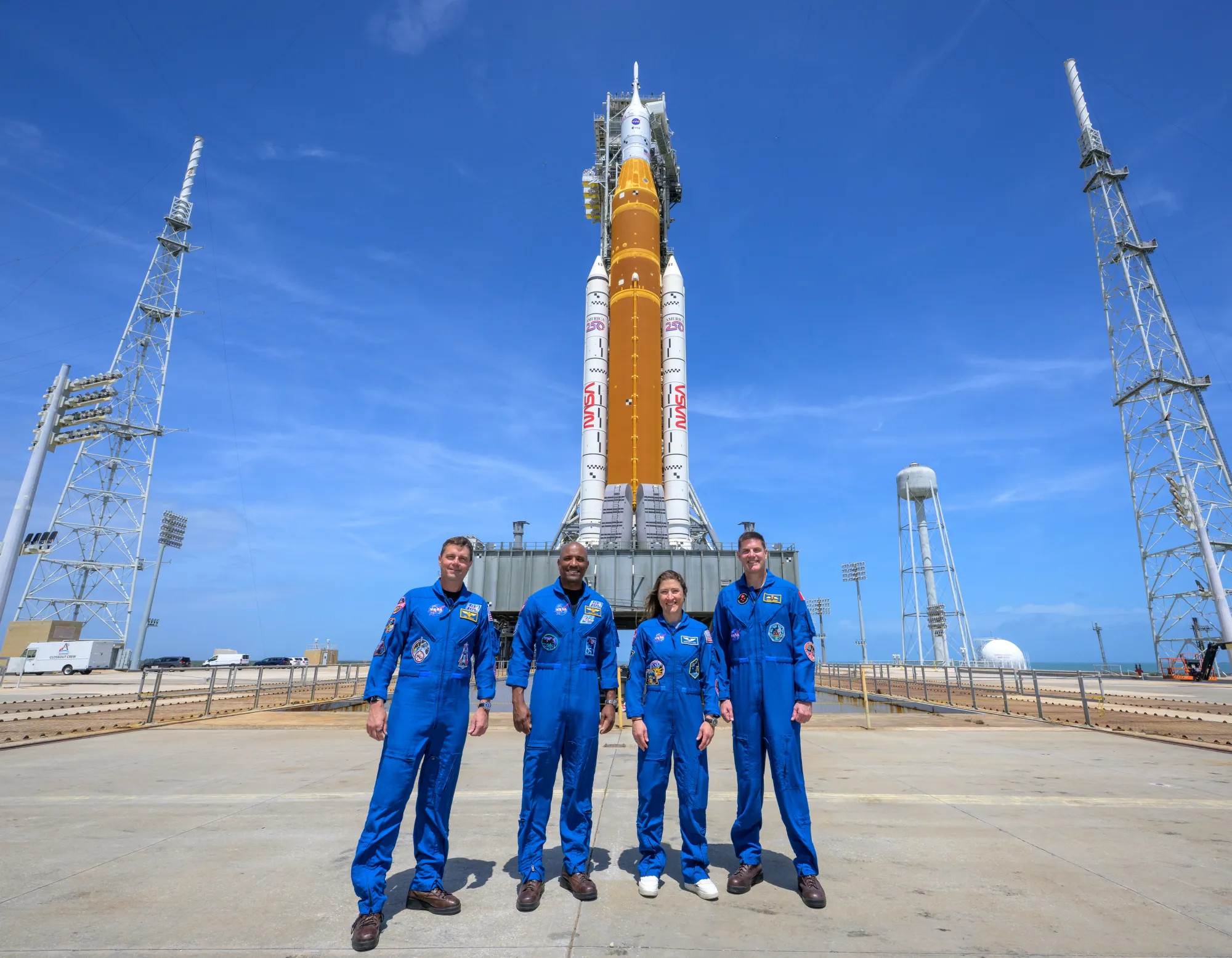
The long-anticipated Artemis II launch is in its final hours, with NASA teams undergoing a carefully planned series of checks and preparations for the launch, scheduled for today by 6:24 p.m. EDT.
At Kennedy Space Center in Florida, engineers and mission experts are working methodically to ensure that both the Space Launch System (SLS) rocket and the Orion spacecraft are fully compatible with humanity’s next steps toward deep space exploration.
Final preparations at Kennedy Space Center
As the Artemis II launch window approaches, activity at Launch Complex 39B intensifies. Engineers began the day by completing critical diagnostics on the rocket’s four RS-25 engines.
These engines are essential to powering spacecraft beyond Earth’s orbit, and they pass a series of health checks to ensure sensor, connectivity, and performance systems are working as expected.
The rocket’s upper stage, known as the interim cryogenic propulsion stage, is also attracting attention. After the previous system validation is completed, it is in a stable and safe standby mode and is ready to proceed to the next stage of operation.
Meanwhile, the team is focused on ensuring reliable onboard power. The Orion spacecraft’s flight battery is fully charged, a critical step in supporting avionics, communications and life support systems during launch and early flight.
Engineers also began charging the SLS core stage battery, which will power key control systems throughout the ascent.
Safety systems and crew readiness
Since astronauts will be aboard the Orion spacecraft, preparations have focused on crew safety. Engineers conducted detailed leak tests on the astronauts’ pressurized suits and confirmed that the seals and pressure systems were airtight.
These suits act as a critical safeguard in case of cabin depressurization, and having them ready prior to launch is a non-negotiable requirement.
Late last night, the team moved the launch pad into its final configuration. Non-essential personnel have evacuated the area to reduce risk as the countdown enters its most sensitive phase. Only a small group of experts remained to oversee the final technical steps.
Another important milestone occurs early on the day of launch when the ground launch sequencer is activated. This automation system is responsible for executing thousands of commands in precise order in the final minutes before launch.
From controlling valves to coordinating system transitions, it effectively takes over the countdown with seconds-to-second precision.
Engineers also perform an important safety step: replacing the air in the rocket’s internal cavity with nitrogen gas. This process removes oxygen and moisture, creating an inert environment that reduces the risk of combustion during refueling operations.
Weather forecast for Artemis II launch
Current forecasts give an 80% chance of favorable conditions for launching Artemis II, a strong outlook by launch criteria. However, weather teams are still closely monitoring several variables, including cumulus cloud formation, surface winds, and solar activity.
NASA is working with the U.S. Space Force’s space launch Delta 45, and its experts will continue to assess the situation right up to launch. Final decisions rely on real-time data, as even the slightest change in weather can affect safety.
How to watch Artemis II launch live
Public interest in the Artemis II launch is high, and NASA is planning a large-scale live broadcast.
Broadcasts of the refueling mission will begin at 7:45 a.m. ET on launch day via NASA’s YouTube channel. Complete coverage of the launch will follow at 12:50 PM ET and will be available on multiple platforms including NASA+, Amazon Prime, and YouTube.
Mission: What is the goal of Artemis II?
The launch of Artemis II is much more than just a technical milestone. This is the first crewed mission in NASA’s Artemis program and marks the return of humans to lunar exploration for the first time in more than 50 years.
The mission will send four astronauts, Reed Wiseman, Victor Glover, Christina Koch, and Canadian astronaut Jeremy Hansen, on a 10-day journey around the moon.
Unlike the Apollo program, Artemis II is designed as a proving ground for future deep space exploration rather than a landing mission.
The crew will fly beyond low Earth orbit, test life support systems, and validate the performance of both the SLS rocket and Orion spacecraft in real-world environments.
This mission lays the foundation for Artemis III, which aims to return humans to the lunar surface. More broadly, this is an important step toward establishing a sustained human presence on and around the Moon.
Ultimately, NASA sees the Artemis program as a stepping stone to future human missions to Mars.
In fact, Artemis II is aimed at risk mitigation and system validation. Every system, from propulsion to navigation to crew safety, is tested under the exact conditions that will be encountered on future missions. Success here would greatly reduce uncertainty for the next phase of lunar exploration.
Decisive moments in spaceflight
As Artemis II’s launch approaches, anticipation builds. Years of engineering, testing, and international collaboration come together in a moment.
If all goes according to plan, this mission will mark the beginning of a new era in human space exploration. It will extend beyond Earth’s orbit and set the stage for a deeper journey into the solar system.
For now, all eyes are on Kennedy Space Center, where the countdown continues.
Source link
