

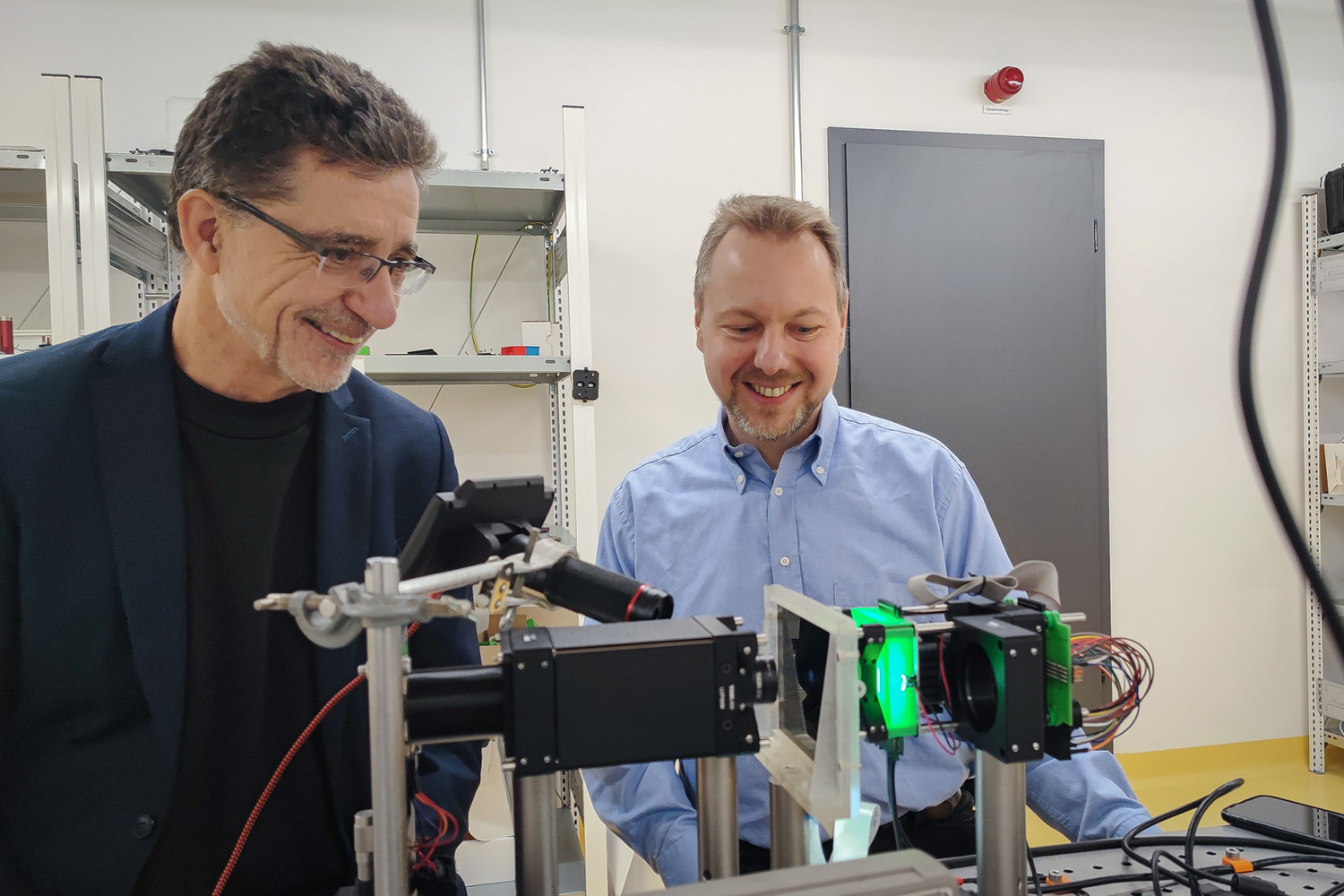
The Nitride Technology Center (NTC), a microelectronics consortium led by the Braunschweig University of Technology, is pioneering a new era in computing.
Funded by the state of Lower Saxony and the Volkswagen Foundation with funding of 15 million euros, the initiative entitled “Bringing Light to Microelectronics” (BRIGHT) aims to create neuromorphic computers using tiny LEDs.
The project will start on April 1, 2026 and will run for five years until 2031.
Reduce AI energy consumption
Researchers from the Braunschweig University of Technology, Leibniz University of Hannover, Ostfalia University of Applied Sciences and the Physical University of Technology (PTB) are working to address one of the biggest challenges of modern technology: the rapidly increasing energy demands of AI systems.
According to the International Energy Agency (IEA), data centers could consume 3% of the world’s electricity by 2030, which is approximately twice Germany’s current total electricity usage. This is mainly due to the huge amount of computation required to simulate neural networks.
How neuromorphic computers work
Unlike traditional computers, which use sequences of 0s and 1s across multiple processing stages to simulate neural networks, neuromorphic computers implement these networks directly in hardware.
NTC’s approach uses tiny LEDs to recreate the parallel connections of neurons in the human brain.
This allows AI calculations to be performed simultaneously instead of sequentially, significantly reducing energy consumption while increasing processing efficiency.
Hybrid technology: fusion of light and silicon
The BRIGHT project combines two previously separate technologies to maximize performance.
Traditional silicon-based integrated circuits (CMOS) are extremely versatile, but they cannot emit light. Chips made from materials such as gallium nitride, on the other hand, are brighter and more energy efficient.
By integrating these technologies into a hybrid system, NTC aims to create neuromorphic computers that benefit from both the reliability of silicon and the energy efficiency of light-emitting components.
This hybrid approach also opens new possibilities across a wide range of microelectronic applications.
Angela Ittel, Rector of the Technical University of Braunschweig, commented:
“The combination of light, microelectronics and neuromorphic thinking significantly reduces energy consumption and paves the way for more sustainable and powerful AI. We would like to thank Lower Saxony and the VW Foundation for their trust.”
“Special mention must be made of the vision and courage of the dedicated teams in Braunschweig and Hannover in developing such a positive theme based on excellent research and collaboration. Together today, we are laying the foundations for the technologies that will shape tomorrow’s society.”
Proven concepts and future goals
The LENA research center in Braunschweig has already demonstrated the feasibility of LED-based neuromorphic computing.
Over the next five years, the BRIGHT team plans to optimize the system, increase connectivity, and improve key components for large-scale deployment.
The ultimate goal is to develop an AI data center that is not only faster but also much more energy efficient than current standards.
A bright future for sustainable AI
As global energy demand for AI increases at an unprecedented rate, NTC’s research could provide important solutions.
By combining LEDs, hybrid chip integration, and neuromorphic architectures, the BRIGHT project shows a promising path toward sustainable, low-energy AI.
If successful, this innovation has the potential to redefine how artificial intelligence is powered and significantly reduce the environmental footprint of next-generation computing.
Source link
