

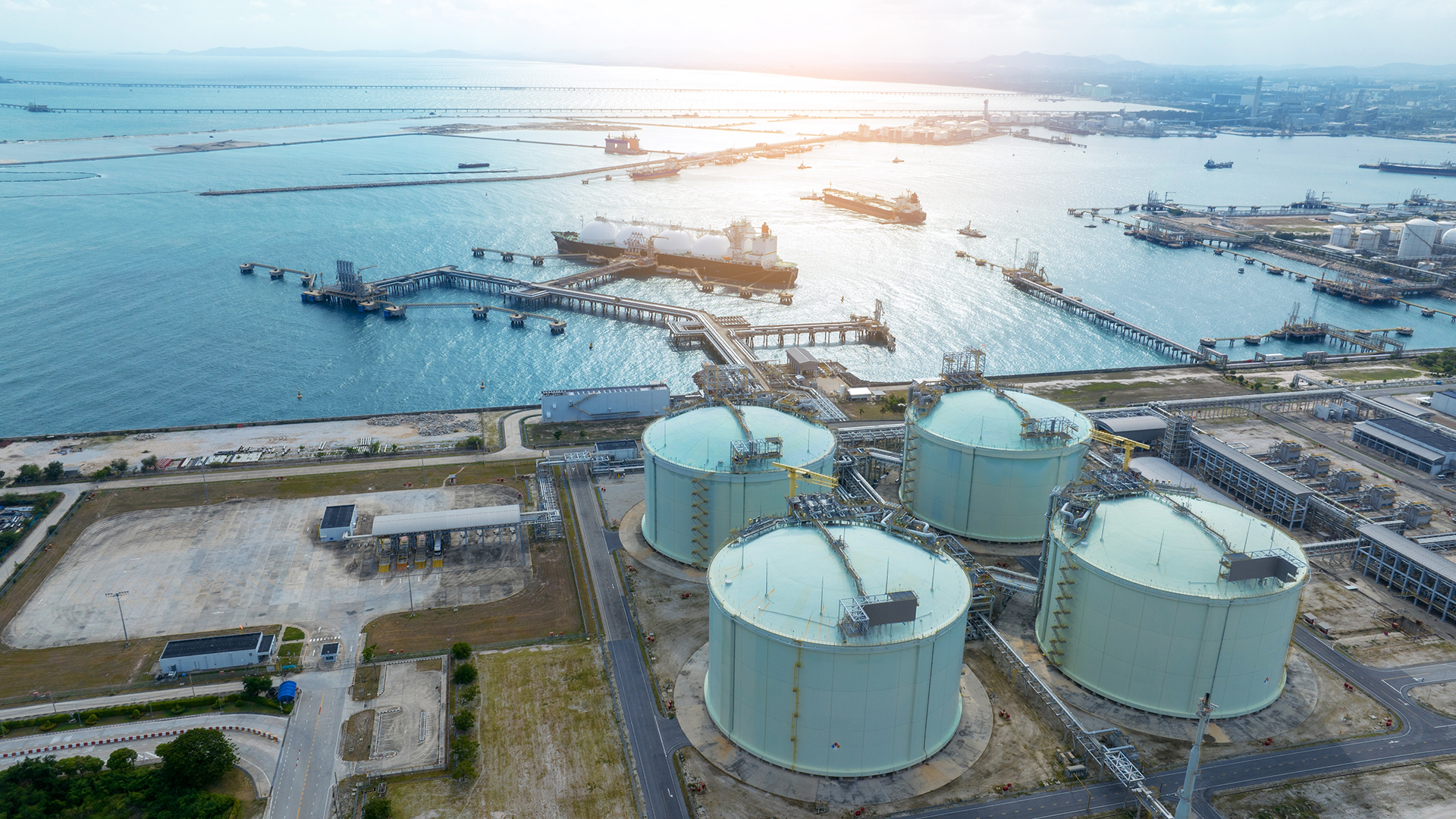
NICOLHy is investigating the concept of vacuum insulated panels (VIP) for economical and safe insulation of large liquefied hydrogen tanks.
Europe’s energy import and storage transition faces critical challenges: how to safely and efficiently store and transport hydrogen at scale. Although gaseous hydrogen pipelines and underground storage are only partially available, liquefied hydrogen (LH₂) is gaining increasing attention. Due to its high volumetric energy density, LH₂ is an ideal solution for international shipping by ship and has the potential to revolutionize global energy transport.
Why liquid hydrogen?
Among hydrogen derivatives, LH₂ has decisive advantages. It is extremely clean, does not require chemical conversion processes, resulting in high process chain efficiency and reliability, is non-toxic, and possibly allows the use of existing liquefied natural gas (LNG) infrastructure. LH₂ therefore makes a significant contribution to Europe’s energy supply security. But one major hurdle remains. That is, large-scale LH₂ storage tanks do not yet exist, and current technology is difficult and expensive to scale.
solution
Since LH₂ and LNG are stored at different temperatures, namely -253 °C and -161 °C, insulation techniques for transport and stationary tanks cannot be directly applied. This is where the EU-funded NICOLHy project comes into play. Researchers from BAM (DE), Uni Bologna (IT), DLR (DE), NTNU (NO) and NTUA (GR) are developing a new insulation concept based on vacuum insulated panels. This technology aims to make the production of large LH₂ tanks safer and significantly more cost-effective. Vision: Ships and stationary tanks have a storage capacity of 40,000 to 200,000 m3, comparable to today’s LNG facilities.

Innovation with vacuum insulation panels
VIPs are at the heart of this new approach. VIP is based on a vacuum filler surrounded by a gas-tight envelope in the form of a membrane. This combination provides improved thermal performance compared to, for example, a thermos flask. An exemplary VIP has dimensions of 1 m x 1 m in length and width, and a thickness of 0.1 m, and can also be manufactured in any size depending on the application. In addition, VIP achieves a lifespan of 10 to 100 years depending on fill material and envelope selection. VIP is a standardizable, mass-produced product that can be realized in an industrial environment with a highly automated prefabrication process and very high quality assurance. The VIP principle allows the current shape of large LH₂ tanks to be changed from spherical to prismatic, which increases the storage capacity of ships by up to 65%, for example. In addition, the VIP principle reduces tank manufacturing time, and the high volume of VIP makes tank installation easy and fast, ensuring redundancy and safety. Nowadays, VIP is used not only in houses but also in refrigerators and packaging materials. However, when used under extreme conditions, such as LH₂ insulation, some questions remain. How can the material withstand thermal stress? How should it be attached and installed?
Nicole’s progress
NICOLHy addresses the complex challenges of LH₂ storage by considering both large tanks and detailed insulation design. A comprehensive design study supported by a literature review and interdisciplinary workshops within the project group and with industry experts resulted in several conceptual variations. These will be evaluated for safety, economics, scalability and sustainability and will be benchmarked throughout the project by project-defined key performance indicators (KPIs) and the European Clean Hydrogen Joint Venture’s strategic research and innovation agenda.

One promising concept for LH₂ tank walls and their insulation features an inner and outer wall that separates the entire wall into two chambers, with an airtight barrier between them. This barrier allows for slightly different pressure conditions and gas compositions while also acting as a thermal balance layer. A gas is applied within each chamber that does not condense or freeze under the temperature conditions of each chamber. Therefore, hydrogen (H) or helium (He) with very low boiling points may be associated with the chamber next to the wall in contact with LH2. Nitrogen (N) can be applied to the chamber next to the outer wall and barrier. Nitrogen has several advantages, including being nonflammable, cost-effective, widely available as a major component of air, and able to be liquefied and handled efficiently. The last two support the integration of liquefied nitrogen (LN₂) at temperatures down to -196°C as a cooling fluid for airtight barriers and insulation. The cooling system supports the commissioning of tanks for transporting LH₂, increasing efficiency while reducing boil-off losses during operation. This principle is known from cryoshield technology, which has been applied for decades, such as LH₂ trailer transport. Insulation of the tank is achieved by installing VIPs in two chambers. This approach combines advanced materials and smart thermal management to provide a safe, economical and scalable hydrogen storage solution.
The evaluation of the VIP-based concepts, numerical models and databases under development includes material combinations, spatial configurations, shapes, dimensions and installation principles, as well as their circularity, economy and safety. The most promising concepts will be tested and evaluated using a large-scale test rig that will be operational in spring 2026. The most important aspects of these tests are the consideration of installation procedures, the testing of the mechanical operation of stacked VIPs and other configurations, and the consideration of the effects of accidents, all under realistic conditions. This activity and its prioritization will be carried out in close collaboration with Nikolai’s Stakeholder Advisory Board (SAB), which includes political decision makers, industry representatives, standards bodies, research and other project representatives. This cooperation ensures high quality, applicability, acceptance of results and good transferability. The results of the NICOLHy project will facilitate global trade in LH2 through cost-effective, efficient and safe stationary and marine tanks, and by supporting the development of recommendations, regulations and standards.
conclusion
Initial results suggest that VIP-based insulation has the potential to revolutionize LH₂ storage, improving cost and time efficiency while maintaining safety. The NICOLHy consortium’s close collaboration with industry and stakeholder advisory boards ensures practical relevance and supports standardization efforts.
Please note: This is a commercial profile
This article will also be published in the quarterly magazine issue 26.
Source link
