
Close Menu
  • Home
  • Identity
  • Inventions
  • Future
  • Science
  • Startups
  • Spanish
What's Hot

Resolve AI, a startup led by former Splunk executives, reaches $1 billion Series A valuation

Establish a venture-backable company in a highly regulated field

Cursor continues acquisition spree with deal with Graphite

Facebook X (Twitter) Instagram
  • Home
  • About Us
  • Advertise with Us
  • Contact Us
  • DMCA
  • Privacy Policy
  • Terms & Conditions
  • User-Submitted Posts
Facebook X (Twitter) Instagram
Fyself News
  • Home
  • Identity
  • Inventions
  • Future
  • Science
  • Startups
  • Spanish
Fyself News
Home » New research hints at a decades-old X-ray mystery in which two black holes took turns killing this star
Science

New research hints at a decades-old X-ray mystery in which two black holes took turns killing this star

userBy userDecember 10, 2025No Comments3 Mins Read
Share Facebook Twitter Pinterest Telegram LinkedIn Tumblr Email Copy Link
Follow Us
Google News Flipboard
Share
Facebook Twitter LinkedIn Pinterest Email Copy Link

About 3 billion years ago, an unlucky star got caught in a twisted tug of war between two massive black holes. And now we are witnessing the faint screams of X-rays emanating from this violent event. If confirmed, this could be the most distant episode of two black holes attacking a star ever observed.

An international team of astronomers reported on decades of observations of the faintest variable X-ray flares known in a paper accepted for publication in the journal The Innovation in November.

The X-ray source, named XID 925, was first discovered in 1999 during the Chandra X-ray Observatory’s Deep Field South survey. This is the deepest and most complete X-ray survey ever undertaken. Since then, astronomers have watched the star carefully, watching as its initially bright pinpricks of radiation became dimmer and dimmer, reaching just one-fortieth of its first observed peak.

you may like

make star spaghetti

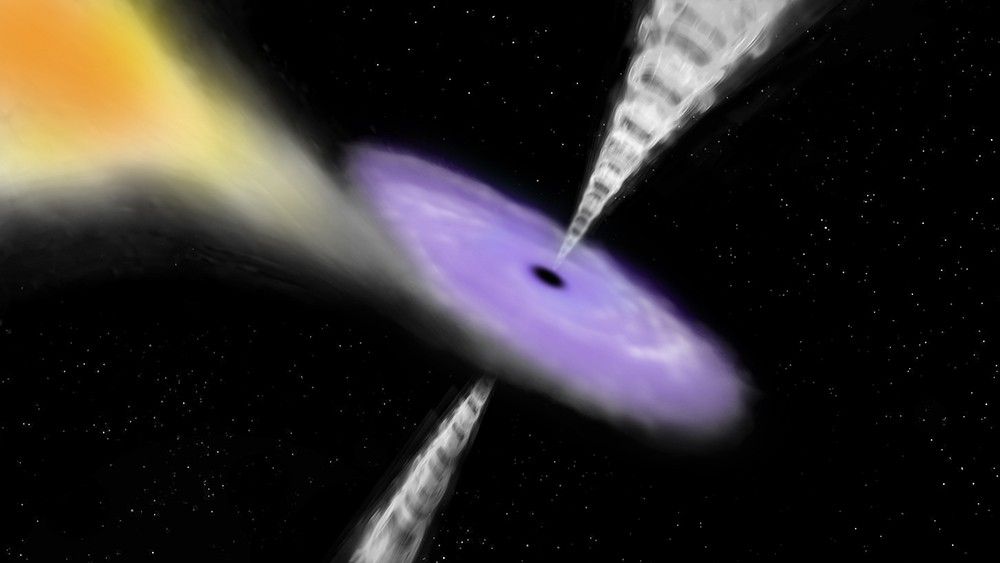
A bright surge of X-rays followed by a long dimming is exactly what astronomers would expect from a violent encounter called a tidal disruption event (TDE), which occurs when a star gets too close to a supermassive black hole. The black hole’s massive gravity tears the star to shreds before it is swallowed up by the monster’s event horizon (point of no return). This process is cutely named “spaghettification,” as if the stars were being pulled into a thin piece of pasta.

This stellar material then sinks into a thin, rapidly rotating disk just outside the black hole. The energy released by this process makes the gas so hot that it emits X-ray radiation that can be seen from the far side of the universe. The matter then flows into the gaping mouth of the black hole itself, and the disk loses its brightness.

XID 925 is already notable because it was one of the most distant and faintest known TDEs ever recorded. But in 1999, everything went awry.

From January to March of that year, XID 925 unexpectedly quickly brightened by a factor of 27. After that, the X-ray brightness decayed as quickly as it appeared, and XID 925 continued to disappear from the scene.

Get the world’s most fascinating discoveries delivered straight to your inbox.

Continuous black hole attack

Astronomers behind the new study now think there is another culprit behind this strange brightening. This is not a simple case of a TDE around a single supermassive black hole. This is the case for a TDE around two supermassive black holes.

They argue that the unlucky star was trapped within the gravity of a massive central black hole and a smaller (but still large) companion black hole. The larger black hole tore apart the star and turned it into an accretion disk. But then the second black hole swung closer to the disk and even penetrated through it, and the chaos triggered a ferocious burst of energy, scientists explained.

Like an unlucky car crashing into an accident scene, the incident caused the release of more X-rays, further confusing a chaotic situation. Once the small black hole moved, the system returned to normal.

While the astronomers cautioned that this story does not fully account for all the data, they argued that this is the most plausible scenario given what we know. If true, this would be the most distant known tidal disruption event of a binary black hole, providing us with an important and exciting window into the complex relationships between stars and black holes at the centers of young galaxies.


Source link

#Biotechnology #ClimateScience #Health #Science #ScientificAdvances #ScientificResearch
Follow on Google News Follow on Flipboard
Share. Facebook Twitter Pinterest LinkedIn Tumblr Email Copy Link
Previous ArticleReact2Shell exploit delivers crypto miners and new malware across multiple sectors
Next Article A 1,700-year-old mosaic unearthed in Britain depicts the long-lost story of the Trojan War
user
  • Website

Related Posts

Japan trials 100-kilowatt laser weapon – capable of cutting metal and drones while in flight

December 19, 2025

2025 Urids meteor shower: When and where to see ‘shooting stars’ on the longest night of the year

December 19, 2025

Roman soldiers stationed at Hadrian’s Wall suffer from diarrhea and abdominal pain, and microscopic parasites are discovered.

December 19, 2025
Add A Comment
Leave A Reply Cancel Reply

Latest Posts

Resolve AI, a startup led by former Splunk executives, reaches $1 billion Series A valuation

Establish a venture-backable company in a highly regulated field

Cursor continues acquisition spree with deal with Graphite

Elon Musk’s $56 billion Tesla pay package reinstated by Delaware Supreme Court

Trending Posts

Subscribe to News

Subscribe to our newsletter and never miss our latest news

Please enable JavaScript in your browser to complete this form.
Loading

Welcome to Fyself News, your go-to platform for the latest in tech, startups, inventions, sustainability, and fintech! We are a passionate team of enthusiasts committed to bringing you timely, insightful, and accurate information on the most pressing developments across these industries. Whether you’re an entrepreneur, investor, or just someone curious about the future of technology and innovation, Fyself News has something for you.

Castilla-La Mancha Ignites Innovation: fiveclmsummit Redefines Tech Future

Local Power, Health Innovation: Alcolea de Calatrava Boosts FiveCLM PoC with Community Engagement

The Future of Digital Twins in Healthcare: From Virtual Replicas to Personalized Medical Models

Human Digital Twins: The Next Tech Frontier Set to Transform Healthcare and Beyond

Facebook X (Twitter) Instagram Pinterest YouTube
  • Home
  • About Us
  • Advertise with Us
  • Contact Us
  • DMCA
  • Privacy Policy
  • Terms & Conditions
  • User-Submitted Posts
© 2025 news.fyself. Designed by by fyself.

Type above and press Enter to search. Press Esc to cancel.