
Close Menu
  • Home
  • Identity
  • Inventions
  • Future
  • Science
  • Startups
  • Spanish
What's Hot

New York state lawmaker proposes three-year moratorium on new data centers

This week’s science news: Anomalies inside Earth, the Artemis II leak and how psychedelics can help treat PTSD

Warning of signal phishing targeting German government agencies, politicians, military personnel and journalists

Facebook X (Twitter) Instagram
  • Home
  • About Us
  • Advertise with Us
  • Contact Us
  • DMCA
  • Privacy Policy
  • Terms & Conditions
  • User-Submitted Posts
Facebook X (Twitter) Instagram
Fyself News
  • Home
  • Identity
  • Inventions
  • Future
  • Science
  • Startups
  • Spanish
Fyself News
Home » New scan reveals Martian meteorite that fell to Earth was filled with ancient water
Science

New scan reveals Martian meteorite that fell to Earth was filled with ancient water

userBy userFebruary 5, 2026No Comments4 Mins Read
Share Facebook Twitter Pinterest Telegram LinkedIn Tumblr Email Copy Link
Follow Us
Google News Flipboard
Share
Facebook Twitter LinkedIn Pinterest Email Copy Link

Many tiny flecks of ancient water are trapped inside the oldest and most famous Martian meteorite ever to fall to Earth, a new study has found. The surprising discovery, achieved using a new form of ‘neutron scanning’, reveals further clues about Mars’ watery past, which may have been the setting for the flourishing of extraterrestrial life.

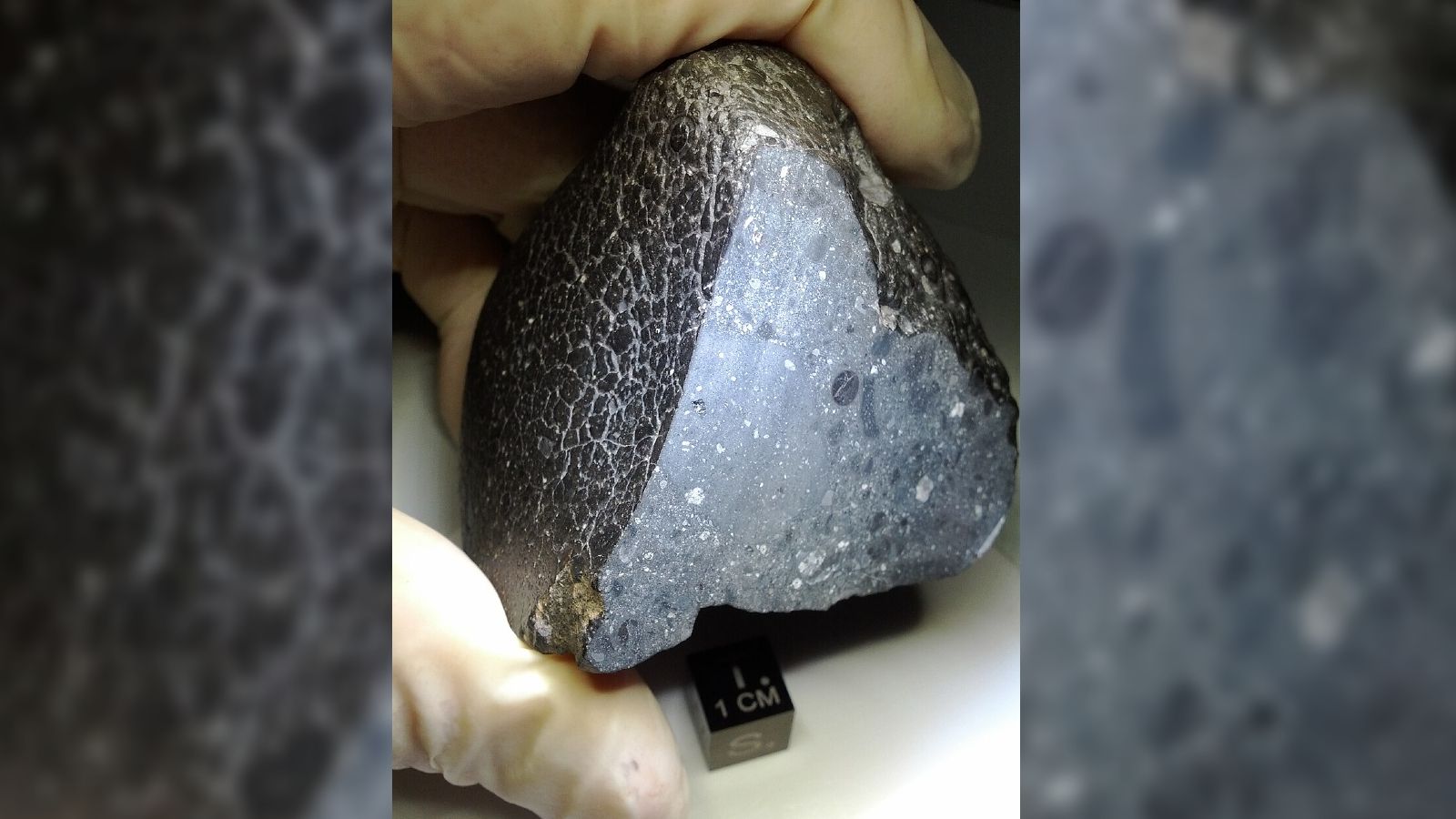
Meteorite NWA 7034, commonly known as Black Beauty, is an approximately 11-ounce (320-gram) chunk of Mars that was ejected when another space rock crashed into the Red Planet. It was discovered in 2011 by nomads in the Moroccan region of the Sahara Desert, but it is unclear when it fell to Earth. Since then, this meteorite has become famous for its dark color, which was further accentuated by the intense polishing of one of its faces.

According to Live Science’s sister site Space.com, Black Beauty likely originated from the 6-mile-wide (10 km) Karratha crater near Mars’ equator and was ejected into space between 5 million and 10 million years ago. But it’s much older than that, and scientists have since dated the coal-like rock to at least 4.44 billion years old, making it the oldest Martian meteorite ever discovered.

you may like

Researchers have known since 2013 that black beauty contains trace amounts of water. Recent analyzes of meteorites have revealed evidence that this water may have been partially heated, raising hopes that Martian microbes may once have thrived in the planet’s warm waters.

But until now, researchers had to separate and destroy small chunks of meteorites to properly study the water trapped inside them, limiting what they could learn from them, according to Universe Today.
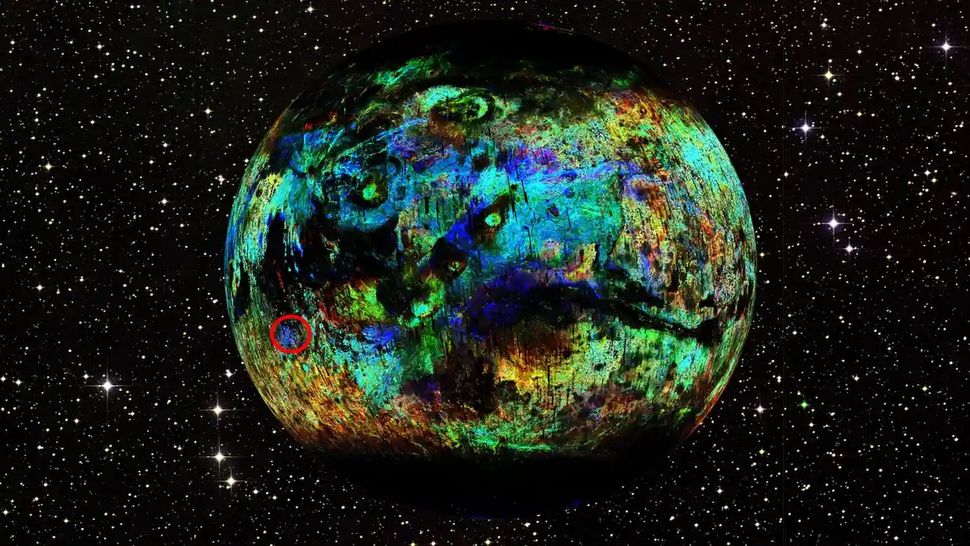
Multicolor map of Mars highlighting the location of the crater that gave birth to Black Beauty

Researchers previously tracked Black Beauty to Karratha Crater in Mars’ southern hemisphere. (Image courtesy of Curtin University)

But in a new study uploaded to the preprint server arXiv on January 13, researchers report that a new scanning method has enabled the first detailed analysis of the water content of an entire meteorite.

According to Universe Today, the test revealed that water likely made up about 0.6% of Black Beauty’s mass. This corresponds to a piece of rock the size of a human fingernail. This may not sound like a big deal, but it’s much more than previous estimates.

Get the world’s most fascinating discoveries delivered straight to your inbox.

Most of this water is trapped in small pieces, or crusts, of hydrogen-rich iron oxyhydroxide (FeHO2). FeHO2 is similar to the main component of rust and is formed when iron reacts with water under high pressure, such as during a meteorite impact.

In the new study, researchers used a version of CT scan that uses X-rays to build internal images of soft objects, such as the human body. But instead of using electromagnetic radiation, the team bombarded the meteorite with neutrons. The neutrons turned out to be particularly good at identifying hydrogen atoms embedded in very dense samples.

You can see this process in action in a YouTube video shared by one of the researchers.

you may like

water on mars
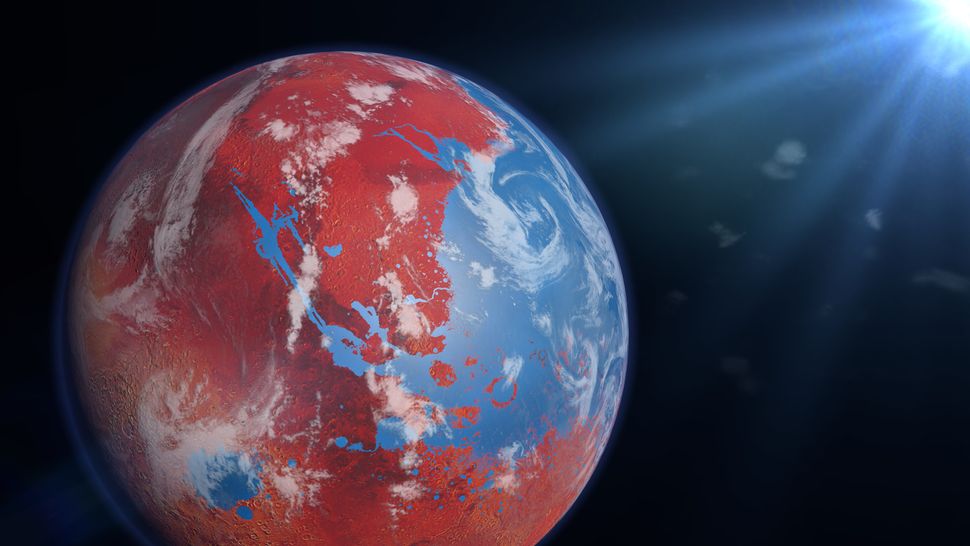
Artist's illustration of what the oceans of Mars looked like from space

Research has shown that Mars once had a large ocean similar to Earth’s, raising hopes that it was once home to extraterrestrial life. (Image source: Getty Images)

It’s hard to imagine that the dusty red ball of today’s Mars was once a world of water. But growing evidence suggests that the planet was once home to a large Earth-like ocean until about 3 billion years ago.

Much of this water has since disappeared, but some remains in the form of buried ice slabs near the Earth’s equator, frosty deposits atop Martian mountains, and a giant underground reservoir discovered in 2024.

Black Beauty is widely considered to be the oldest direct evidence of water on Mars, and could help us understand how the planet first acquired its once-abundant water. Therefore, researchers are keen to further analyze its interior.

Given that NASA recently canceled plans for a Mars sample return mission that would have brought samples collected by the rover Perseverance back to Earth, meteorites like Black Beauty are the only way to directly study water on Mars.


Source link

#Biotechnology #ClimateScience #Health #Science #ScientificAdvances #ScientificResearch
Follow on Google News Follow on Flipboard
Share. Facebook Twitter Pinterest LinkedIn Tumblr Email Copy Link
Previous ArticlePacific Fusion finds cheaper way to run fusion reactors
Next Article Meta tests standalone app for AI-generated “Vibes” videos
user
  • Website

Related Posts

This week’s science news: Anomalies inside Earth, the Artemis II leak and how psychedelics can help treat PTSD

February 7, 2026

Psychedelics may rewire the brain to treat PTSD. Scientists are finally beginning to understand how.

February 6, 2026

All major galaxies except one are moving away from the Milky Way – and we finally know why

February 6, 2026
Add A Comment
Leave A Reply Cancel Reply

Latest Posts

New York state lawmaker proposes three-year moratorium on new data centers

This week’s science news: Anomalies inside Earth, the Artemis II leak and how psychedelics can help treat PTSD

Warning of signal phishing targeting German government agencies, politicians, military personnel and journalists

Benchmark raises $225 million in special funding to double Cerebras

Trending Posts

Subscribe to News

Subscribe to our newsletter and never miss our latest news

Please enable JavaScript in your browser to complete this form.
Loading

Welcome to Fyself News, your go-to platform for the latest in tech, startups, inventions, sustainability, and fintech! We are a passionate team of enthusiasts committed to bringing you timely, insightful, and accurate information on the most pressing developments across these industries. Whether you’re an entrepreneur, investor, or just someone curious about the future of technology and innovation, Fyself News has something for you.

Castilla-La Mancha Ignites Innovation: fiveclmsummit Redefines Tech Future

Local Power, Health Innovation: Alcolea de Calatrava Boosts FiveCLM PoC with Community Engagement

The Future of Digital Twins in Healthcare: From Virtual Replicas to Personalized Medical Models

Human Digital Twins: The Next Tech Frontier Set to Transform Healthcare and Beyond

Facebook X (Twitter) Instagram Pinterest YouTube
  • Home
  • About Us
  • Advertise with Us
  • Contact Us
  • DMCA
  • Privacy Policy
  • Terms & Conditions
  • User-Submitted Posts
© 2026 news.fyself. Designed by by fyself.

Type above and press Enter to search. Press Esc to cancel.