
Close Menu
  • Home
  • Identity
  • Inventions
  • Future
  • Science
  • Startups
  • Spanish
What's Hot

Musk needed a new vision for SpaceX and xAI. He landed on Moonbase Alpha.

Hackers associated with Epstein removed from Black Hat Cyber ​​Conference website

Automattic plans to have 10 competitors subject to royalty fees, WP Engine claims in new filing

Facebook X (Twitter) Instagram
  • Home
  • About Us
  • Advertise with Us
  • Contact Us
  • DMCA
  • Privacy Policy
  • Terms & Conditions
  • User-Submitted Posts
Facebook X (Twitter) Instagram
Fyself News
  • Home
  • Identity
  • Inventions
  • Future
  • Science
  • Startups
  • Spanish
Fyself News
Home » Newly discovered radio signals from the center of the galaxy could put Einstein’s theory of relativity to the test
Science

Newly discovered radio signals from the center of the galaxy could put Einstein’s theory of relativity to the test

userBy userFebruary 11, 2026No Comments3 Mins Read
Share Facebook Twitter Pinterest Telegram LinkedIn Tumblr Email Copy Link
Follow Us
Google News Flipboard
Share
Facebook Twitter LinkedIn Pinterest Email Copy Link

Is there an ultra-dense core of a gigantic star lurking at the center of the Milky Way?

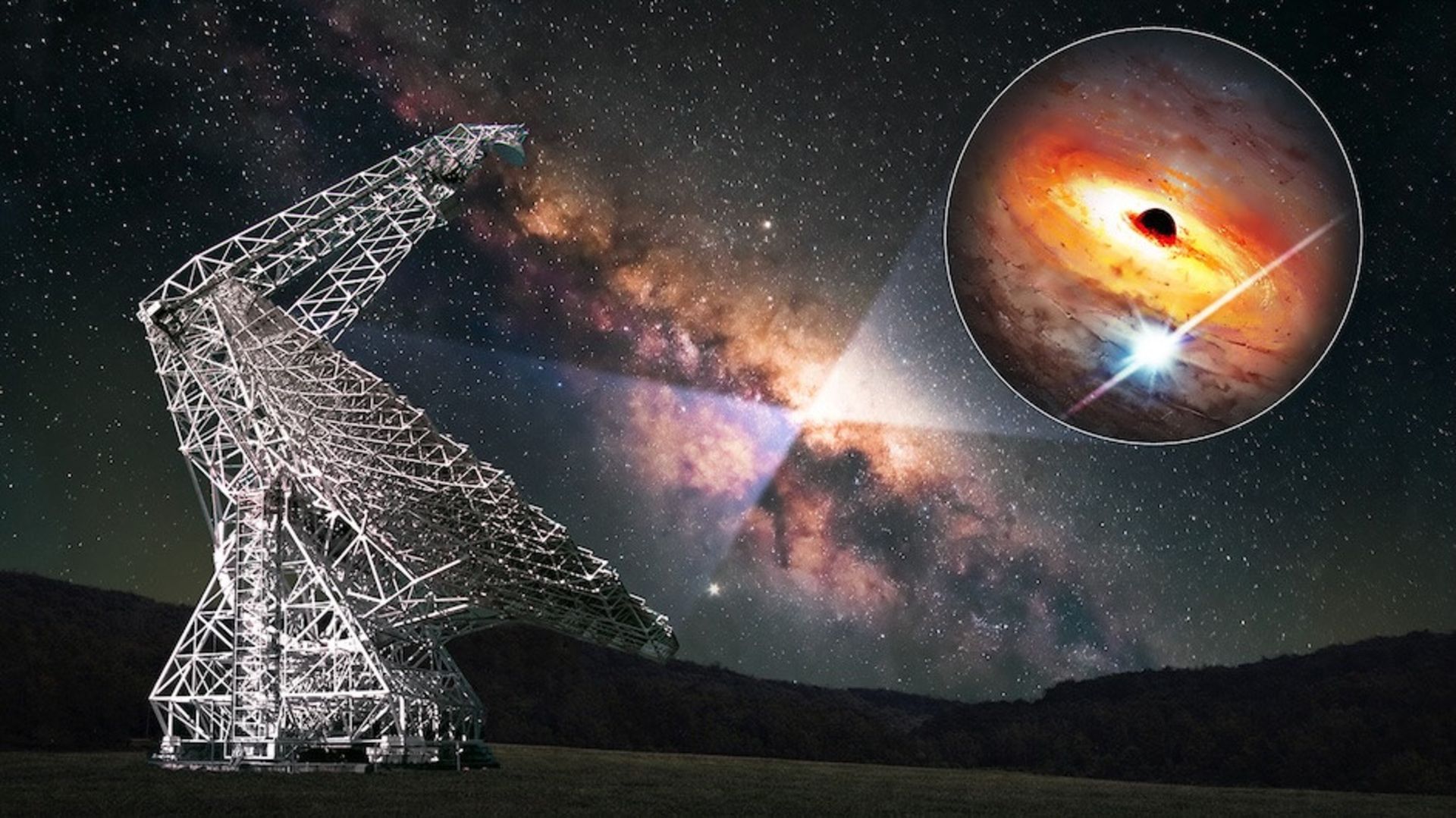
Scientists think they may have discovered just that. It’s a signal from a pulsar, the fast-rotating core of an ancient star at the center of our galaxy. This unusual discovery could be used to test the predictions of Einstein’s theory of general relativity.

Pulsars, a type of neutron star, are known as the “lighthouses of the universe” because they send out beams of radio radiation every time they rotate, and sometimes those beams pass by Earth. The suspected pulsar rotates on its axis every 8.19 milliseconds and is located near Sagittarius A*, a supermassive black hole with the mass of 4 million suns embedded in the center of the Milky Way galaxy.

you may like

The researchers published their results on Monday (February 9) in The Astrophysical Journal. The study was led by Karen Perez, a postdoctoral fellow at the SETI Institute and a doctoral student at Columbia University at the time of the study.

“We look forward to seeing what follow-up studies will reveal about this pulsar candidate,” Perez said in a statement. In particular, researchers hope to use pulsars to investigate general relativity, she added.

test the laws of the universe

General relativity, first proposed by Albert Einstein, proposes that gravity is not a force of nature, but a property of the curvature of space-time.

A pulsar near the Milky Way would allow researchers to learn about “precise measurements of spacetime around a supermassive black hole,” the statement said. That’s because pulsars rotate so fast that, like other stars, they are sensitive to the subtle gravitational forces of nearby massive objects.

Get the world’s most fascinating discoveries delivered straight to your inbox.

Study co-author Slavko Bogdanov, a research scientist at the Columbia Institute of Astrophysics, said the pulsar’s rotation could theoretically create an “anomaly” in the light pulses sent toward Earth.

“Furthermore, when a pulse moves near a very massive object, it can be deflected and cause time delays due to space-time distortions, as predicted by Einstein’s theory of general relativity,” Bogdanov added.

Researchers detected the suspected pulsar through Breakthrough Listen, a scientific research program aimed at discovering signals from extraterrestrial civilizations. This new discovery comes from the Breakthrough Listen Galactic Center Survey, which, as the name suggests, tracks signals coming from the center of the Milky Way.

Breakthrough Listen has made all data publicly available, “enabling researchers around the world to pursue independent analysis and complementary scientific cases,” the researchers added.

Further research is needed to confirm whether the signal was really a pulsar or came from some other unusual radio source.

Source: Perez, KI, Gajjar, V., Bogdanov, S., Halpern, JP, Demorest, PB, Croft, S., Lebofsky, M., MacMahon, DHE, and Siemion, APV (2026). About the deepest search for galactic central pulsars and the investigation of interesting millisecond pulsar candidates. Journal of Astrophysics, 998(1), 147. https://doi.org/10.3847/1538-4357/ae336c

Milky Way Quiz: How much do you know about our galaxy?


Source link

#Biotechnology #ClimateScience #Health #Science #ScientificAdvances #ScientificResearch
Follow on Google News Follow on Flipboard
Share. Facebook Twitter Pinterest LinkedIn Tumblr Email Copy Link
Previous ArticleElon Musk suggests successive xAI withdrawals were a push, not a pull
Next Article AI inference startup Modal Labs is in procurement talks at a valuation of $2.5 billion, sources say
user
  • Website

Related Posts

China’s carbon emissions may have reached a critical tipping point sooner than expected

February 12, 2026

Thawing permafrost and “shrub” are pushing Alaska’s northern slopes into wildfire conditions not seen in 3,000 years.

February 11, 2026

The world’s oldest known sewn garment may have been sewn together from sections of Ice Age skin unearthed in an Oregon cave.

February 11, 2026
Add A Comment
Leave A Reply Cancel Reply

Latest Posts

Musk needed a new vision for SpaceX and xAI. He landed on Moonbase Alpha.

Hackers associated with Epstein removed from Black Hat Cyber ​​Conference website

Automattic plans to have 10 competitors subject to royalty fees, WP Engine claims in new filing

Aurora’s driverless trucks can now travel faster and longer distances than human drivers

Trending Posts

Subscribe to News

Subscribe to our newsletter and never miss our latest news

Please enable JavaScript in your browser to complete this form.
Loading

Welcome to Fyself News, your go-to platform for the latest in tech, startups, inventions, sustainability, and fintech! We are a passionate team of enthusiasts committed to bringing you timely, insightful, and accurate information on the most pressing developments across these industries. Whether you’re an entrepreneur, investor, or just someone curious about the future of technology and innovation, Fyself News has something for you.

Castilla-La Mancha Ignites Innovation: fiveclmsummit Redefines Tech Future

Local Power, Health Innovation: Alcolea de Calatrava Boosts FiveCLM PoC with Community Engagement

The Future of Digital Twins in Healthcare: From Virtual Replicas to Personalized Medical Models

Human Digital Twins: The Next Tech Frontier Set to Transform Healthcare and Beyond

Facebook X (Twitter) Instagram Pinterest YouTube
  • Home
  • About Us
  • Advertise with Us
  • Contact Us
  • DMCA
  • Privacy Policy
  • Terms & Conditions
  • User-Submitted Posts
© 2026 news.fyself. Designed by by fyself.

Type above and press Enter to search. Press Esc to cancel.