

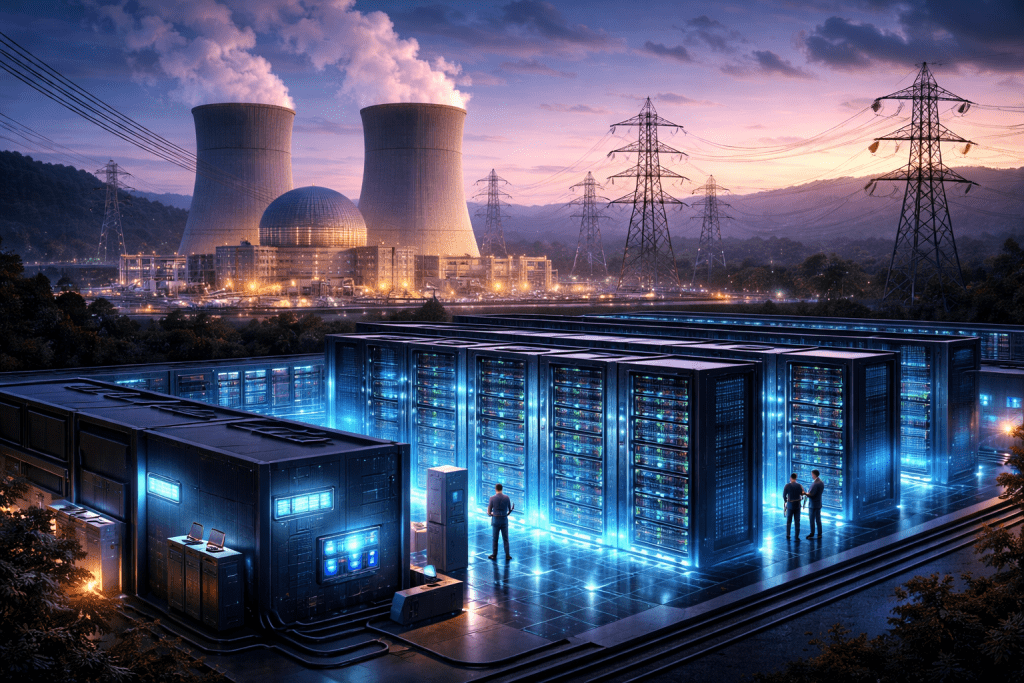
A new US study outlines how nuclear capacity can support the 24-hour power demands of rapidly expanding digital infrastructure.
Accelerating data center growth is forcing a reassessment of how we provide reliable large-scale power, and new research suggests nuclear power plants could play a central role in meeting that demand.
A study led by Argonne National Laboratory scientists and conducted in collaboration with Idaho National Laboratory and Oak Ridge National Laboratory examines how nuclear energy systems can be integrated with data centers.
The findings, published in a U.S. Department of Energy (DOE) report, point to nuclear power as a technically viable option to continuously provide low-carbon electricity to industries facing severe energy demands.
Data centers drive new wave of power demand
Data centers, the backbone of cloud computing, streaming services, and AI workloads, are becoming one of the fastest growing sources of electricity consumption in the United States.
According to the report, demand in this sector could reach 85 gigawatts (GW) by the end of this decade.
To put this into context, 1 gigawatt is roughly enough to power a medium-sized city. The projected increase of 24 to 74 GW by 2028 will place a significant strain on existing energy systems.
Currently, most data centers rely on grid power, sometimes supplemented by on-site natural gas generation.
However, the variability of renewable energy and the emissions concerns associated with fossil fuels are forcing operators to look for alternatives that can provide consistent output.
Nuclear power plants, which operate continuously and are largely unaffected by weather, are increasingly being considered as a potential solution.
Integrated model: from grid supply to colocation
This study outlines five different approaches to linking nuclear facilities and data centers.
These range from traditional grid-tied deployments where nuclear power plants power a broader network, to more integrated models where data centers are built adjacent to or directly connected to nuclear power plants.
In particular, colocation has been highlighted as offering operational advantages. By locating data centers next to power plants, carriers have the potential to reduce transmission losses, improve reliability, and reduce long-term costs.
Other models include dedicated power purchase agreements with existing nuclear power plants and hybrid configurations that combine grid and direct supply mechanisms.
Expand nuclear capacity to meet demand
Meeting projected demand will require a significant expansion of nuclear capacity. The study estimates that between 27 and 85 GW of nuclear capacity could be needed to support the anticipated data center growth.
In the short term, researchers suggest that a combination of strategies could realistically allocate 20 to 28 GW to data centers by the early 2030s. These include restarting recently retired nuclear reactors, extending the life of existing plants, and building new facilities.
Advanced nuclear technology is also part of the equation. Small modular reactors (SMRs) are designed to be smaller and faster to deploy than traditional plants, and are considered particularly suitable for data center applications due to their scalability and lower initial costs.
Site selection and infrastructure requirements
The feasibility of combining a nuclear power plant with a data center is highly location-dependent. A suitable site must meet criteria common to both types of infrastructure, such as stable geology, suitable land, and access to water for cooling.
Additional requirements include high-capacity grid connectivity, fiber optic networks, and proximity to a skilled workforce. The study found viable locations exist in essentially every state in the United States, including locations associated with existing or decommissioned power plants.
Reusing infrastructure, such as the site of a coal-fired power plant, offers economic and logistical benefits and can reduce construction costs and schedules.
Economic impact and job creation
Beyond energy supply, co-locating nuclear facilities and data centers can have significant economic implications. Both sectors are capital intensive and generate significant employment and tax revenue.
The report estimates that a 1 GW data center connected to a nuclear power plant could support approximately 1,700 direct operational operations. Further employment effects could amount to more than 7,000 jobs in urban areas and 3,000 jobs in rural areas.
Such developments could be particularly important for communities transitioning away from fossil fuel industries, where existing infrastructure and workforce skills could be reused.
Challenges: Cost, Regulation, and Schedule
Despite the potential benefits, the report identifies several barriers to widespread adoption. Nuclear projects typically involve high initial capital costs and long construction schedules, both of which can conflict with data center rapid deployment schedules.
Regulatory complexity is another factor, especially when it comes to licensing new reactors and restarting decommissioned reactors. Availability of water for cooling and local location constraints are also practical challenges.
But researchers argue that these problems are not insurmountable. Strategies such as modernizing the regulatory framework, leveraging existing infrastructure, and deploying SMR may help alleviate some of the constraints.
Policy support and future developments
DOE has already taken steps to consider integrated energy and data center projects. Federal land is available for potential development, and proposals are being considered in several locations, including the Idaho National Laboratory, the Oak Ridge Reservation, the Paducah site in Kentucky, and the Savannah River site in South Carolina.
The study’s authors emphasize that coordination between governments, the technology sector, and the nuclear industry is essential to move from concept to implementation.
Further studies are planned to assess fueling requirements, economic feasibility, and site-specific case studies. The broader objective is to establish a scalable framework that allows nuclear power plants to support continued expansion of data centers while maintaining energy reliability and reducing emissions.
As demand for digital infrastructure accelerates, the question is no longer whether new energy sources are needed, but which ones can scale at a sufficient pace.
Source link
