
Close Menu
  • Home
  • Identity
  • Inventions
  • Future
  • Science
  • Startups
  • Spanish
What's Hot

China-linked DKnife AitM framework, routers targeted for traffic hijacking and malware distribution

How AI is helping solve labor issues in rare disease treatment

Backlash over OpenAI’s decision to deprecate GPT-4o shows how dangerous AI companions can be

Facebook X (Twitter) Instagram
  • Home
  • About Us
  • Advertise with Us
  • Contact Us
  • DMCA
  • Privacy Policy
  • Terms & Conditions
  • User-Submitted Posts
Facebook X (Twitter) Instagram
Fyself News
  • Home
  • Identity
  • Inventions
  • Future
  • Science
  • Startups
  • Spanish
Fyself News
Home » Nvidia unveils powerful new Rubin chip architecture
Startups

Nvidia unveils powerful new Rubin chip architecture

userBy userJanuary 5, 2026No Comments3 Mins Read
Share Facebook Twitter Pinterest Telegram LinkedIn Tumblr Email Copy Link
Follow Us
Google News Flipboard
Share
Facebook Twitter LinkedIn Pinterest Email Copy Link

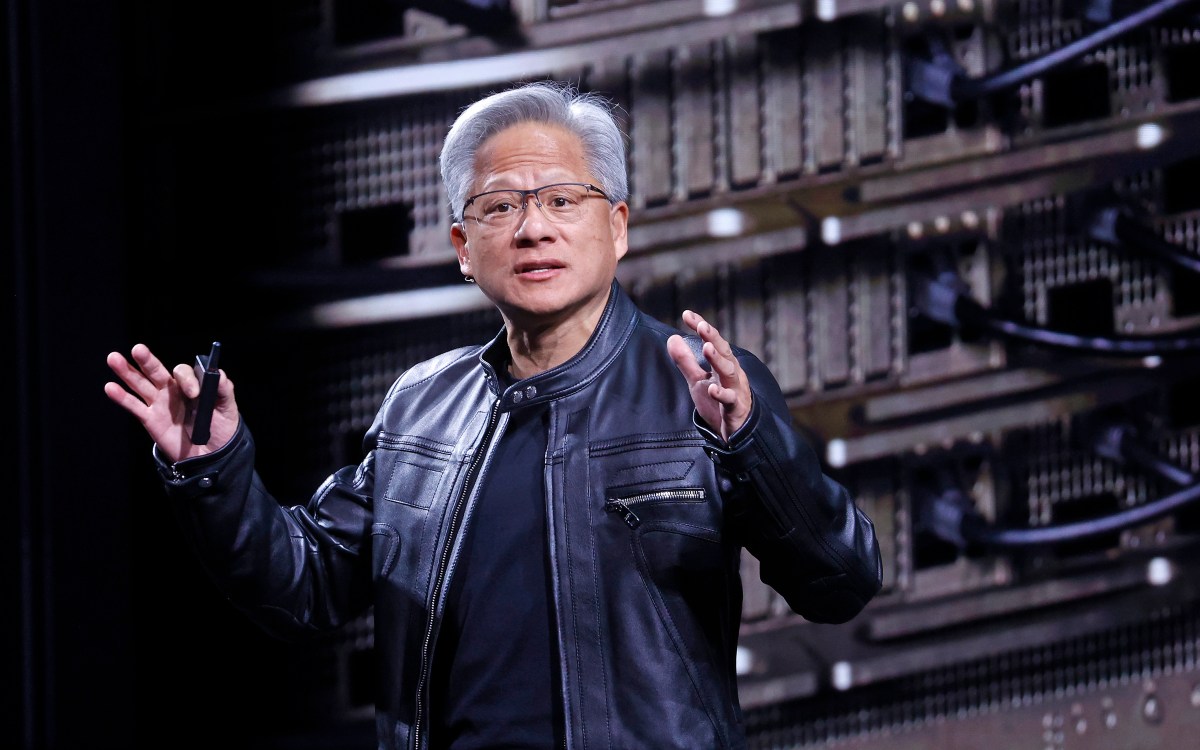
Today at the Consumer Electronics Show, Nvidia CEO Jensen Huang officially announced the company’s new Rubin computing architecture, calling it the state-of-the-art in AI hardware. The new architecture is currently in production and will be further enhanced in the second half of this year.

“Vera Rubin is designed to address a fundamental challenge we have: the rapidly increasing amount of computation required for AI,” Huang told the audience. “Today, I can say that Vera Rubin is in full operation.”

First announced in 2024, the Rubin architecture is the latest in Nvidia’s continuous hardware development cycle that has turned it into the world’s most valuable company. The Rubin architecture replaces the Blackwell architecture, which replaces the Hopper and Lovelace architectures.

Rubin chips are already slated for use with nearly every major cloud provider, including Anthropic, OpenAI, and Nvidia’s famous partnership with Amazon Web Services. The Rubin system will also be used in HPE’s Blue Lion supercomputer and Lawrence Berkeley National Laboratory’s upcoming Doudna supercomputer.

The Rubin Architecture, named after astronomer Vera Florence Cooper Rubin, consists of six separate chips designed to work together. Although Rubin GPUs are at the center, the architecture also addresses growing bottlenecks in storage and interconnect with new improvements in the Bluefield and NVLink systems, respectively. The architecture also includes a new Vera CPU designed for agent inference.

Dion Harris, senior director of AI Infrastructure Solutions at Nvidia, explained the benefits of the new storage while pointing to the increased caching-related memory demands of modern AI systems.

“As new types of workflows start to take effect, such as agent AI and long-term tasks, they place a lot of stress and requirements on the KV cache,” Harris told reporters on a conference call, referring to the memory system used by AI models to compress input. “So we introduced a new storage layer that connects outside of the computing device, allowing us to scale our storage pool more efficiently.”

tech crunch event

san francisco
|
October 13-15, 2026

As expected, the new architecture also shows significant advances in speed and power efficiency. According to Nvidia testing, the Rubin architecture runs 3.5x faster than the previous Blackwell architecture for model training tasks and 5x faster for inference tasks, reaching up to 50 petaflops. The new platform also supports 8x more inference compute per watt.

Rubin’s new capabilities come amid a fierce race to build AI infrastructure. In this race, both AI labs and cloud providers are competing for Nvidia chips and the equipment needed to power them. During an October 2025 earnings call, Huang estimated that $3 trillion to $4 trillion will be spent on AI infrastructure over the next five years.

Read TechCrunch’s full coverage of the annual CES conference here.

Watch as Nvidia CEO Jensen Huang reveals what he describes as the cutting edge in AI hardware: the new Rubin computing architecture.

“Vera Rubin is designed to address a fundamental challenge we have: the exponentially increasing amount of computation required for AI.” Yellow… pic.twitter.com/MhGVqytX04

— TechCrunch (@TechCrunch) January 5, 2026


Source link

#Aceleradoras #CapitalRiesgo #EcosistemaStartup #Emprendimiento #InnovaciónEmpresarial #Startups
Follow on Google News Follow on Flipboard
Share. Facebook Twitter Pinterest LinkedIn Tumblr Email Copy Link
Previous ArticleBoston Dynamics’ next-generation humanoid robot will incorporate Google DeepMind DNA
Next Article Nvidia aims to make Android the generalist robot
user
  • Website

Related Posts

How AI is helping solve labor issues in rare disease treatment

February 6, 2026

Backlash over OpenAI’s decision to deprecate GPT-4o shows how dangerous AI companions can be

February 6, 2026

Reddit sees AI search as its next big opportunity

February 5, 2026
Add A Comment
Leave A Reply Cancel Reply

Latest Posts

China-linked DKnife AitM framework, routers targeted for traffic hijacking and malware distribution

How AI is helping solve labor issues in rare disease treatment

Backlash over OpenAI’s decision to deprecate GPT-4o shows how dangerous AI companions can be

CISA orders removal of unsupported edge devices to reduce risk to federal networks

Trending Posts

Subscribe to News

Subscribe to our newsletter and never miss our latest news

Please enable JavaScript in your browser to complete this form.
Loading

Welcome to Fyself News, your go-to platform for the latest in tech, startups, inventions, sustainability, and fintech! We are a passionate team of enthusiasts committed to bringing you timely, insightful, and accurate information on the most pressing developments across these industries. Whether you’re an entrepreneur, investor, or just someone curious about the future of technology and innovation, Fyself News has something for you.

Castilla-La Mancha Ignites Innovation: fiveclmsummit Redefines Tech Future

Local Power, Health Innovation: Alcolea de Calatrava Boosts FiveCLM PoC with Community Engagement

The Future of Digital Twins in Healthcare: From Virtual Replicas to Personalized Medical Models

Human Digital Twins: The Next Tech Frontier Set to Transform Healthcare and Beyond

Facebook X (Twitter) Instagram Pinterest YouTube
  • Home
  • About Us
  • Advertise with Us
  • Contact Us
  • DMCA
  • Privacy Policy
  • Terms & Conditions
  • User-Submitted Posts
© 2026 news.fyself. Designed by by fyself.

Type above and press Enter to search. Press Esc to cancel.