

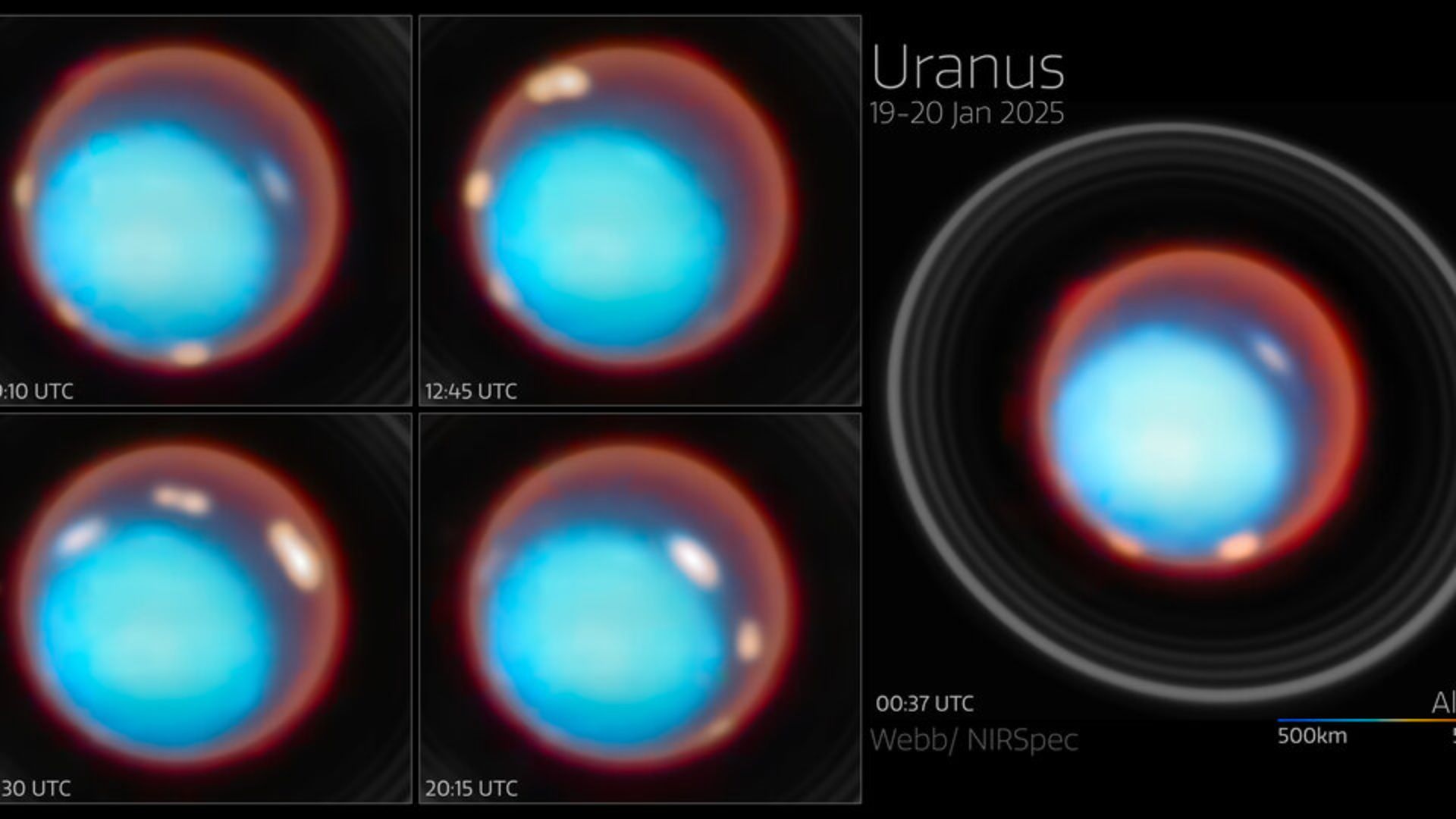
Scientists using the James Webb Space Telescope have mapped Uranus’ mysterious upper atmosphere for the first time, revealing strange new features of the planet’s mysterious magnetic field and glowing auroras.
The James Webb Space Telescope (JWST) observed Uranus’ rotation for 15 hours (almost a full day) to learn more about how the ice giant distributes energy in the upper layers of its atmosphere and to investigate how the planet’s auroras work.
you may like
To learn more, scientists used JWST to study Uranus’ magnetosphere, the region of space around Uranus that is dominated by the planet’s magnetic field.
“Uranus’ magnetosphere is one of the strangest in the solar system,” lead study author Paola Tiranti, a PhD student at Northumbria University in the UK, said in a statement from the European Space Agency (ESA). “Webb showed us how deep that effect reaches into the atmosphere.”
Uranus’ strange light
ESA officials said in a statement that JWST has created “the most detailed picture yet” of how particles in Uranus’ upper atmosphere are energized (ionized) by interactions with the Sun. The study, published February 19 in the journal Geophysical Research Letters, aims to measure the temperature and density of ions up to 3,100 miles (5,000 kilometers) from Uranus’ cloud tops.
According to JWST, temperature and density do not peak at the same altitude. The ions are warmest between about 2,500 and 3,100 miles (4,000 and 5,000 km), but densest at about 600 miles (1,000 km). This is due to the “complex geometry” of the planet’s magnetic field, ESA officials said in a statement.
This geometry also produced two bright auroral bands near Uranus’s magnetic poles. But between the auroral zones, there is a “reduction” in both ion density and auroral emission, the scientists said, an effect likely caused by transitions between the planet’s magnetic field lines. Observations in Jupiter’s upper atmosphere show a similar transition region.
In addition to providing the first three-dimensional illustration of Uranus’ upper atmosphere, JWST confirmed previous research suggesting that Uranus’ upper atmosphere has been steadily cooling since the early 1990s. The telescope showed that the average temperature of Uranus’ atmosphere is about 307 degrees Fahrenheit (153 degrees Celsius). This is lower than temperatures measured by other spacecraft or ground-based telescopes.
“By revealing Uranus’s vertical structure in such detail, Webb is helping us understand the ice giant’s energy balance,” Tiranti said. “This is an important step toward characterizing giant planets outside our solar system.”

brandon specter
Space and physics editor
Uranus, the only planet that rotates sideways around the sun, is a literal oddball. Up close observations have been limited to a single flyby by Voyager 2 in 1986, but there is much to discover from afar. One of JWST’s key missions is to study the atmospheres of the solar system’s planets in infrared light, providing new clues about how our neighboring worlds formed and whether alien star systems may follow a similar path. Ultimately, understanding giant planets like Uranus will help scientists explore potentially habitable worlds around distant stars.
Tiranti, P. I., Melin, H., Moore, L., Thomas, E. M., Knowles, K. L., Stallard, T. S., Roberts, K., and O’Donoghue, J. (2026). JWST discovered the vertical structure of Uranus’ ionosphere. Geophysical Research Letters, 53(4). https://doi.org/10.1029/2025gl119304
Source link
