

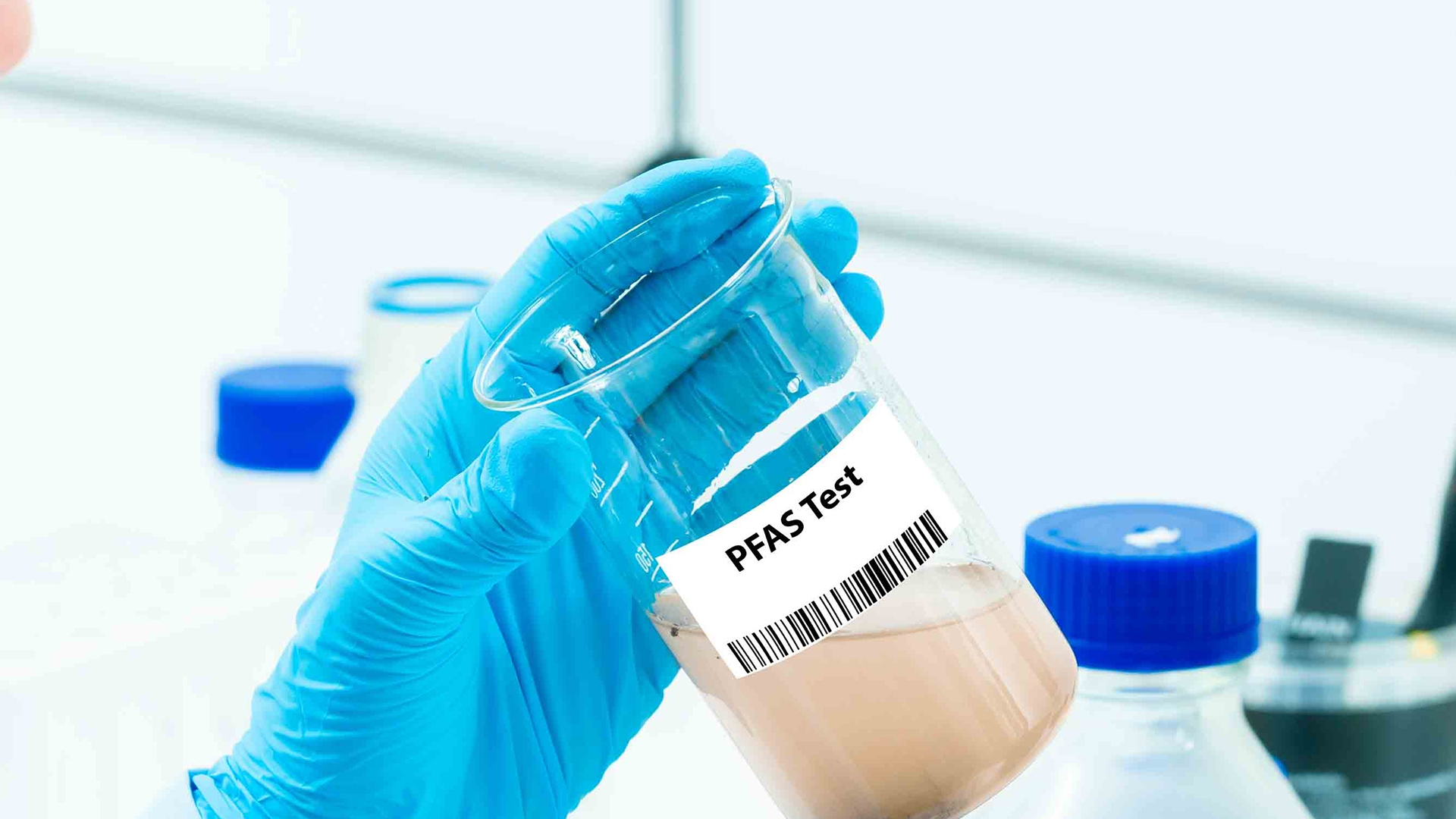
Explore the different types of PFAS tests and see how they continue to evolve.
Current Environmental Protection Agency (EPA) targeted PFAS sample testing methods can quantify up to 40 PFAS. Currently, these methods include PFAS with maximum contamination limits, but there is significant concern about the thousands of potential PFAS that have not been screened or quantified. Therefore, it is critical that laboratories be able to provide analytical tests that complement the currently available EPA methods. This provides a more complete picture of how much PFAS contamination is present in aqueous, solid, and gaseous samples.
Additional test methods for PFAS in aqueous samples
Expansion of testing methods for analytes
Currently, the drinking water analytical methods published by EPA for PFAS analysis test for only 18 analytes (Method 537.1) and 25 analytes (Method 533). These methods use liquid chromatography-tandem mass spectrometry (LC-MS/MS) to analyze samples that have been previously concentrated by solid-phase extraction (SPE). The combination of preconcentration and LC-MS/MS allows for very precise and accurate determination of target PFAS. To screen for more PFAS compounds beyond those included in the EPA method, it is possible to develop an LC-MS/MS method to quantify more than 70 total PFAS analytes while maintaining the same precision and limits of detection (LOD) that the EPA method achieves. Extended analyte methods can be a great tool to provide more detailed information about additional types of PFAS in drinking water. However, the ability to screen for many other PFAS compounds that could potentially be found in drinking water samples is still lacking.
Total organic fluorine (TOF) PFAS screening
EPA’s method of analyzing PFAS in drinking water can be described as a targeted analysis. This means that only a relatively small number of PFASs are screened and quantified. TOF is a non-specific assay that produces an estimate of total fluorine content from fluorine-containing organic materials. Therefore, TOF does not provide details about which PFAS are present in the sample and cannot select only PFAS. Additionally, TOF detection limits are typically in the parts per billion (ppb) range, far exceeding the regulatory limits for some PFAS (e.g., PFOA, which has a maximum contaminant limit of 4 ppt). Therefore, TOF can be considered a complementary analysis to EPA drinking water methods when there is concern that PFAS are present in excess of those screened by the EPA method.

Total oxidative precursor (TOP) assay
TOP analysis combines the benefits of the broad screening approach found in TOF with the sensitivity of current EPA methods for PFAS analysis. This method works by oxidizing PFAS, which are not typically detected by EPA drinking water methods, and converting them to products that can be part of targeted analyzes with detection limits of ppt. Compared to TOF screening, TOP has a much lower detection limit and can provide higher specificity for other potential PFAS present in the sample. However, because the analytical method is still a targeted analysis, TOP analysis may miss PFAS that have been oxidized to products with carbon chains shorter than 4 or greater than 14 carbons. Ultimately, TOP assays are gaining popularity because they provide complementary data to traditional EPA methods and can help provide a complete picture of whether EPA methods are underreporting total PFAS concentrations in samples.
Ultra-short chain PFAS analysis
Current EPA methods used to analyze PFAS in drinking water can only analyze PFAS with a carbon chain length of four carbons or greater. Very short-chain PFAS are not only produced and used in products around the world, but they can also be a common byproduct of larger PFAS that degrade in the environment. There is growing concern about ultra-short chain PFAS because current water treatment systems have difficulty capturing them. These systems are intended to capture long-chain PFAS, such as perfluorooctanoic acid (PFOA). In addition, ultra-short chain PFAS move through the environment more easily than long-chain PFAS, so they can contaminate water and final resources more quickly.

This combination of mobility and persistence led to the observed large TFA concentrations in aqueous samples. For example, a white paper published by Eurofins studied the concentration of very short-chain PFAS in juices and beverages, and found elevated levels of trifluoroacetic acid (TFA) as high as 84,000 ppt in some orange juices. Because ultrashort-chain PFAS are prevalent in a variety of aqueous and solid samples, specific detection methods have been developed to quantify these compounds. A team at DOD Labs developed an analytical method to test for five very short-chain PFAS up to 156 ppt.
Soil testing per EPA 1633A
While PFAS in drinking water is a concern because of its direct impact on people who consume water, another sample matrix is increasingly being studied. PFAS can enter the environment in a variety of ways, with a common method being dispersion through soil. PFAS can diffuse through soil into water systems, but they can also be retained and accumulate in soil. Laboratories can now test for 40 PFAS analytes in soil down to low ppt levels according to EPA Method 1633A. Performing a soil test can be very beneficial. This can be used to screen for significant PFAS contamination in specific locations near landfills or facilities that use firefighting foam. It typically accumulates in the soil and can leach into water systems. Analyzing your soil can also help you understand whether agricultural land for growing crops or residential land is PFAS-free.
Air test (OTM) with other test methods
Although many analytical methods are under development to test for PFAS in aqueous and solid samples, PFAS in air emissions are even more prevalent. There can be many sources of PFAS in the air, from chemical manufacturing to thermal incineration. Two methods are commonly used to sample and quantify PFAS in air: OTM-45 and OTM-50. OTM-45 tests for 50 semi-volatile and condensable PFAS from stationary sources. For example, a chemical stack from a manufacturing plant that uses PFAS can track emissions by subsampling a portion of the gas stream and analyzing it for ionic and covalent PFAS using OTM-45. The OTM-45 uses a robustly designed sampling system with multiple filters and cold traps to accurately quantify 50 analytes of interest. It also minimizes breakthroughs that occur in the sampling train.

OTM-50 is an alternative sampling method that tests for 30 specific volatile PFAS analytes that are byproducts of known industrial chemicals or thermal destruction. This method typically uses a canister under vacuum to draw gas from a stationary source over time and then analyze the resulting gas container. Overall, OTM-45 and OTM-50, like other air test methods, are important tools for quantifying PFAS emissions in the air and are essential for tracing the sources of PFAS contamination in the environment.
DOD Labs (DODlabs.com) is a full-service analytical laboratory specializing in PFAS, water, soil, and air testing. Utilizing EPA-validated methodologies, we support environmental monitoring programs and help organizations meet evolving regulatory requirements with accurate data that they can confidently defend.
Please note: This is a commercial profile
This article will be published in the upcoming PFAS Special Focus Publication in April.
Source link
