

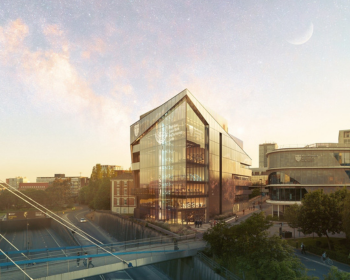
The building, located in the heart of Newcastle and overlooking the city’s central motorway, is being transformed with a clear ambition to place the North East firmly within the UK’s growing space economy.
The North East Space Technology and Technology Center (NESST), being developed by Northumbria University, is a £50m investment aimed at bringing together research, industry and education in one of the most strategically important areas of the coming decades.
Supported by the UK Space Agency, global aerospace company Lockheed Martin and Northumbria University, the center aims to be both a research powerhouse and a training ground for the next generation of space engineers and scientists.
NESST will open in 2026 and is expected to become the region’s center of space innovation and a catalyst for the rapidly developing Northeast Space Cluster.
A big investment in the future
The creation of NESST is the result of significant investment from government, industry and academia.
The UK Space Agency is funding the project with £10 million through the Space Cluster Infrastructure Fund (SCIF), a national initiative aimed at strengthening the UK’s space research and development infrastructure.
Lockheed Martin, one of the world’s largest aerospace and defense companies, has committed £15m to support a 10-year research collaboration, technology development and skills programme.
Northumbria University provided match funding of £25m for the two investments, bringing the total cost of the project to £50m.
The scale of this support reflects a wider national strategy to increase the UK’s share of the global space economy market, which is expected to grow dramatically in the coming decades.
It is also a significant regional investment for the North East. NESST is predicted to support the creation of over 350 jobs and generate over £260 million for the local economy over the next 30 years.
New national space assets
NESST is not just a university building, but a national research and technology facility.
The center, located on Northumbria University’s Newcastle city campus, will transform the existing Wyn Jones building into a modern hub specifically designed for space collaboration.
Once completed, this facility will house:
Advanced research facilities Satellite test and development environments Specialist education and training facilities Collaborative workspaces for industry partners Office and conference spaces designed to connect researchers and companies
The aim is to create an environment where academic expertise and commercial innovation can develop in parallel.
The center aims to shorten the path from scientific discovery to practical application by bringing researchers, students, and industry engineers together in the same building.
Lockheed Martin becomes anchor tenant
A key feature of NESST is its direct integration with industry.
Lockheed Martin will be the first anchor tenant within the center, creating a permanent presence that directly connects regional research to the global aerospace market.
The company’s £15 million investment will be split between the facility’s capital equipment and joint research and development projects.
The partnership builds on Lockheed Martin’s existing relationship with Northumbria University, which began in 2022.
Previous collaborations between the two companies have included research into machine learning algorithms designed to detect nanojets (tiny solar plasma jets associated with space weather) and research exploring space-based solar power technologies.
By incorporating international aerospace companies into the facility, NESST organizers hope to create new opportunities for UK companies to connect with the global space supply chain.
Advances in key areas of space research
NESST is expected to support research across several areas in which the UK is developing world-class expertise.
These include optical satellite communications, an emerging technology that uses laser links to transmit large amounts of data between satellites and ground stations.
The center will also focus on space weather research, a growing field that studies solar activity and its impact on satellites, communications networks and power infrastructure on Earth.
Another important area of research is space energy systems, including research into space solar power, an idea that could provide renewable energy from orbit.
The center aims to put the UK at the forefront of emerging space technologies by bringing together researchers working across these fields.
Building Britain’s future space workforce
Along with research, one of NESST’s core missions is education and workforce development.
The UK’s space sector has grown rapidly over the past 20 years, with hundreds of companies involved in satellite manufacturing, earth observation, communications and navigation technology.
However, the industry faces the continuing challenge of a shortage of highly skilled engineers and scientists.
NESST will include specialized education laboratories and training programs designed to prepare students for careers in the space field.
Students have the opportunity to work directly with industry partners on research projects and technology development, gaining experience that is difficult to replicate in a traditional academic environment.
By integrating training with active research and commercial activity, the center aims to help build the talent pipeline that the sector increasingly relies on.
Strengthening the Northeast Space Cluster
The UK’s best-known space hubs are in places such as Harwell in Oxfordshire and the small satellite manufacturing cluster in Glasgow, but the North East is steadily developing its own capabilities.
Universities in the region have built strong research programs in areas such as data science, advanced materials, solar physics, and energy systems, all of which have direct applications to space technology.
Meanwhile, the region’s industrial base includes companies with expertise in precision engineering, electronics and manufacturing, skills that feed directly into the satellite supply chain.
NESST is expected to serve as the central anchor of this emerging ecosystem, attracting businesses, start-ups and international partners to the region.
Importantly, the center is also open to companies of all sizes, providing collaboration space for both established companies and small technology start-ups active in the space sector.
symbol of regional ambition
For the North East of England, NESST is more than just a research facility.
The region has spent decades undergoing economic transformation with the decline of traditional heavy industry. Leaders in academia, government, and business are now focused on building new knowledge-driven sectors that can generate long-term growth.
Space technology, which requires advanced engineering, software development, and high-value manufacturing, fits right into that vision.
By establishing a major national facility in Newcastle, NESST is demonstrating that the North East intends to play a key role in the next stage of the UK’s tech economy.
Toward launch in 2026
Construction and redevelopment work is currently underway and the center is expected to open later this year.
If realized, NESST would be one of the UK’s most significant investments in regional space infrastructure in recent years.
Ultimately fulfilling our ambition to transform the North East into a major space cluster will depend on continued investment, collaboration and our ability to attract talent and companies from across the sector.
But the foundations are now being laid.
And in a city once defined by shipyards and heavy industry, the next generation of engineering may soon focus on space rather than the ocean.
Source link
