


The SMARTLINE-PV project aims to develop scalable and environmentally friendly tin-based perovskite solar cells, address the challenge of lead toxicity and improve the crystallization process.
Solar energy conversion through photovoltaics is critical in Europe’s transition to a clean, resilient and climate-neutral energy system. Although silicon solar modules dominate today’s photovoltaic market, their stiffness, weight, and limited design flexibility limit their use in many emerging applications. In contrast, next-generation thin-film photovoltaic technologies, particularly perovskite solar cells, enable the production of solar energy even in areas where traditional photovoltaic power generation is not suitable.
Among these emerging technologies, perovskite solar cells have attracted significant attention over the past decade. The rapid increase in power conversion efficiency, now exceeding 27%, combined with low temperature processing and compatibility with flexible substrates, positions it as a disruptive alternative to traditional solar power generation. However, these high-performance perovskite solar cells contain lead, which raises environmental and social concerns and can make large-scale deployment difficult.
The EU-funded Horizon Europe project SMARTLINE-PV is addressing this challenge by developing scalable tin halide perovskite solar cells focusing on innovative crystallization techniques. By combining materials innovation, plasma-assisted processing, eco-design, and application-driven demonstrators, SMARTLINE-PV aims to open up new application areas, particularly in the rapidly growing fields of Internet of Things (IoT) devices and building-integrated photovoltaics (BIPV).
A powerful European consortium driving innovation
SMARTLINE-PV brings together a multidisciplinary consortium of 13 partners from across Europe, combining academic and applied research expertise with industrial know-how. Universities and research institutes (Graz University of Technology, HZB, Joanum Institute, CNR, Fraunhofer ISE, CEA, and bifa Umwertin Institute) are leading the development of advanced tin perovskite materials, crystallization chemistry, device architectures, module integration, sustainability assessment, and circularity, while industrial partners (INO GmbH, temicon, Homerun Energy, COMTES FHT, Terran, FILBAU) Scalable processing, roll-to-roll compatibility, market-oriented design. This tightly integrated collaboration allows SMARTLINE-PV to bridge the gap between basic materials research and industrially relevant photovoltaic solutions, enabling the transition from laboratory innovation to deployable clean energy technology.

From lead to tin: sustainable materials transition
Replacing lead with tin in perovskite solar cells is a promising route to environmentally friendly solar power generation. Tin halide perovskites share many advantageous optoelectronic properties similar to lead-based perovskites, such as strong light absorption and excellent charge transport. Encouragingly, tin-based perovskite solar cells have already demonstrated efficiencies of over 17%.
Despite this progress, several important challenges remain. Tin perovskites tend to crystallize quickly, have high defect densities, and become chemically unstable, especially due to the oxidation of Sn2+ to Sn4+. These factors negatively impact device efficiency, reproducibility, long-term stability, and large-area manufacturing.
SMARTLINE-PV addresses these issues through novel precursor chemistry and crystallization control strategies. An innovative crystallization mediator is designed to slow down the crystal formation process, allowing tin perovskite films to grow with fewer defects and improved structural uniformity. In parallel, this project studies interactions between non-oxidizing solvents, hydrogen bond interactions, and halides to stabilize the oxidation state of tin and further improve membrane quality. These material innovations lay the foundation for high-performance and stable tin halide perovskite solar cells that are suitable for laboratory demonstration as well as industrial-related manufacturing.
Plasma-assisted crystallization for scalable manufacturing
Traditional perovskite production often relies on antisolvent dripping, but this process is difficult to control and solvent-intensive, making it poorly suited for large-area or roll-to-roll production. In contrast, the plasma-assisted approach studied at SMARTLINE-PV enables rapid solvent-free crystallization at low temperatures and provides good control over nucleation and crystal growth. By combining an optimized precursor formulation and carefully tuned plasma conditions, uniform, high-quality perovskite films can be produced without the use of anti-solvents. The process is also highly compatible with roll-to-roll (R2R) manufacturing, allowing continuous deposition onto large areas of flexible substrates. This compatibility represents an important step towards industrial scalability, reduced energy consumption and lower production costs.
Device engineering for efficiency and stability
In addition to optimizing perovskite absorbers, SMARTLINE-PV focuses on customizing device architectures specifically for tin perovskites. Tailored interlayers are developed to enhance charge extraction, suppress recombination losses, and protect sensitive interfaces within solar cell stacks. New device architectures are being explored to improve mechanical flexibility and long-term operational stability under real conditions.
Through this integrated approach, SMARTLINE-PV aims to achieve efficiencies of more than 20% in tin-based perovskite solar cells. This is an ambitious but realistic goal that highlights the potential of this solar cell technology as a viable alternative to established thin-film technologies.
MorphoColor Color module with concept and building integration
In the built environment, solar energy systems are expected to combine performance with design and functionality. SMARTLINE-PV addresses this issue by enabling color variations in tin perovskite solar modules through its MorphoColor concept, which takes inspiration from the structural colors found in butterfly wings. MorphoColor’s concept relies on a photonic structure that combines a geometrically patterned substrate and an interference layer to create bright, customizable colors without relying on pigments. This approach enables color-selectable perovskite solar modules, making them ideal for architectural integration.
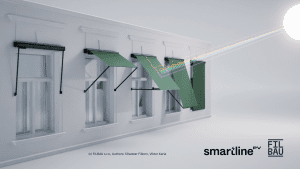
For BIPV applications, this design freedom is transformative. Facade, shading and roof elements can be generated at the same time and contribute to the visual identity of the building, an essential element for its introduction into urban and historic environments.
Ecodesign, circularity and low carbon emissions
Sustainability is a guiding principle throughout SMARTLINE-PV. The project integrates ecodesign and circularity concepts throughout the solar cell lifecycle, from raw materials and manufacturing to usage, recycling and end-of-life considerations. Low-temperature, high-speed processing reduces energy demands during manufacturing, contributing to lower carbon emissions compared to traditional solar power technologies. Eliminating lead- and solvent-intensive processes further increases environmental compatibility and social acceptability.
Demonstrators supporting technology transfer
To bridge the gap between laboratory research and real-world deployment, SMARTLINE-PV focuses on application-oriented demonstrators. Flexible tin perovskite solar modules can be integrated into IoT devices to enable autonomous, maintenance-free power supplies for sensors and smart systems.
In parallel, the BIPV demonstrator will showcase the integration of flexible, color-selectable modules into architectural elements such as roof tiles and awnings. These demonstrators are tested under real-world conditions and provide valuable data on performance, durability, and user acceptance.
Shaping the future of thin film solar power
SMARTLINE-PV represents a significant step toward a new generation of thin-film solar power by addressing efficiency, scalability, sustainability, and aesthetics through a holistic approach. This project demonstrates that tin-based perovskite solar cells can move beyond a niche research topic and become strong candidates for real-world applications.
SMARTLINE-PV shows how advanced materials research, innovative processing, and thoughtful design can be combined to develop practical and impactful solar power solutions. By addressing both technical performance and integration aspects, the project will support the widespread adoption of solar power in everyday applications and contribute to a more sustainable built environment.
Disclaimer

This project has received funding from the European Union’s Horizon Europe research and innovation program under grant agreement no. 101122327.
This article will also be published in the quarterly magazine issue 25.
Source link
