

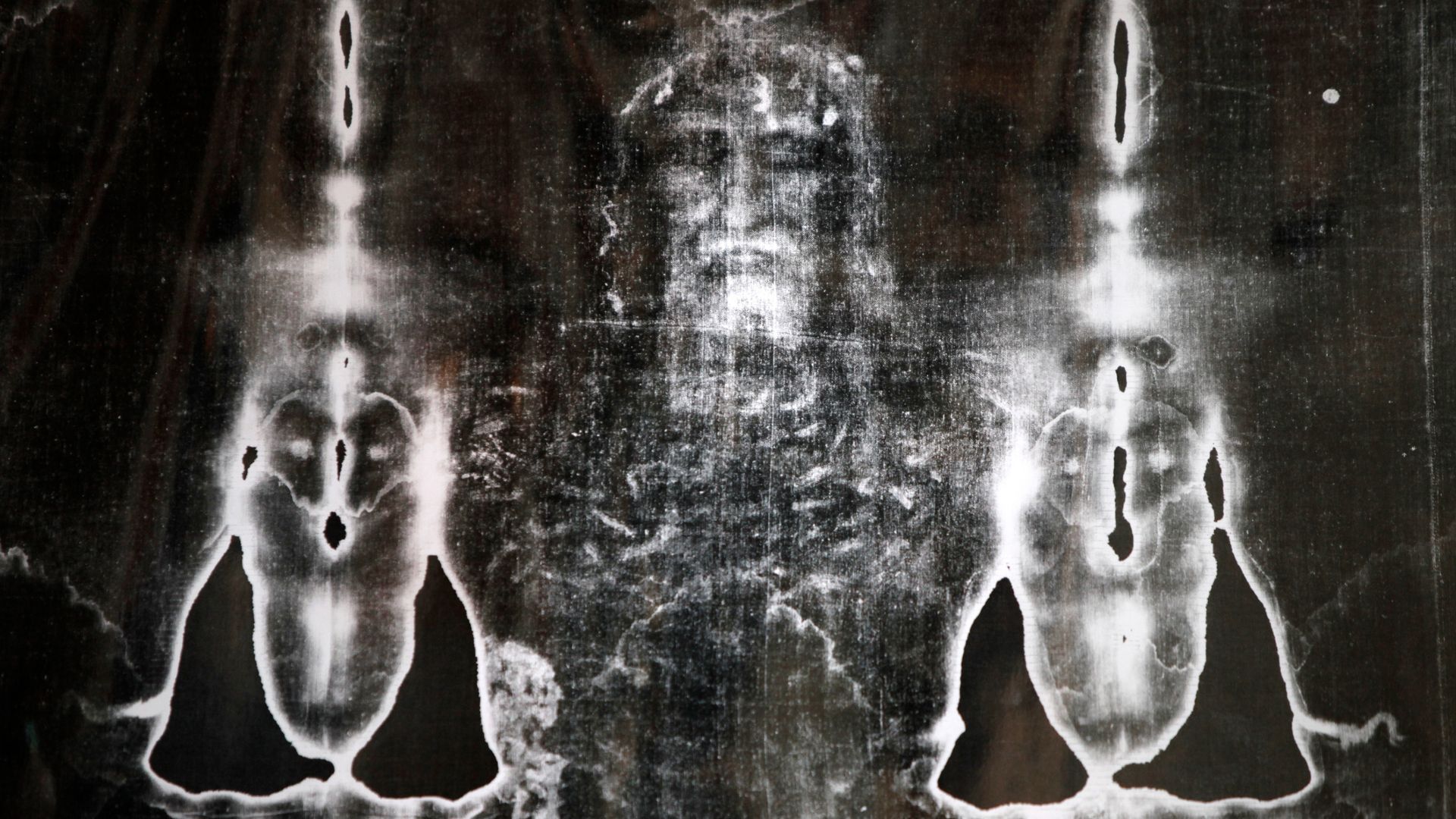
The Shroud of Turin, which some claim is Jesus’ burial shroud, contains the DNA of multiple people, along with a vast number of other species, including carrots, melons, and red coral.
Some DNA traces suggest an Indian influence, which could mean the cloth originated there, researchers claim in a new study.
you may like
likely to be fake
The famous Shroud has traveled throughout Europe for centuries, but the first written mention of it was in 1354 in the northern French village of Lilley. Even at the time there was debate as to whether it was an authentic relic of the Crucifixion. The rectangular cloth measures 14.4 x 3.6 feet (4.4 x 1.1 meters) and contains a faint image of a man and numerous stains, some of which are claimed to be blood.
The most reliable evidence for the Shroud’s age comes from a carbon dating analysis conducted in 1989, which determined that the Shroud was made between 1260 and 1390, making it definitely medieval. And last year, research revealed that the human image on the Shroud probably arose from a piece of cloth placed over a low-relief carving.
Some Christian scholars still believe that the Shroud is authentic and is 2,000 years old. However, there is no evidence that the multishaft looms needed to produce the type of cloth used for the shroud existed in Europe, India, or the Levant 2,000 years ago.
“These structures require a four-shafted loom invented in the Middle Ages. [in Europe]” Andrea Nicotti, a historian at the University of Turin who was not involved in the study, told Live Science.
Analyze DNA
In 2015, Gianni Barcaccia, a professor of genetics and genomics at the University of Padova in Italy, and colleagues suggested that the Shroud of Turin may have been made in India, based on genetic analysis of samples taken from the Shroud in 1978.
With more powerful genomics techniques now available, Barcassia and his colleagues performed new DNA and metagenomic analyzes on the 1978 samples to determine which species the DNA signatures came from. The study was posted to the preprint server bioRxiv on March 22, but has not yet been peer-reviewed.
What to read next
Researchers found human DNA that appeared to belong to multiple people, one of whom was the same person who collected the sample in 1978. Bacterial species accounted for 10% to 31% of the DNA. Barcaccia’s team noted the presence of DNA from Mediterranean red coral (Corallium rubrum), which suggests that it was of “Mediterranean origin or passed through the Mediterranean region.”
But even if the coral came from a certain place, Nicolotti pointed out, that doesn’t mean the shroud was there either. “When people think of red coral, they probably think of the seas in Palestine,” he said, adding that there was a more likely scenario for how the coral could have attached itself to the shroud. “It is reminiscent of coral crosses, rosaries, or reliquaries that are known to have been placed in contact with cloth.”
Barcaccia’s team found that cats and dogs made up about 44 percent of the animals’ DNA, but there were also traces from chickens, cows, goats, sheep, pigs, horses, deer, and rabbits. Additionally, there were slight traces of skin mites, ticks, and various fish.
We believe that this diversity of identified plant and animal species highlights the significant environmental pollution of the Shroud that has probably occurred in recent centuries, especially after the voyages of Marco Polo and Christopher Columbus.
Gianni Barcaccia, Professor of Genetics and Genomics, University of Padova, Italy
A wide variety of plants were also represented. Carrot DNA provided approximately 31% of the plant DNA. But there was also DNA from wheat, corn, rye, peppers, tomatoes, potatoes, melons or cucumbers, and peanuts, as well as traces of grass, bananas, almonds, walnuts, and oranges.
Some of these plants may reflect typical European or Mediterranean agricultural practices, the study authors wrote, but some of the plants, such as bananas, potatoes, peppers and tomatoes, were introduced to Europe from the Americas primarily from the 16th century onwards. And the carrot’s DNA is genetically similar to varieties originally bred from orange carrots grown in Western Europe between the 15th and 16th centuries, suggesting a relatively recent contamination, Balcassia told Live Science in an email.
“We believe that this diversity of plant and animal species identified highlights the significant environmental pollution of the Shroud that has probably occurred in recent centuries, especially after the voyages of Marco Polo and Christopher Columbus,” he said.
Notably, several species historically associated with the Mediterranean region were missing.
“While the wide range of plant and animal material does not appear to be indicative of any particular environment, we noted the absence of olives, dates, pomegranates, camels, and of course myrrh and aloe,” Hugh Farry, an independent researcher who runs a blog called The Medieval Shroud and was not involved in the study, told Live Science via email.
I tried to imagine how many people must have touched the Shroud, touched all the instruments used by American scholars in 1978, and even touched or made the brushes used to regularly dust the Shroud.
Andrea Nicotti, historian at the University of Turin
Human DNA is transferred to objects with or without contact, as is the DNA of other animals and plants, so many traces may have remained on the Shroud because it was on public display in medieval cities. “When I see vegetables, I remember the market 100 meters away.” [330 feet] “It’s like the piazza where public exhibitions were held for centuries in Turin, or the dust of Chambery, where the Shroud was once displayed along a tree-lined avenue,” Nicolotti said.
Researchers dated several threads on the Shroud, saying one dated between 1451 and 1622 and the other between 1642 and 1800. The researchers noted that these dates coincide with the restoration of the Shroud in 1534, shortly after fire damage, and with further conservation efforts in 1694.
Importantly, Nicolotti said, any new findings are consistent with the definitive carbon dating analysis conducted in 1989.
More controversial, however, is Barcaccia et al.’s interpretation that nearly 40% of the human DNA found on the Shroud is of Indian descent, suggesting that the threads may have been produced in India.
Nicolotti does not think it is unlikely that the Shroud came from India, and remains convinced that it is a forgery of medieval European origin, as carbon dating in 1989 suggests. He was also not surprised to find a variety of human DNA on the cloth.
“I tried to imagine how many people would have touched the Shroud, and all the instruments used by American scholars in 1978, and even how many people would have touched or made the brushes that were used to regularly dust the Shroud,” he said.
Barcaccia, G., Migliore, N.R., Gabelli, G., Agostini, V., Palumbo, F., Moroni, E., Nicolini, V., Gao, L., Mattutino, G., Porter, A., Palmowski, P., Procopio, N., Perego, U.A., Iorizzo, M., Charbel, T.F., Bollone, P.B., Torroni, A., Squartini, A., and Achilli, A. (2026). DNA traces of the Shroud of Turin: metagenomics of the 1978 official sample collection. bioRxiv (Cold Spring Harbor Laboratory). https://doi.org/10.64898/2026.03.19.712852
Source link
