
Close Menu
  • Home
  • Identity
  • Inventions
  • Future
  • Science
  • Startups
  • Spanish
What's Hot

Anthropic CEO Dario Amodei calls OpenAI’s message about military agreement a ‘blatant lie,’ report says

Google settles with Epic Games, lowers Play Store fees to 20%

MacBook Neo, iPhone 17e, and everything else Apple announced this week

Facebook X (Twitter) Instagram
  • Home
  • About Us
  • Advertise with Us
  • Contact Us
  • DMCA
  • Privacy Policy
  • Terms & Conditions
  • User-Submitted Posts
Facebook X (Twitter) Instagram
Fyself News
  • Home
  • Identity
  • Inventions
  • Future
  • Science
  • Startups
  • Spanish
Fyself News
Home » Slippery clay hidden on the ocean floor may have worsened Japan’s devastating 2011 tsunami
Science

Slippery clay hidden on the ocean floor may have worsened Japan’s devastating 2011 tsunami

userBy userFebruary 17, 2026No Comments3 Mins Read
Share Facebook Twitter Pinterest Telegram LinkedIn Tumblr Email Copy Link
Follow Us
Google News Flipboard
Share
Facebook Twitter LinkedIn Pinterest Email Copy Link

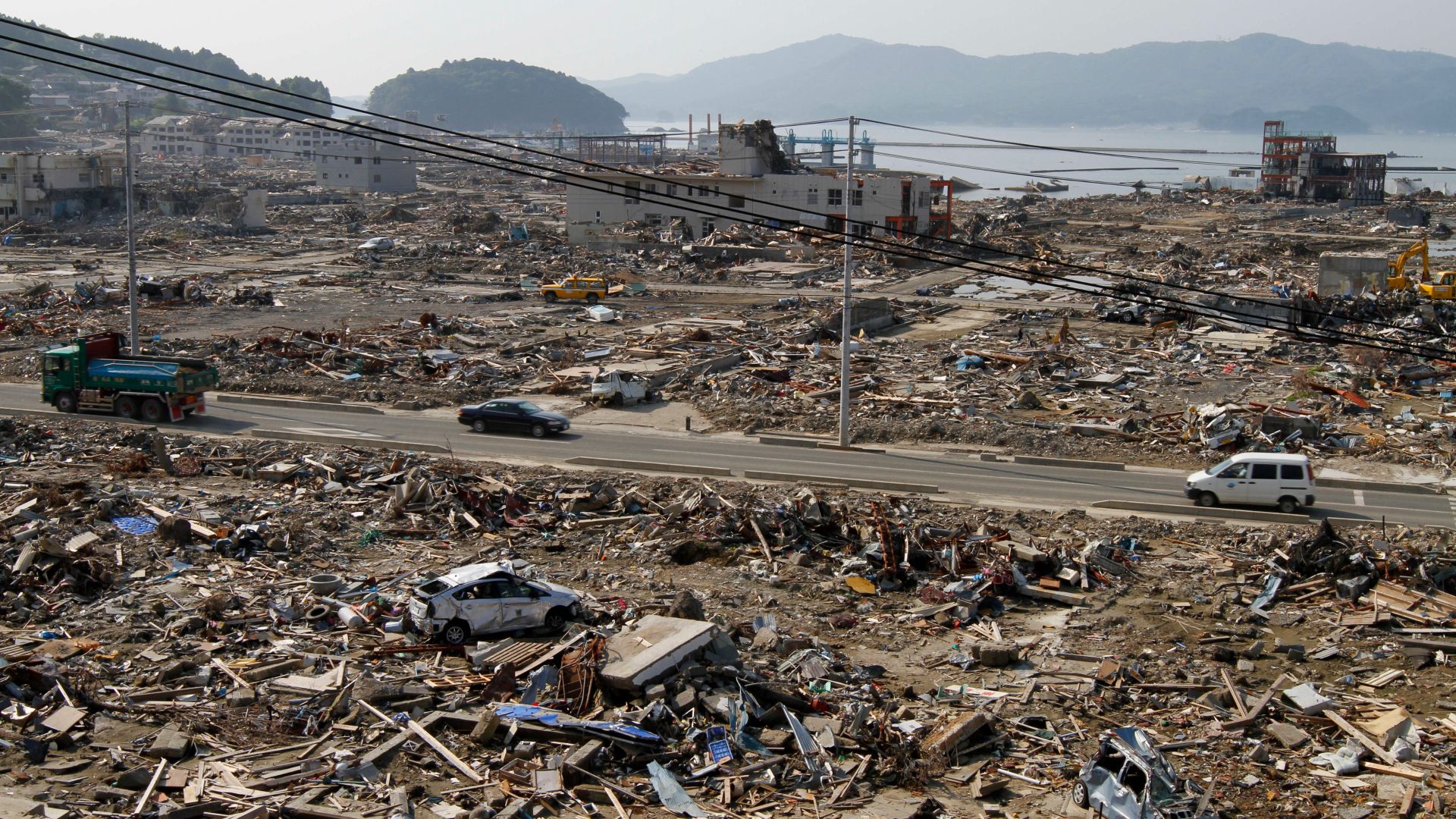
The 2011 Tohoku earthquake that triggered a devastating tsunami in eastern Japan was made worse by a thick layer of slippery clay, a new study has found.

The clay layer on the ocean floor was up to 30 meters thick, creating a vulnerable spot where the motion of a magnitude 9.1 earthquake could travel to the ocean floor. The movement pushed the ocean floor up by 164 to 230 feet (50 to 70 meters) over about 310 miles (500 kilometers). And the movement of the ocean floor, penetrating the ocean above, triggered a tsunami that submerged 217 square miles (561 square kilometers) of Japan.

“Clays are weak because they have low friction,” said Ron Hackney, a geophysicist at the Australian National University and director of the Australia-New Zealand International Scientific Drilling Consortium. “It’s very slippery.”

you may like

Hackney told Live Science that the fault’s lateral rupture was about half what researchers expected, concentrating the upward movement in a smaller area and likely intensifying the resulting tsunami. He said the findings explain why the tsunami was larger and more concentrated than expected, and such detailed studies could help issue better warnings for future earthquakes.

“We can be a little more prepared in terms of letting people know what to expect and how to respond when an earthquake occurs,” he said.

The 2011 earthquake occurred along a subduction zone where the Pacific Plate slides beneath Japan. In 2024, Hackney and other researchers aboard the research vessel Chikyu drilled directly into the fault that caused the earthquake. After drilling 23,000 feet (7,000 m) below sea level and 3,300 feet (1,000 m) below the ocean floor, they pulled up cores of sediment within the fault and from the Pacific Plate.

They discovered that the Pacific Plate is covered by a thick layer of clay that has slowly accumulated over about 130 million years. As the Pacific Plate pushes beneath Japan, this layer is compressed, and the continental rocks above it are also compressed. The result is a mechanical weakness, much like a hole in a piece of notebook paper, which makes the rock more susceptible to breakage.

Get the world’s most fascinating discoveries delivered straight to your inbox.

The researchers published their results in December 2025 in the journal Science.

Similar clay layers may or may not exist in other subduction zones, Hackney said. There is some evidence that they may exist near the Indonesian island of Sumatra, site of the magnitude 9.1 earthquake that caused a devastating tsunami on December 26, 2004. But less is known about the material flowing into fault zones in places like Kamchatka, where large earthquakes also occur, he said.

Hackney and his colleagues are working to discover the link between topography, rock density, and the eventual movement of earthquakes. Earth scientists are becoming increasingly better at predicting the magnitude of earthquakes and where they will be felt when they occur, enabling early warning systems that can warn people seconds to minutes before an earthquake is coming. Since tsunami warnings take longer to issue, more lives could be saved if we could more accurately predict where a tsunami would arrive by fully understanding the movement of the ocean floor.

Kirkpatrick, J.D., Savage, H.M., Regala, C., Sreedharan, S., Ross, C., Okuda, H., Nicholson, U., Ujiie, K., Hackney, R., Konin, M., Pei, P., Satori, S., Chan, J., Fulton, P., Ikari, M., Kodaira, S., Maeda, L., Okutsu, N., Toczko, S., and Eguchi, N. (2026). Extreme plate boundary localization promotes shallow seismic slip in the Japan Trench. Science, 391(6784), 489–493. https://doi.org/10.1126/science.ady0234


Source link

#Biotechnology #ClimateScience #Health #Science #ScientificAdvances #ScientificResearch
Follow on Google News Follow on Flipboard
Share. Facebook Twitter Pinterest LinkedIn Tumblr Email Copy Link
Previous ArticleEuropean Parliament blocks AI on MPs’ devices due to security risks
Next Article Keenadu firmware backdoor infects Android tablets via signed OTA update
user
  • Website

Related Posts

When was the last time there was no ice in Antarctica?

March 4, 2026

Diagnostic dilemma: A doctor discovers the genetic mutation behind a family member’s mysterious tooth loss condition

March 4, 2026

Prehistoric aquatic freak with sideways teeth and twisted jaw was already a ‘living fossil’ 275 million years ago

March 4, 2026
Add A Comment
Leave A Reply Cancel Reply

Latest Posts

Anthropic CEO Dario Amodei calls OpenAI’s message about military agreement a ‘blatant lie,’ report says

Google settles with Epic Games, lowers Play Store fees to 20%

MacBook Neo, iPhone 17e, and everything else Apple announced this week

149 hacktivist DDoS attacks hit 110 organizations in 16 countries after Middle East conflict

Trending Posts

Subscribe to News

Subscribe to our newsletter and never miss our latest news

Please enable JavaScript in your browser to complete this form.
Loading

Welcome to Fyself News, your go-to platform for the latest in tech, startups, inventions, sustainability, and fintech! We are a passionate team of enthusiasts committed to bringing you timely, insightful, and accurate information on the most pressing developments across these industries. Whether you’re an entrepreneur, investor, or just someone curious about the future of technology and innovation, Fyself News has something for you.

Castilla-La Mancha Ignites Innovation: fiveclmsummit Redefines Tech Future

Local Power, Health Innovation: Alcolea de Calatrava Boosts FiveCLM PoC with Community Engagement

The Future of Digital Twins in Healthcare: From Virtual Replicas to Personalized Medical Models

Human Digital Twins: The Next Tech Frontier Set to Transform Healthcare and Beyond

Facebook X (Twitter) Instagram Pinterest YouTube
  • Home
  • About Us
  • Advertise with Us
  • Contact Us
  • DMCA
  • Privacy Policy
  • Terms & Conditions
  • User-Submitted Posts
© 2026 news.fyself. Designed by by fyself.

Type above and press Enter to search. Press Esc to cancel.