

With our increasing reliance on satellites, GPS, and global communications, understanding the sun’s impact on Earth has never been more important.
That is the purpose of the Solar Wind Magnetospheric Ionospheric Link Explorer (Smile) mission.
Just over a year after arriving in the Netherlands in two sections, the spacecraft was fully assembled, tested, and cleared for launch.
It will officially depart for Europe’s spaceport in Kourou, where it will be prepared for launch on a Vega-C rocket between April 8 and May 7.
The Smile mission, a joint mission between the European Space Agency and the Chinese Academy of Sciences, will observe how Earth responds to the Sun’s erratic behavior and provide new insights into space weather and its impact on Earth.
Why advances in space weather science are essential
Essentially, space weather refers to changes in the conditions of the universe that are primarily caused by the Sun. Solar flares, coronal mass ejections, and fluctuations in the solar wind can all disrupt Earth’s magnetic environment.
When these solar storms reach Earth, they can cause geomagnetic storms. These events are more than just scientific curiosities. Severe weather in space can disrupt satellite communications, disrupt GPS signals, damage power grids, and pose dangers to astronauts and high-altitude flights.
Even everyday technologies like mobile banking and navigation apps rely on satellite systems that are sensitive to solar activity.
Earth’s magnetic field usually protects us from the worst effects, but that shield is dynamic. Compressed, stretched, and recombined by the pressure of the solar wind. Until now, scientists had only a partial understanding of these processes.
The Smile mission aims to change that. By imaging the boundary where Earth’s magnetic field meets the solar wind, Smile will allow researchers to observe these interactions on a global scale for the first time.
A better understanding of space weather means better predictions, more resilient satellites, and better protection for infrastructure on the ground.
A mission years in the making
The Smile mission is part of ESA’s Cosmic Vision program and seeks to answer some of the biggest questions about how the solar system works. Rather than studying distant planets or deep space phenomena, Smile brings its gaze closer to home.
The spacecraft carries four scientific instruments designed to observe how Earth reacts to the constant stream of charged particles flowing from the Sun, known as the solar wind.
ESA provided the payload module, three of the four instruments, and launch services. We also lead soft X-ray imagers and contribute to ultraviolet imagers and mission operations.
The Chinese Academy of Sciences will provide the spacecraft platform and three instruments and oversee Smile’s operations once it reaches orbit.
By combining X-ray and ultraviolet imaging with measurements of particles and magnetic fields, the Smile mission will provide the first comprehensive view of how Earth’s magnetic shield interacts with incoming solar material.
Journey to the launch pad
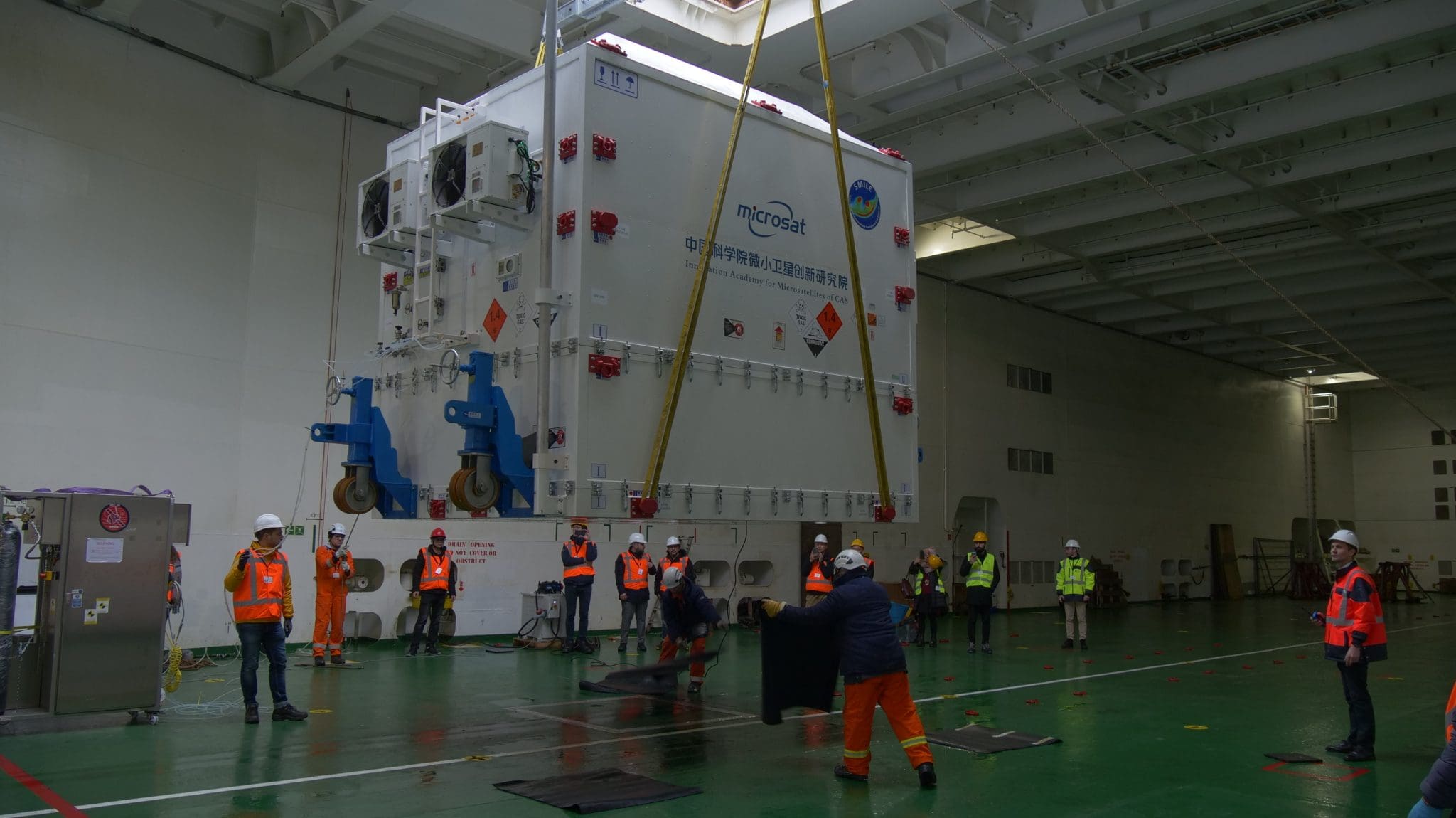
Smile began its latest journey on February 11, leaving ESA’s technical center in the Netherlands by truck in the early morning.
From there it headed to the port of Amsterdam where it was loaded onto the cargo ship Colibri operated by Maritime Nantes. The same ship famously transported the James Webb Space Telescope in 2021.
Later that night, the ship set sail for the port of Parisabo in French Guiana on a two-week transatlantic crossing. The ship carried 12 containers carrying the spacecraft and its support equipment, as well as four team members from Europe and China.
Transporting spacecraft across oceans is no easy task. With rough seas expected, the team carefully secured all hardware.
Spacecraft containers are continuously flushed with nitrogen to remove moisture and oxygen, keeping sensitive components clean and dry. Sensors track temperature, pressure and humidity during the voyage.
Two days into the journey, the ship made a brief port call in Saint-Nazaire, France, to retrieve the upper stage of the Vega-C rocket. For the first time, a spacecraft and the rocket stage that carries it into orbit will share the same deck.
A new chapter in international space science
Once the spacecraft arrives in Kourou, teams from Europe and China will begin final preparations. This process includes unpacking, additional testing, refueling, and integration of Smile and the Vega-C upper stage before deployment to the launch pad.
If all goes according to plan, the Smile mission will soon begin work in orbit, providing a new perspective on Earth’s relationship with the sun.
With launch just around the corner, Smile, as its name suggests, is poised to provide a clearer view of the invisible forces that shape our space environment.
Source link
