

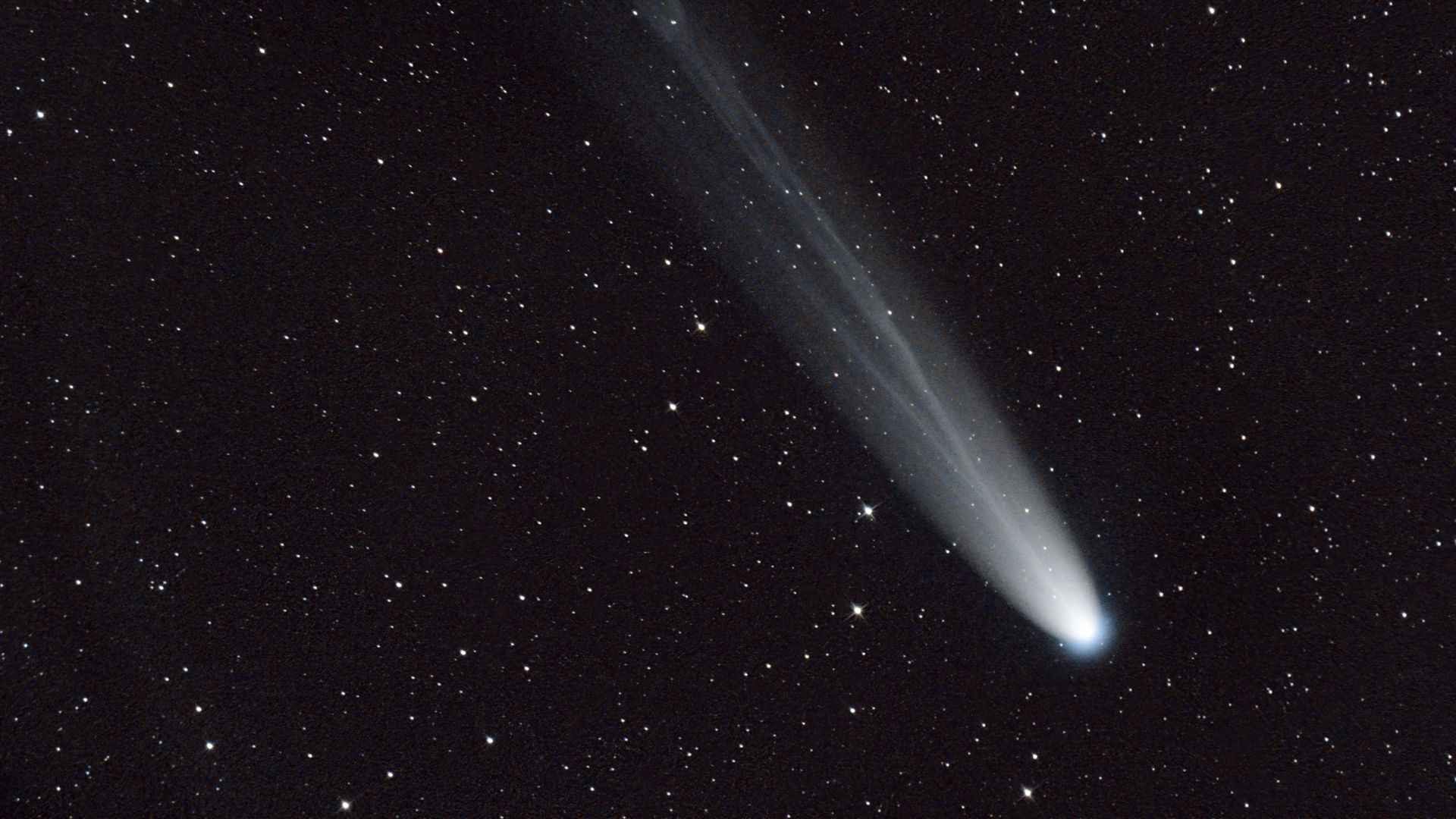
A rare ‘sungrazer’ comet is about to pass very close to our star and could become visible in sunlight. Or it could completely collapse before our eyes. Either way, there’s a chance we’ll see something special in the night sky, and a big tail could be visible later this week.
Comet C/2026 A1 (MAPS) was discovered by French astronomers at the AMACS1 observatory in Chile on January 13th. The comet’s core was originally thought to be about 1.5 miles (2.4 kilometers) wide, but astronomers later reduced that estimate to less than 0.25 miles (0.4 kilometers) based on observations made with the James Webb Space Telescope in February.
you may like
According to the British Astronomical Association (BAA), C/2026 A1 (MAPS) is expected to come within 98,000 miles (158,000 kilometers) of the Sun’s surface and pass through the Sun’s outer atmosphere, or the lower region of the corona, at 9:30 a.m. EDT (13:30 UTC) on Saturday (April 4). Much of Kreuz’s sungrazer will evaporate, but if it survives, it could put on a spectacular show, the European Space Agency said.
C/2026 A1 (MAPS) will be difficult to see before April 4 as it moves in the glare of the sun. If it survives a close encounter with the Sun, it may become visible briefly in the evening after sunset, even if it is fragmented. BAA says a large, bright tail could be seen in the western evening sky starting around April 9, unless it splits before approaching the sun.
If that happens, Comet C/2026 A1 (MAPS) will be the first of two comets visible in April, while the fainter but more predictable Comet C/2025 R3 (PanSTARRS) will be an easy target for binoculars near April 20th.
Source link
