

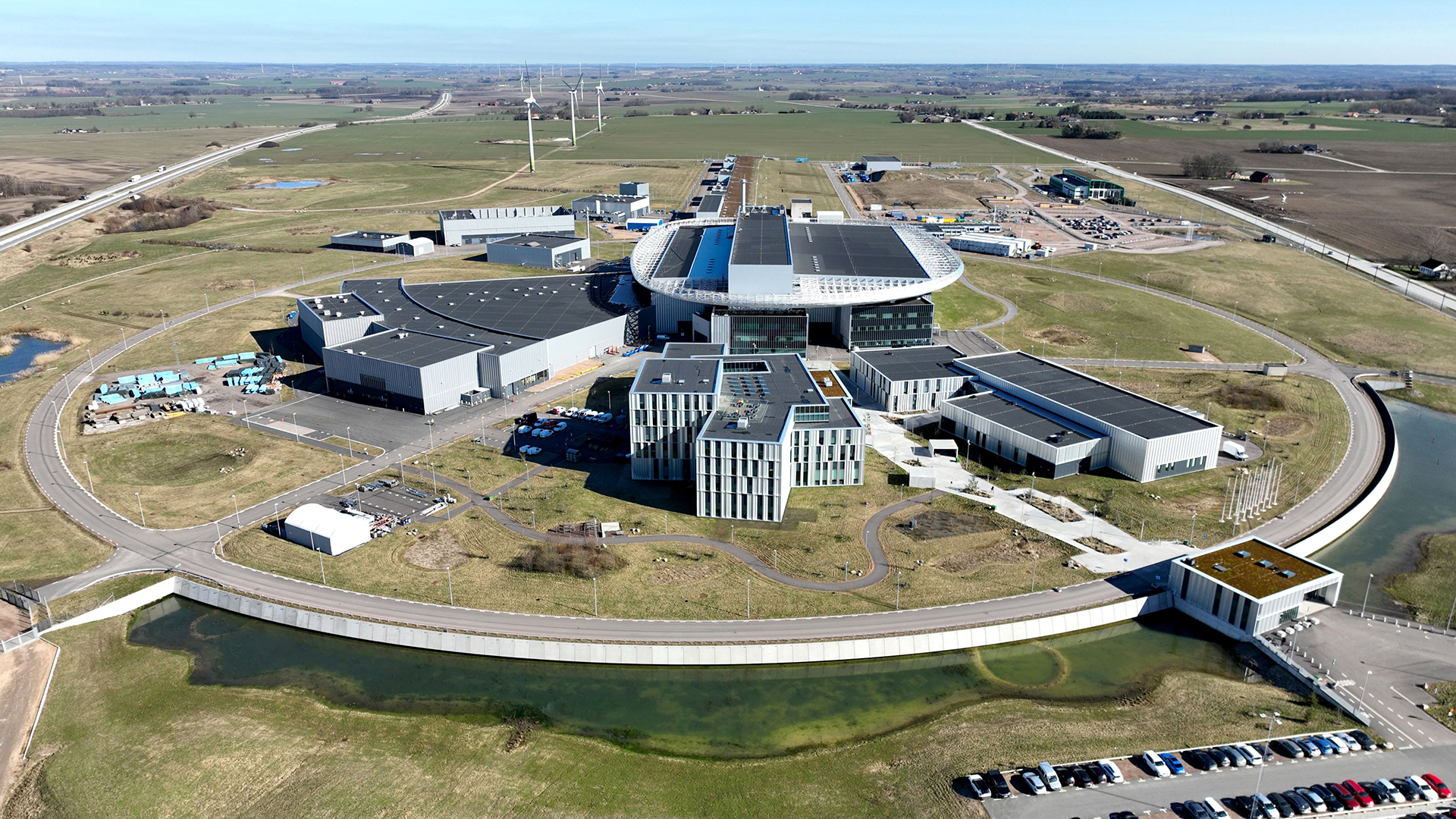
Helmut Schober, director of the European Spallation Source (ESS), shares an update on progress to date in the construction of Sweden’s next-generation neutron science facility.
The European Spallation Source is a next-generation neutron science facility under construction in Lund, Sweden, with its data management and scientific computing center in Copenhagen, Denmark. Once completed and fully operational, ESS will be the world’s leading accelerator-based neutron source for studying the structure and behavior of materials at the atomic level.
Under construction since 2014, ESS is one of the largest scientific and technological infrastructure projects currently under construction. The design and construction of the facility includes the most powerful linear proton accelerator ever built, a 5-ton helium-cooled tungsten target wheel, 15 state-of-the-art neutron instruments, a suite of laboratories, and a supercomputing data management and software development center.
To find out more about the progress made so far and the great scientific potential that will emerge from this facility, Innovation Platform spoke to ESS Director Helmut Schober.
Can you tell us more about what ESS offers and how it differs?
ESS is designed to produce the world’s most powerful beam of neutrons for research in materials science, chemistry, biology, energy, and other fields. Unlike nuclear reactors, ESS uses high-energy protons that collide with a tungsten target to produce neutrons. This is a process called “nuclear spallation.”
The exceptional brightness of the neutron beam and its long-pulse source design set it apart from other spallation sources and enable experiments with greater sensitivity, resolution, and speed. ESS has the potential to transform fields such as energy materials, pharmaceuticals, catalysis, and nanotechnology, facilitating breakthroughs not possible with existing neutron sources.
What stage of construction is the facility currently in?
In 2025, the accelerator, target station, integrated control system, and several initial neutron scattering instruments have made significant progress toward commissioning. The accelerator delivered the first full-energy, low-power test beam to the conditioned beam dump to demonstrate the fully integrated operation of this critical part of the facility. The current focus is on continuing system verification, validation, and commissioning to establish safety and operational readiness.
The accelerator will undergo a second beam-on-dump commissioning period this spring at a higher power than last year’s beam-on-dump.
Progress on the ESS goal, unique in the fields of neutron science and spallation, experienced a setback at the end of 2025 (see below for details of the incident). However, integration testing continues and the team has identified mitigating factors that will enable so-called “neutron factory testing” by the end of the year.
The first six instrument sets are being prepared to receive neutrons, and the next set of instruments is being installed, with plans to launch a user program in 2028, when scientists from around the world will come to ESS to perform experiments.
What were the main technical challenges faced and how were they overcome?
The main technical challenges include the precise installation and alignment of the 600-meter superconducting accelerator. Ensure high reliability and safety of cryogenic systems. Achieves complex neutron targeting (with rotating tungsten wheel and extensive shielding). Integration of digital control systems across different technologies and partner contributions.
These challenges were overcome through rigorous prototyping, international collaboration, adaptive project management, intensive testing before and during commissioning, and continuous knowledge sharing between partners.

Our most recent challenge occurred at the end of 2025. That’s when power reductions affected a critical component of the target station, the reducer, stalling progress toward producing the first neutrons. The reducer is one of the target station’s most innovative components, slowing down the neutrons as they leave the target wheel, making them the right energy for the instrument.
The ESS team and in-kind partners took immediate steps to assess the damage to the moderator, determine the impact on progress toward neutron production, and establish a new schedule for this important milestone. Alternative moderators, which were already in production at the time, are scheduled to be installed and tested in the last quarter of 2026.
What were your key achievements in 2025?
In 2025, ESS achieved several important achievements. Most importantly, you’ve reached Beam on Dump. For the first time, protons were accelerated to the required energy and sent all the way from the ion source down a 600-meter-long accelerator tunnel to a conditioning beam dump 542.5 meters down. This achievement shows that the ESS accelerator and associated control system function as an integrated system from source to dump.
Other achievements include the installation and expanded commissioning of the first set of neutron instruments. Receipt and installation of major hardware components from partner institutions. Further development of data management and preparation of user programs.

In parallel, ESS continued its transition to steady-state operations and further developed the organizational structures and operational processes necessary to ensure reliable and efficient facility operations as of 2028.
The progress achieved in 2025 reflects the collective efforts of hundreds of people across the ESS team, disciplines, and partner institutions working together toward one goal: producing neutrons for science.
What will 2026 be like?
Work is progressing well throughout the ESS facility. Despite the reducer setback, work continues on the target system to test that all components work together so that the system is ready for the installation of the new reducer and the next stage: receiving protons from the accelerator. The accelerator itself successfully achieved beam-on-dump last year and has moved on to the next commissioning stage, and is currently preparing for its second beam-on-dump commissioning period.
On the equipment side, three more equipment will be ready with Beam on Target in addition to the three equipment already planned. This will move ESS toward its long-term goal of having a complete set of 14 (and 15 in the future) instruments to receive neutrons when the facility begins operations.
How important was European contribution and cooperation to ESS?
European cooperation is fundamental to the success of ESS. More than 100 institutions from 13 European countries have contributed expertise, design, hardware and funding. This collaborative model has provided access to top talent in science, technology and engineering, accelerated development and ensured broad scientific relevance. The partnership model also supports decentralized responsibility for equipment construction, data management, and long-term governance.
This article will also be published in the quarterly magazine issue 25.
Source link
