


Scientists may have solved a long-standing mystery surrounding Uranus’ unusually strong radiation belts.
A new analysis of Voyager 2 data suggests that a temporary space weather event may have made the planet’s electron radiation belts more intense than usual as Voyager 2 passed by. The discovery could help explain why the radiation belt was much stronger than scientists expected.
you may like
In January 1986, Voyager 2 flew close to Uranus and measured the intensity of its radiation belts. Although the ion radiation belts were slightly weaker than expected, the electron radiation belts were much stronger than scientists expected and close to the maximum intensity that Uranus can sustain. Since then, scientists have been trying to figure out why this happened.
“Science has come a long way since the Voyager 2 flyby,” Robert Allen, an astrophysicist at the Southwest Research Institute (SwRI) and co-author of the new study, said in a statement. “We decided to take a comparative approach by looking at the Voyager 2 data and comparing it to Earth observations we have made in the decades since then.”
earth vs uranus
In the study, published in the journal Geophysical Research Letters in November 2025, Allen and his colleagues reviewed data collected by Voyager 2 during its flight around Uranus. They found some similarities between Voyager data and data collected from Earth orbit during a 2019 space weather event.
The team found that Uranus’s unusually strong radiation belts may be caused by “corotational interaction regions.” Corotational interaction regions occur when the faster solar wind overtakes the slower solar wind flow. The phenomenon may have accelerated the electrons, adding energy to the radiation belts, the researchers said.
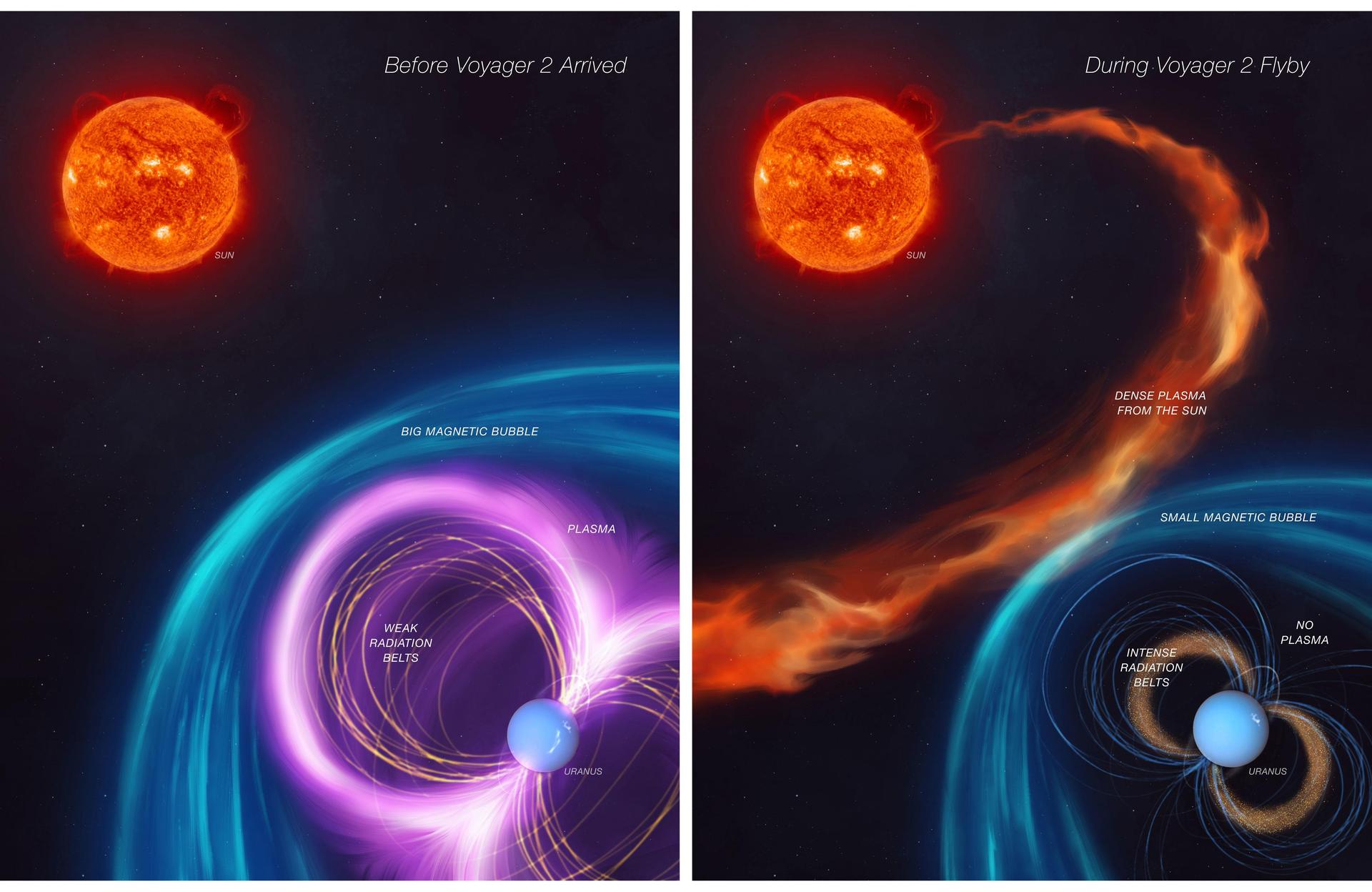
“In 2019, Earth experienced one of these events, causing a huge amount of electron acceleration in the radiation belts,” said study co-author Sarah Vines, an astrophysicist at SwRI. “If a similar mechanism interacted with the Uranus system, it would explain why Voyager 2 observed this unexpected additional energy.”
If so, it would raise many more questions about the physics of Uranus’ magnetosphere and its interaction with the solar wind, including the stability of the radiation belts during extreme seasons caused by the tilt of Uranus’ axis of rotation. Spacecraft orbiting Uranus and collecting data from different parts of the magnetosphere could help answer these questions, the researchers wrote in their study.
“This is just another reason to send a mission to Uranus,” Allen said in a statement. “This discovery has several important implications for similar star systems like Neptune.”
Allen, RC, Vines, SK, & Ho, GC (2025). Unraveling the mystery of Uranus’ electron radiation belts: Using knowledge of Earth’s radiation belts to reexamine Voyager 2 observations. Geophysical Research Letters, 52(22). https://doi.org/10.1029/2025gl119311
Source link
