
Close Menu
  • Home
  • Identity
  • Inventions
  • Future
  • Science
  • Startups
  • Spanish
What's Hot

AWS CodeBuild misconfiguration exposed GitHub repository to potential supply chain attacks

Higgsfield, the AI ​​video startup founded by former Snap executives, is valued at $1.3 billion

Iran’s internet shutdown becomes longest in history as protests continue

Facebook X (Twitter) Instagram
  • Home
  • About Us
  • Advertise with Us
  • Contact Us
  • DMCA
  • Privacy Policy
  • Terms & Conditions
  • User-Submitted Posts
Facebook X (Twitter) Instagram
Fyself News
  • Home
  • Identity
  • Inventions
  • Future
  • Science
  • Startups
  • Spanish
Fyself News
Home » The most complete Homo habilis skeleton ever discovered dates back more than 2 million years and retains ‘Lucy’-like features
Science

The most complete Homo habilis skeleton ever discovered dates back more than 2 million years and retains ‘Lucy’-like features

userBy userJanuary 14, 2026No Comments4 Mins Read
Share Facebook Twitter Pinterest Telegram LinkedIn Tumblr Email Copy Link
Follow Us
Google News Flipboard
Share
Facebook Twitter LinkedIn Pinterest Email Copy Link

Paleoanthropologists have unveiled the world’s most complete skeleton of Homo habilis, an ancestor of humans who lived in northern Kenya more than 2 million years ago. Collection of fossil bones revealed unusually strong arms that distinguish H. habilis from later species.

The bones were first discovered in 2012 by a team of researchers led by Meave Leakey of the Turkana Basin Research Institute, and subsequently presented at a research conference in 2015. Now, the full analysis of the remains is described in a paper published in the journal ‘The Anatomical Record’ on Tuesday (January 13).

The skeleton, designated KNM-ER 64061, was discovered in a geological formation that is between 2.02 and 2.06 million years old. A complete set of lower teeth clearly identified the skeleton as H. habilis. The skeleton included the clavicle. part of the shoulder blade. All bones of the upper and lower arm. It is the most complete H. habilis skeleton ever recovered, and one of the oldest, containing fragments of vertebrae, ribs, femurs, and pelvis, researchers noted in their study. (The oldest H. habilis skeleton on record is from Ethiopia and is 2.33 million years old.)

you may like

“There are only three other highly fragmentary and incomplete partial skeletons known of this important species,” study lead author Fred Grein, a paleoanthropologist at Stony Brook University in New York, said in a statement. The discovery is important because it represents both the most complete and oldest partial skeleton of early humans, the researchers said in their study.

Homo habilis was a transitional species in that it was the first named species that marked the beginning of our genus after evolving from Australopithecus, the lineage that includes the famous fossil skeleton Lucy, but it differed from our better-understood ancestor Homo erectus, which spread throughout the world. Homo habilis fossils are therefore key to understanding the adaptations of our early ancestors. Hominidae includes modern humans and extinct relatives.

KNM-ER 64061 Close analysis of the fossil reveals that the arm bones of Homo habilis are similar to those of other early hominin specimens and some australopithecines. For example, Homo habilis had longer forearms than later Homo erectus, and heavy, thick arm bones similar to Australopithecus.
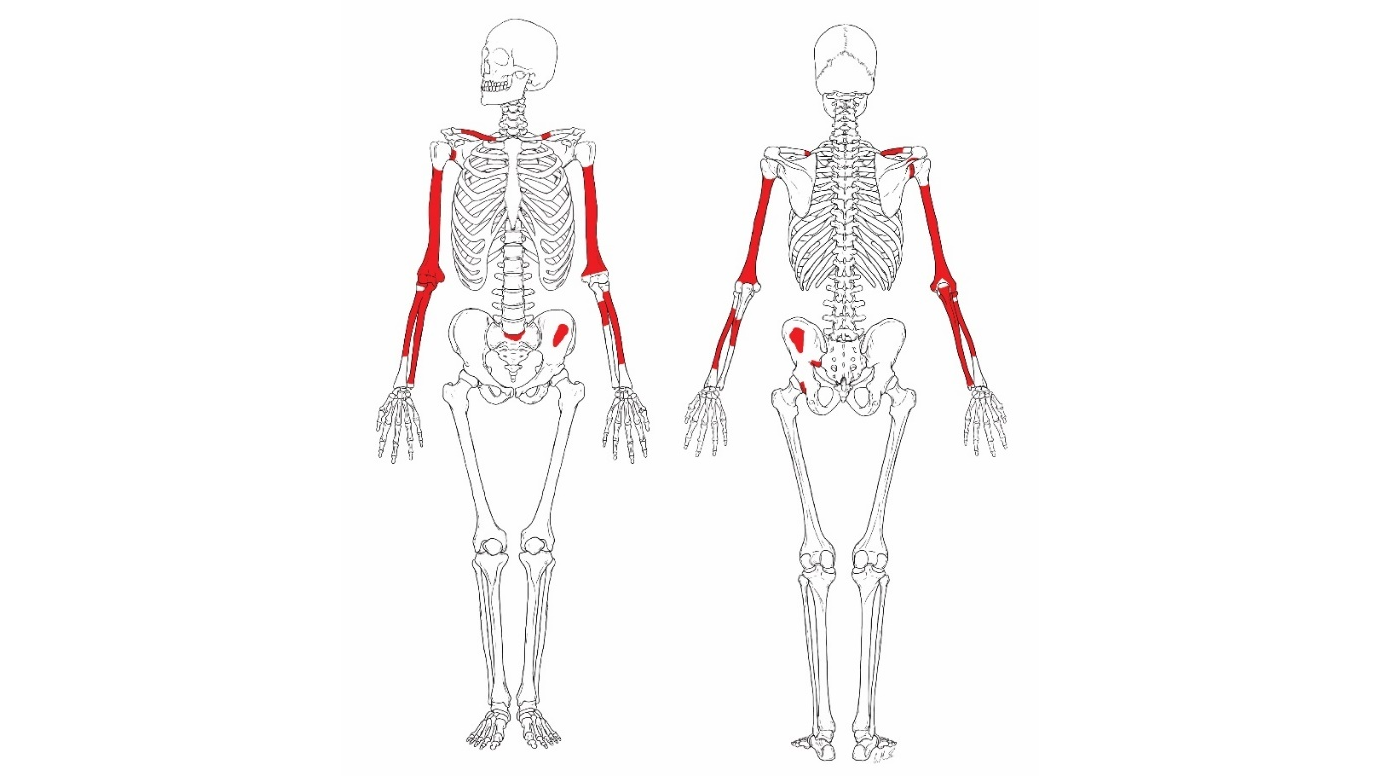
Overview of human bones showing which bones of Homo habilis were discovered

Two illustrations of modern human skeletons showing Homo habilis bones discovered in 2012. (Image credit: Adapted from Grine, FE et al., 2026)

Based on the length of the humerus (upper arm bone), researchers determined that KNM-ER 64061 was a young adult approximately 5 feet 3 inches (160 centimeters) tall. From leg bone fragments, they estimated that the individual weighed only about 67.7 pounds (30.7 kilograms). These anatomical features suggest that H. habilis retains similar upper limb proportions to Australopithecus and is shorter and lighter than H. erectus.

Get the world’s most fascinating discoveries delivered straight to your inbox.

However, the researchers say these characteristics do not necessarily mean that H. habilis can fly through trees. “The relatively long forearms of H. habilis may have allowed this species a higher degree of arboreal locomotion than H. erectus, but whether H. habilis was actually arboreal remains open to speculation,” the researchers wrote in their study.

“The limbs of Homo habilis are attracting increasing attention,” study co-author Ashley Hammond, a paleoanthropologist at the Catalan Institute of Paleontology Mikel Courzafont, said in a statement. “The limbs of Homo habilis are attracting increasing attention,” and the new skeleton “confirms that the arms were quite long and strong. What remains elusive is the size and proportions of the lower limbs.”

Although only a few pelvic fragments of KNM-ER 64061 were recovered, they suggest that this H. habilis individual may have had a gait more similar to H. erectus than to early Australopithecus, the researchers noted in the study.

“Future fossils of the lower limbs of Homo habilis are needed, which could further change our view of this major species,” Hammond said in a statement.

The discovery of a surprisingly complete Homo habilis skeleton may also help paleoanthropologists classify the massive group of hominins that lived in eastern Africa between 2.2 million and 1.8 million years ago.

The researchers found that up to four species of hominin (Paranthropus boisei, Homo habilis, Homo rudolfensis, and possibly Homo erectus) lived in the same place at about the same time. Additionally, because H. erectus appeared about 500,000 years before H. habilis disappeared from the fossil record, it is currently unknown whether H. habilis is an ancestor of H. erectus or a close relative.


Source link

#Biotechnology #ClimateScience #Health #Science #ScientificAdvances #ScientificResearch
Follow on Google News Follow on Flipboard
Share. Facebook Twitter Pinterest LinkedIn Tumblr Email Copy Link
Previous ArticleFortinet fixes critical FortiSIEM flaw that allows unauthenticated remote code execution
Next Article Meta reportedly lays off 10% of Reality Labs staff
user
  • Website

Related Posts

NASA astronauts return to Earth after unprecedented medical emergency on ISS

January 15, 2026

China unveils world’s first lunar clock, solving strange time dilation predicted by Einstein

January 15, 2026

Black hole butterfly? The James Webb Telescope discovered dozens of black hole “cocoons” in the early universe.

January 14, 2026
Add A Comment
Leave A Reply Cancel Reply

Latest Posts

AWS CodeBuild misconfiguration exposed GitHub repository to potential supply chain attacks

Higgsfield, the AI ​​video startup founded by former Snap executives, is valued at $1.3 billion

Iran’s internet shutdown becomes longest in history as protests continue

OpenAI invests in Sam Altman’s brain-computer interface startup Merge Labs

Trending Posts

Subscribe to News

Subscribe to our newsletter and never miss our latest news

Please enable JavaScript in your browser to complete this form.
Loading

Welcome to Fyself News, your go-to platform for the latest in tech, startups, inventions, sustainability, and fintech! We are a passionate team of enthusiasts committed to bringing you timely, insightful, and accurate information on the most pressing developments across these industries. Whether you’re an entrepreneur, investor, or just someone curious about the future of technology and innovation, Fyself News has something for you.

Castilla-La Mancha Ignites Innovation: fiveclmsummit Redefines Tech Future

Local Power, Health Innovation: Alcolea de Calatrava Boosts FiveCLM PoC with Community Engagement

The Future of Digital Twins in Healthcare: From Virtual Replicas to Personalized Medical Models

Human Digital Twins: The Next Tech Frontier Set to Transform Healthcare and Beyond

Facebook X (Twitter) Instagram Pinterest YouTube
  • Home
  • About Us
  • Advertise with Us
  • Contact Us
  • DMCA
  • Privacy Policy
  • Terms & Conditions
  • User-Submitted Posts
© 2026 news.fyself. Designed by by fyself.

Type above and press Enter to search. Press Esc to cancel.