

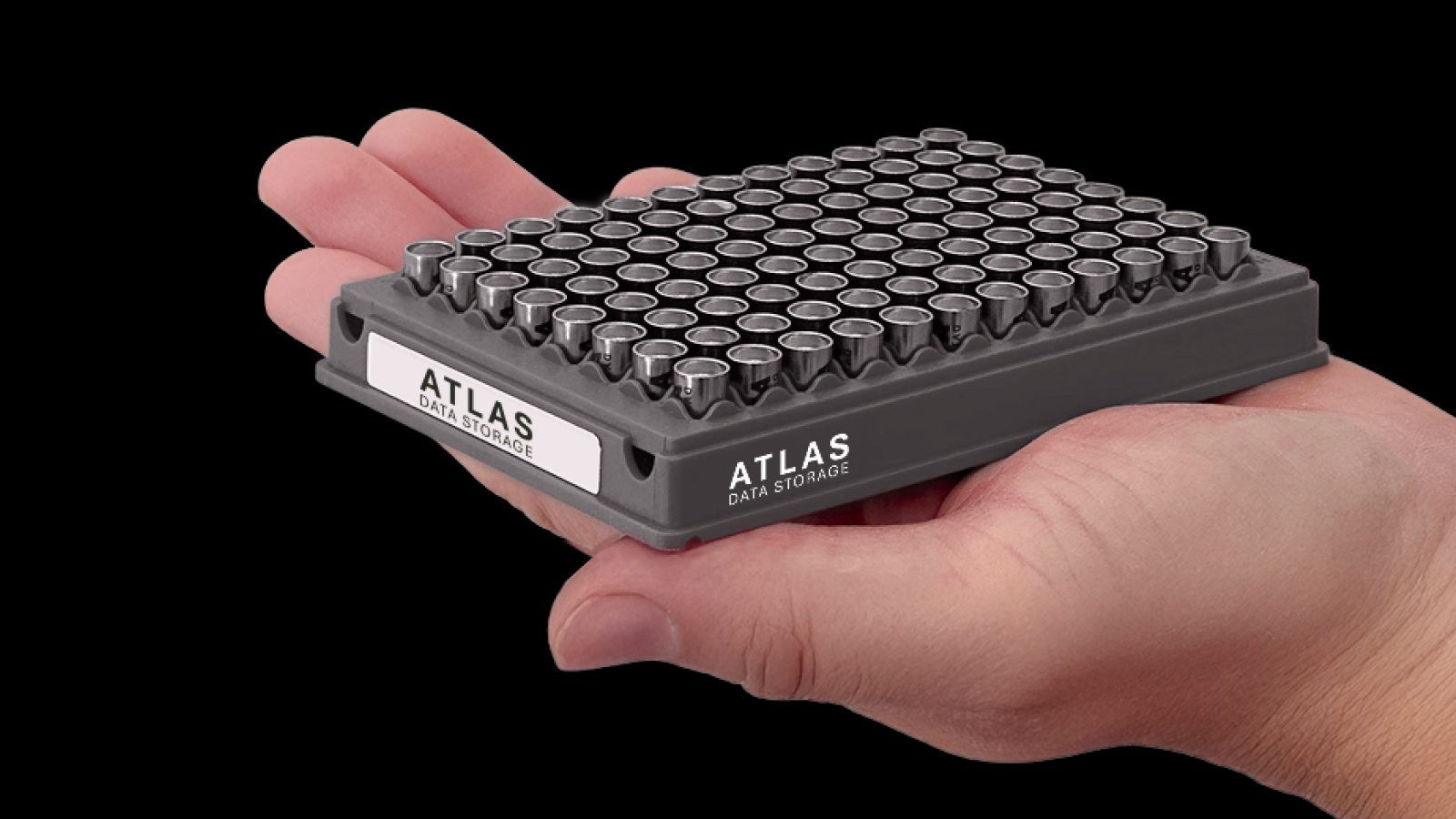
US biotech company Atlas Data Storage has launched a synthetic DNA storage system that can hold 1,000 times more data than traditional magnetic tape.
The product, called Atlas Eon 100, claims to store humanity’s “irreplaceable archive” for thousands of years. These include master versions of family photographs, scientific data, corporate records, cultural artifacts, digital artworks, films, manuscripts, and music.
“This is the culmination of more than a decade of product development and innovation across multiple disciplines,” Atlas Data Storage founder Bill Banyai said in a statement. “We intend to offer new solutions for long-term archiving, data preservation of AI models, and protection of heritage and high-value content.”
you may like
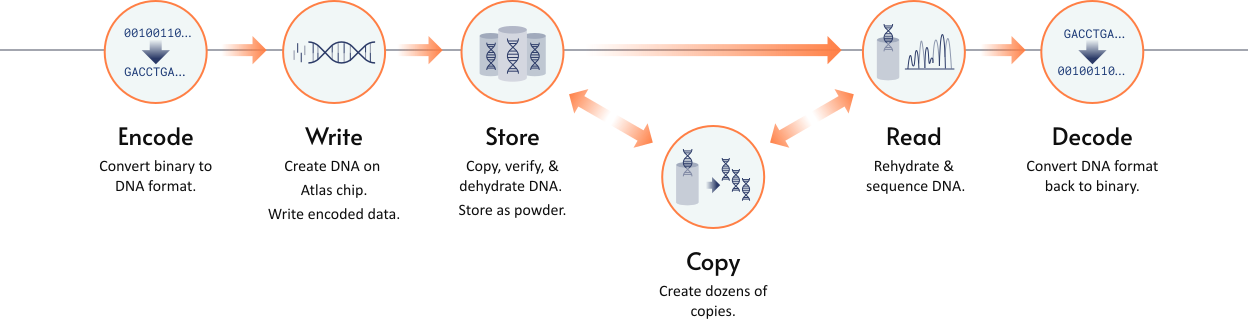
Essentially, all digital data is just a defined sequence of ones and zeros. DNA is similar in that it is composed of a defined sequence of the chemical bases adenine (A), cytosine (C), guanine (G), and thymine (T).
DNA data storage works by mapping binary code to these bases. For example, a coding scheme could assign A to 00, C to 01, G to 10, and T to 11. Artificial DNA can then be synthesized by arranging the bases in their corresponding order.
In the Atlas Eon 100, DNA is dehydrated and stored as a powder in a sturdy 0.7 inch (1.8 cm) high steel capsule. It is only rehydrated when the sequence needs to be determined and the bases translated into binary.
More convenient than magnetic tape
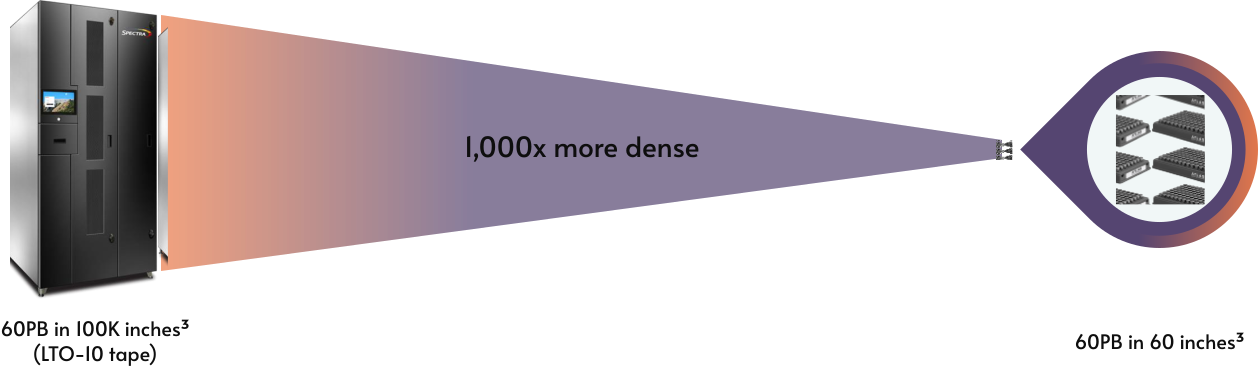
Just 1 quart (1 liter) of DNA solution can store 60 petabytes of data. This equates to 10 billion songs or 12 million HD movies. This makes the Atlas Eon 100, announced on December 2nd, 1,000 times more storage density than magnetic tape.
For comparison, a standard mass storage medium, 0.5 inch (12.7 mm) wide LTO-10 tape, would require approximately 15,500 miles (25,000 km) to hold the same amount of data.
This storage density makes it easier to transfer large amounts of data than a typical hard drive or tape reel. DNA is known to maintain its shape over centuries, making it an extremely stable medium for storing data over very long periods of time.
Atlas Data Storage says its products are 99.99999999999% reliable and stable in office environments, while the capsules can withstand temperatures as high as 104°F (40°C). On the other hand, magnetic tape deteriorates in about 10 years even if temperature and humidity are controlled.
you may like
Optical media such as CDs and DVDs typically degrade within 30 years, while hard drives take approximately 6 to 7 years to show signs of deterioration. Flash memory cells “age” at 70 °C (158 °F) in less than 3 hours as it typically takes a month.
Atlas also claims that its DNA storage service provides an easier way to create backups of customer data than other media. In fact, once a single strand is encoded, enzymes can be used to make more than a billion copies in just a few hours.
What is the solution for a data-hungry society?
According to Atlas, society generates 280 PB of data every minute. The company presents DNA data storage as a potential solution to the proliferation of digital data, which has been greatly exacerbated by the generative artificial intelligence (AI) boom.
However, this biotechnology faces significant scaling challenges. Synthesizing encoded artificial DNA is still a fairly lengthy process compared to, say, storing a photo on an existing hard drive. Twist Bioscience, Atlas’ former parent company that took over the DNA synthesis process, currently has lead times of two to eight business days for orders of genes and oligos (short and long DNA strands).
Sequencing is also notoriously expensive. It costs about $30 to read 1 gigabase of DNA. This equates to approximately 250 GB of data. This also takes a long time, with another recent DNA storage solution reportedly taking 25 minutes to recover a single file. Nevertheless, Atlas Data Storage claims that its modern DNA sequencers “increase throughput and reduce costs 1,000 times faster than Moore’s Law.”
However, because DNA takes time to synthesize and sequence, the DNA Data Storage Alliance said in 2025 that DNA is not expected to be used for large-scale archival data storage for another three to five years.
Thomas Heinis, a professor of computer science at Imperial College London who researches DNA-based data storage, is skeptical of the lack of concrete data Atlas has published about the Atlas Eon 100’s performance. He pointed to the fact that Catalog DNA, which had made similar promises for Shannon Storage Solutions, went out of business a few months ago.
“There’s no question that they’ve developed a great device, but without concrete information it’s hard to assess,” he told Live Science, adding that the big challenge in commercializing DNA storage is synthesis, not sequencing.
“It may sound trivial, but there is no point in making read/sequence costs efficient if write/synthesis costs are not competitive. You can’t read (cheaply) what you can’t afford to write. Currently, synthesis is orders of magnitude more expensive, while sequencing is closer to tape, but still more expensive. Despite being a strong believer in DNA storage, many technological advances are needed, and I have yet to see anyone have an economically viable solution.”
Source link
