

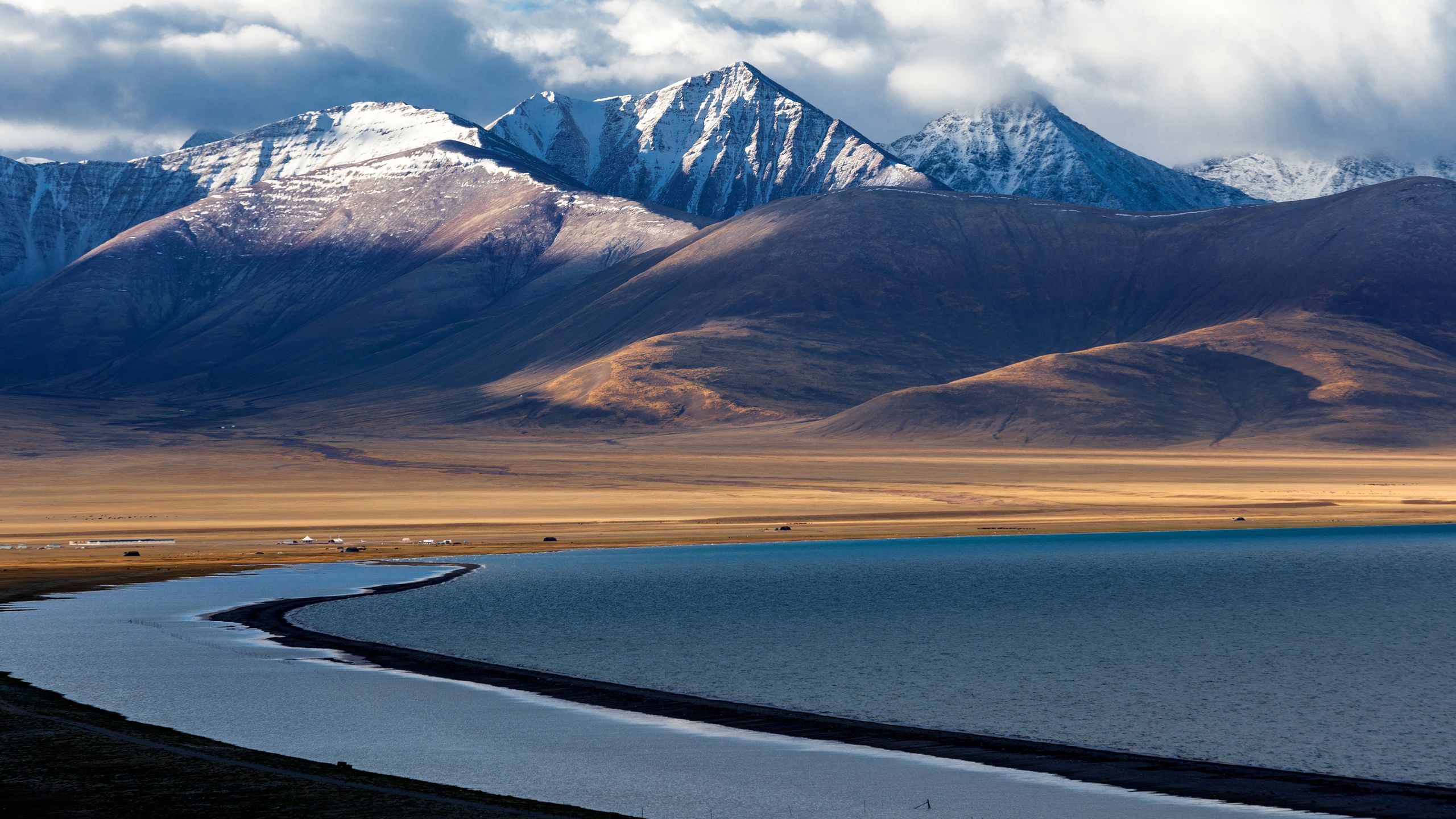
A disappearing lake in southern Tibet may have “awakened” long-dormant faults in the Earth’s crust, triggering earthquakes in the region, researchers say. The discovery adds to the evidence for an unexpectedly strong link between our planet’s climate and geological activity deep beneath our feet.
About 115,000 years ago, southern Tibet was home to huge lakes, some more than 125 miles (200 kilometers) long. Now those lakes are much smaller. These include Lake Nam Co (also known as Lake Nam Tso or Lake Nam), which is only 75 km (45 miles) long.
you may like
The second important point is that southern Tibet is geologically active due to the continuing conflict between India and Eurasia that began about 50 million years ago. Strains have built up in the Earth’s crust beneath southern Tibet, leaving ancient cracks, or faults, in the crust ready to rupture. Geologists reasoned that the slow rise of the Earth’s crust caused by the shrinking of the lake may have triggered such cracks, causing the earthquake.
Researchers believe this is what happened. They analyzed the local geology, mapped the ancient lake’s shoreline, and determined how much water the lake had lost. They then used computer models to predict how much the Earth’s crust would rise in response, revealing that this should have reactivated nearby faults.
The study was published in the journal Geophysical Research Letters on January 17th.
Their analysis suggests that between 115,000 and 30,000 years ago, water from Lake Namco was lost, causing a total of 50 feet (15 meters) of displacement on nearby faults. Lakes 60 miles (100 kilometers) south of Lake Namco lost even more water during the same period. There, there may have been 230 feet (70 m) of movement on a nearby fault.
These calculations suggest that faults in the region experienced an average of 0.008 to 0.06 inches (0.2 to 1.6 millimeters) of movement per year. For comparison, the San Andreas Fault, which runs through California, records much more movement, averaging about 0.8 inches (20 mm) each year. But there, the movement is primarily driven by processes occurring deep underground. New research proves that substantial movement on faults can also be influenced by processes occurring above ground.
“Surface processes can have surprisingly strong effects on the solid Earth,” Matthew Fox, associate professor of geology at University College London, who was not involved in the study, told Live Science via email. “Geologists are increasingly recognizing that to fully understand the evolution of landforms and tectonic regions, they must consider the coupling between Earth’s surface and deep processes.”
Sean Galen, an associate professor of geology at Colorado State University who was not involved in the study, said this doesn’t mean the lake will dry up and earthquakes will occur anytime and anywhere. Such earthquakes only occur where there are lakes above the earth’s crust, where strain has accumulated due to tectonic activity. “Tectonics is always the driving force,” he told Live Science. “Changes in water loading just change how the tectonic forces that have built up over time are released.”
you may like
Strain can also be released by other surface processes, Philippe Steer, assistant professor of geosciences at the University of Rennes in France, told Live Science. Severe storms can cause sudden and rapid erosion, removing heavy rock from parts of the Earth’s crust and uplifting it. Steer, who was not involved in the study, said similar effects exist in quarries, where large amounts of rock are removed from the ground.
But perhaps the most important “unloading” phenomenon in the recent geological past is associated with the last glacial maximum. At that time, about 20,000 years ago, large parts of North America and Eurasia were squeezed by huge ice sheets, several miles thick in places. These ice sheets largely disappeared by about 10,000 years ago. But they were so heavy that the crust beneath where they once lay still bounces around.
Some researchers think this may help explain a long-standing geological mystery. Almost all powerful earthquakes occur along large faults like the San Andreas at the boundaries of Earth’s plates. However, in some cases, powerful earthquakes can occur in the middle of the plates, thousands of miles from these boundaries. For example, in 1811 and 1812, three magnitude 7 or 8 earthquakes occurred along the Mississippi River Valley in the central United States.
One idea is that geological activity along the edge of the North American tectonic plate, thousands of miles away, slowly built up strain on ancient faults in the Mississippi River Valley. Then, as the ice sheets melted and the Earth’s crust began to rise, that strain was released in the form of powerful earthquakes.
“Climate change does not ’cause’ crustal deformation, but it can change stress states within the Earth’s crust,” Fox said. “That needs to be taken into account in future risk assessments.”
Li, C., Li, H., Chevalier, M.-L., Pan, J., and Liu, F. (2026). Lake unloading causes fault slip and rift asymmetry in southern Tibet. Geophysical Research Letters, 53, https://doi.org/10.1029/2025GL120955
What’s Inside the Earth Quiz: Test your knowledge about Earth’s hidden layers
Source link
