


Close Menu
  • Start
  • Celebrities
  • Music
  • Influencers
  • Tendencies
  • Exclusives
  • Business & Brands
  • TwinH
  • Spanish
What's Hot

Jelly Roll files for divorce from Bunny XO after 10 years of marriage

Merlin, a common roadside duck in Mexico City, will be the World Cup mascot.

BTS is the group fans are most looking forward to seeing perform at the 2026 World Cup

Facebook X (Twitter) Instagram
  • Home
  • About The FYMOUS
  • Advertising / Promotion
  • Contact
  • DMCA
  • Privacy Policy
  • Terms
  • Publish News
Facebook X (Twitter) Instagram
FYMOUS News
  • Start
  • Celebrities
  • Music
  • Influencers
  • Tendencies
  • Exclusives
  • Business & Brands
  • TwinH
  • Spanish
FYMOUS News
Home » Traces of ancient ‘megaquake’ in Cascadia subduction zone discovered in deep-sea landslide
Tendencies

Traces of ancient ‘megaquake’ in Cascadia subduction zone discovered in deep-sea landslide

By January 16, 2026No Comments3 Mins Read
Share Facebook Twitter Pinterest Telegram LinkedIn Tumblr Email Copy Link
Follow Us
Google News Flipboard
Share
Facebook Twitter LinkedIn Pinterest Email Copy Link

Deep-sea landslides in the Cascadia subduction zone in the Pacific Northwest hold records of earthquakes dating back 7,500 years, and similar evidence may be found at other plate boundaries around the world, a new study shows.

Subduction zones are where oceanic tectonic plates slide beneath continental plates, which can cause large and damaging earthquakes, such as the 2011 magnitude 9.1 Tohoku earthquake in Japan that caused a devastating tsunami. The Cascadia subduction zone, which stretches from northern California to Vancouver Island, British Columbia, has the potential for earthquakes of at least magnitude 9.0, according to the Pacific Northwest Earthquake Network.

But exactly how often such huge earthquakes occur remains an open question. To understand the history of the Cascadia earthquake, researchers look to geological evidence such as sudden horizon changes and turbidites, underwater sediment flows that occur off the coast during large earthquakes.

you may like

However, turbidites in underwater canyons near the coast can also be caused by storms, ocean currents, and periodic landslides that are unrelated to earthquakes. In a new study published Wednesday (January 14) in the journal Science Advances, U.S. Geological Survey research geologist Jenna Hill and her colleagues decided to dig deeper. They worked with the Monterey Bay Aquarium Research Institute to study the continental slope of southern Cascadia, the steep descent from the North American continent to the deep-sea plains.

Focusing on an area off the coast of Crescent City, California, the researchers used an autonomous, remotely operated vehicle to obtain detailed views of slopes and sediments. They also radiocarbon dated the turbidite deposits using sediment cores from the area and compared their timing to the ages of known ancient Cascadia earthquakes.
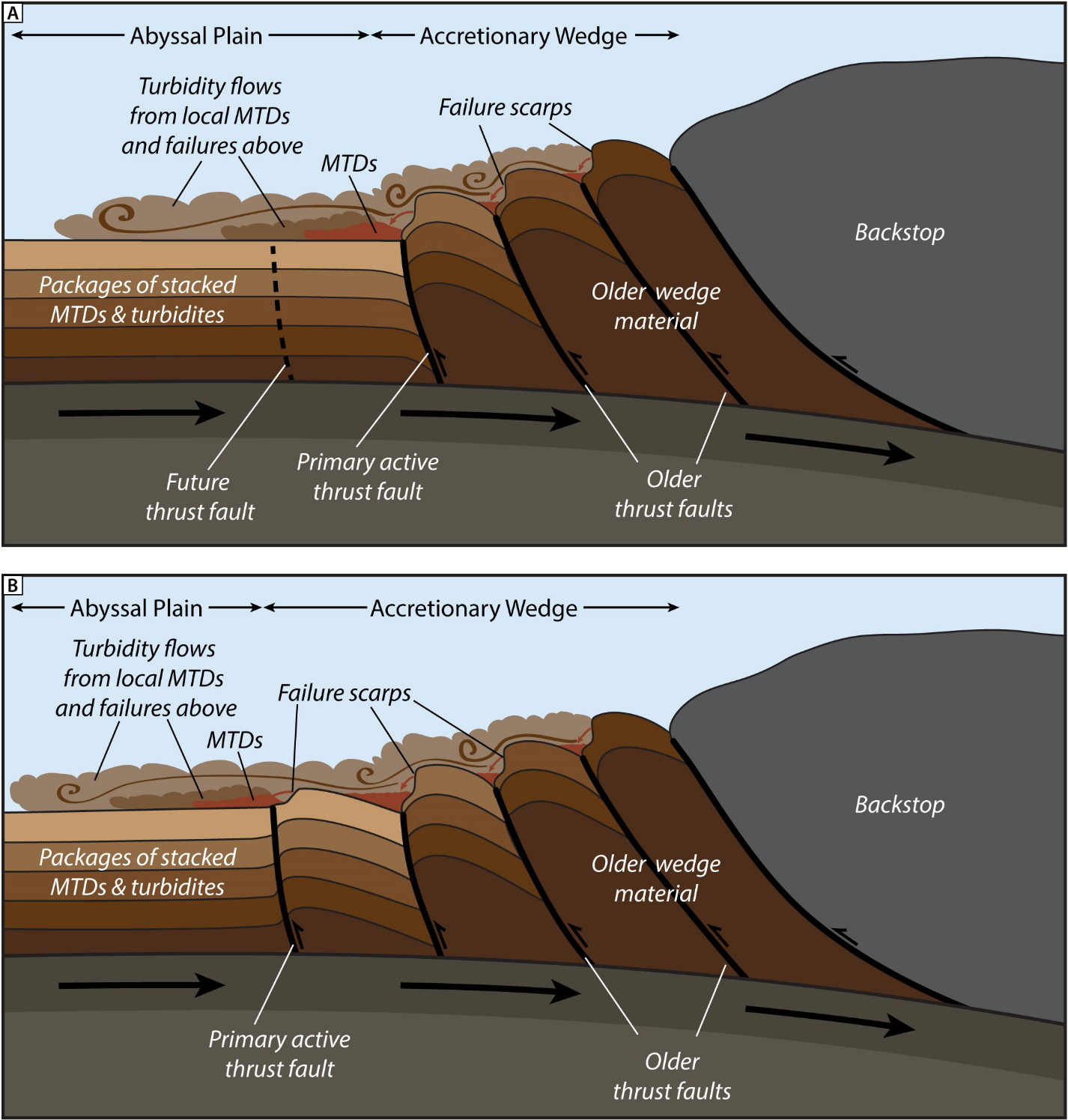
A geological model of deep seismic turbidite formation along the Cascadia subduction zone.

A geological model of deep seismic turbidite generation along the Cascadia subduction zone. (Image credit: Public domain.)

Researchers found evidence of at least 10 events over the past 7,500 years, allowing them to link historic earthquakes, landslides, and the turbidites they produced.

“We were able to figure out where and how turbidites are formed,” Hill told Live Science. “So we know they’re coming from landslides that we know are caused by earthquakes.”

Get the world’s most fascinating discoveries delivered straight to your inbox.

It’s unclear how large an earthquake is needed to cause deep-sea turbidites, but it probably has to be large enough to cause damage, Hill said. She and her colleagues also witnessed signs of seafloor shaking in response to seismic turbidites, which could further increase the risk of tsunamis from these types of earthquakes.

Turbidites, found in underwater canyons near the coast of the Pacific Northwest, have already been used to link earthquakes in Cascadia to those on the nearby San Andreas Fault. Turbidites on continental slopes may be more reliable markers of earthquakes because they are less affected by coastal processes such as tides and rainfall, Hill said.

“We think they occur almost everywhere along subduction zones, so you should be able to find these landslide deposits and ocean turbidites all over the world, even in places you’ve never looked for them before,” she said.


Source link

#Biotechnology #ClimateScience #Health #Science #ScientificAdvances #ScientificResearch
Follow on Google News Follow on Flipboard
Share. Facebook Twitter Pinterest LinkedIn Tumblr Email Copy Link
Previous ArticleFoodTech Challenge 2026 winners advance the agritech ecosystem
Next Article YouTube eases monetization guidelines for some controversial topics

Related Posts

Merlin, a common roadside duck in Mexico City, will be the World Cup mascot.

June 15, 2026

Far from the pitch, David Beckham remains soccer’s biggest star

June 14, 2026

Taylor Swift makes history as the youngest girl to be inducted into the Songwriters Hall of Fame

June 12, 2026
Add A Comment
Leave A Reply Cancel Reply

Latest Posts

Jelly Roll files for divorce from Bunny XO after 10 years of marriage

Merlin, a common roadside duck in Mexico City, will be the World Cup mascot.

BTS is the group fans are most looking forward to seeing perform at the 2026 World Cup

Swimming Pole, Billboard’s Emerging Dance Artist of the Month

Trending Posts

Jelly Roll files for divorce from Bunny XO after 10 years of marriage

June 16, 2026

BTS is the group fans are most looking forward to seeing perform at the 2026 World Cup

June 15, 2026

Swimming Pole, Billboard’s Emerging Dance Artist of the Month

June 15, 2026

Subscribe to News

Subscribe to our newsletter and never miss our latest news

Please enable JavaScript in your browser to complete this form.
Loading

Welcome to The FYMOUS, a modern digital media platform dedicated to celebrities, artists, influencers, brands, entertainment culture, and the growing TwinH ecosystem.

We bring audiences closer to the people, stories, trends, and collaborations shaping today’s culture. From exclusive celebrity news and music releases to influencer highlights, brand partnerships, and TwinH activations, The FYMOUS delivers engaging content designed for the next generation of digital audiences.

Castilla-La Mancha Ignites Innovation: fiveclmsummit Redefines Tech Future

Local Power, Health Innovation: Alcolea de Calatrava Boosts FiveCLM PoC with Community Engagement

The Future of Digital Twins in Healthcare: From Virtual Replicas to Personalized Medical Models

Human Digital Twins: The Next Tech Frontier Set to Transform Healthcare and Beyond

Facebook X (Twitter) Instagram Pinterest YouTube
  • Home
  • About The FYMOUS
  • Advertising / Promotion
  • Contact
  • DMCA
  • Privacy Policy
  • Terms
  • Publish News
© 2026 news.fyself. Designed by by fyself.

Type above and press Enter to search. Press Esc to cancel.