

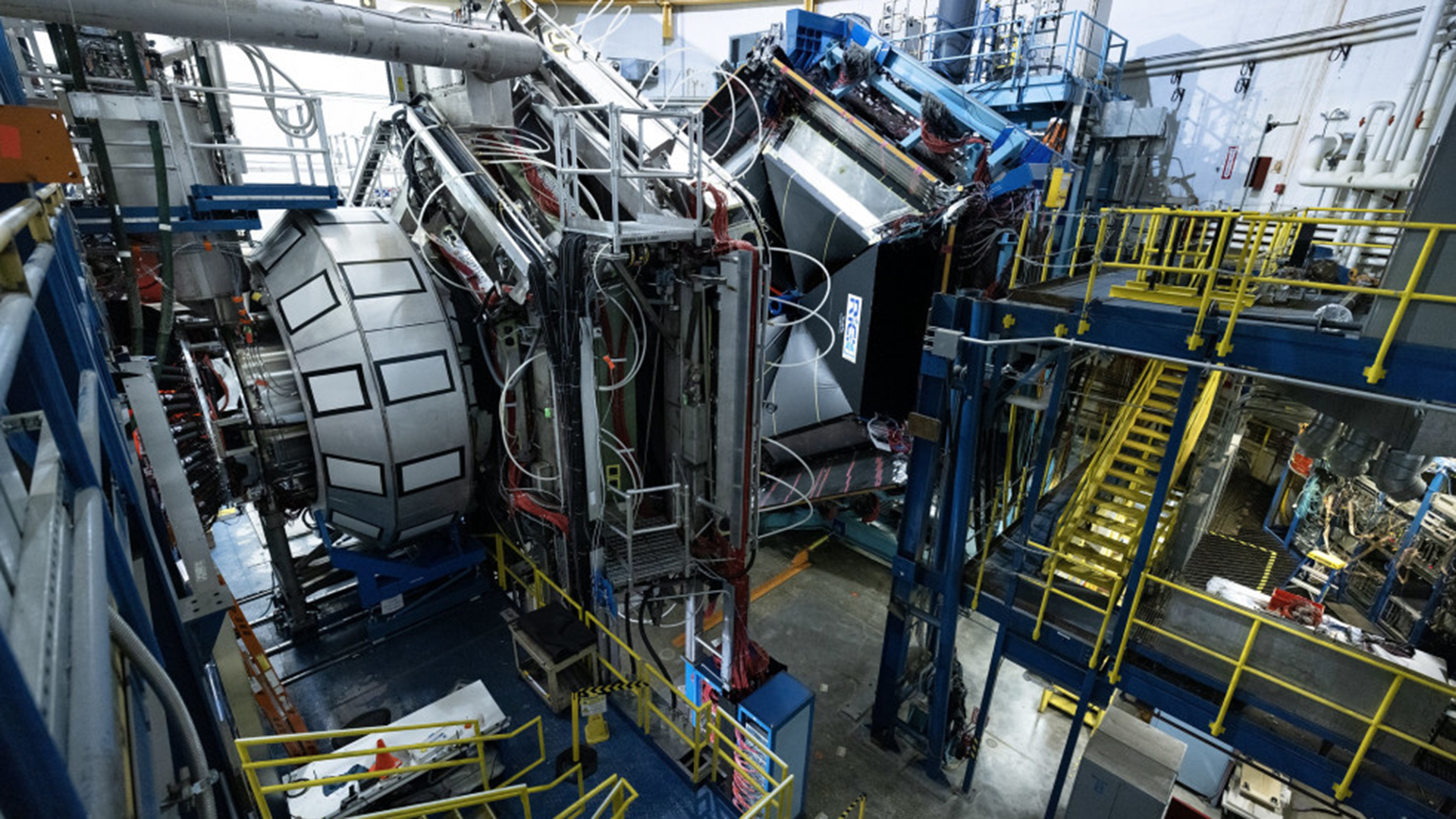
Professor Fatiha Benmokhtar conducts advanced experiments at the Jefferson Laboratory using the Hybrid Ring Imaging Cerenkov Detector to probe the structure of protons.
Understanding the structure of proton quarks and gluons, the fundamental building blocks of visible matter, is a central goal of modern nuclear physics and a top priority of the long-term program of the U.S. Department of Energy/NSF Nuclear Science Advisory Committee (NSAC). In the theory of strong interactions, quantum chromodynamics (QCD), protons appear as relativistic, strongly bound states of nearly massless quarks and gluons (collectively called partons). Decades of experimental and theoretical research have provided deep insights into parton dynamics, but important questions remain unanswered. Among them, the origin of proton spin stands out as one of the most fascinating challenges. Spin is a fundamental quantum property and is essential for investigating the structure of nucleons. Measurements have shown that quark spins account for only about one-third of a proton’s total spin, and that gluon spins alone cannot account for the remaining contribution. This raises an important question: Does the missing component originate from the parton’s orbital angular momentum? Accurate measurements and sophisticated theoretical frameworks are required to address this question.
Understanding proton spin structure through SIDIS experiments
Comprehensive and semi-inclusive polarized deep inelastic scattering (SIDIS) experiments at facilities such as CERN, SLAC, DESY, and the Jefferson Laboratory have made significant advances in our understanding of the spin structure of protons. However, the contribution of strange quarks remains poorly determined due to their small magnitude and the experimental challenges of isolating the strange quark signal, which relies on kaon tagging and has fragmentation uncertainties. Semi-comprehensive measurements using the identified hadrons are required to accurately determine the distribution of strange quarks. Because of quark confinement, individual quarks cannot be observed in isolation. The most suitable hadron species for evaluating the presence of strange and/or anti-strange quarks relative to protons are particles called kaons. For example, kaon plus (consisting of an up quark and a strange antiquark) and kaon minus (consisting of an up antiquark and a strange quark).
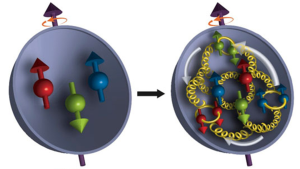
With continued support from the National Science Foundation, Professor Benmoctor works on electron-proton scattering experiments at Thomas Jefferson National Laboratory. Since joining Duquesne University, she has mentored and trained more than 50 undergraduate students on this project. Her contribution to the sea of strangeness began with the G0 experiment in Hall C. The experiment measured the contribution of a sea of strange quarks to the electromagnetic properties of protons. ¹ Since 2018, the Continuous Electron Beam Accelerator at the Jefferson Laboratory has been upgraded to 12 GeV, and Professor Benmoctor is conducting the SIDIS experiment in Hall B using the CLAS12 detector. Two Ring Imaging Cerenkov (RICH) detectors were added to the baseline instrument to identify kaons in the momentum range of 3 to 8 GeV/c.
What is a RICH detector?
The RICH detector is a device that allows the identification of charged subatomic particles through the detection of Cerenkov radiation emitted (as photons) by the particles passing through a medium with refractive index n. Identification is made by measuring the emission angle θc of the Cherenkov radiation, which is related to the velocity of the charged particle v by cos θc = c/(nv), where c is the speed of light. Particles with different masses but the same momentum can be distinguished by the distinct contours of the emitted photons. CLAS12, located in Hall B of the Jefferson Institute, is a magnetic spectrometer based on a toroidal magnetic field generated by six coils that naturally divide the spectrometer into six independent sectors. The CLAS12 baseline instrument consists of a time-of-flight system (TOF) that can efficiently discriminate hadrons up to a momentum of about 3 GeV/c and two Cherenkov gas counters with high (HTCC) and low (LTCC) thresholds, reaching the required pion-blocking ability only near the upper limit of hadronic momentum (about 7 GeV/c) and not being able to distinguish between kaons and protons. The hybrid RICH detector was designed and built in collaboration with Professor Benmokhtar and his collaborators at Duquesne University, the INFN Group in Italy (Dr. M. Contalbrigo and Dr. M. Mirazita), the US’s Jefferson Laboratory (Dr. V. Kubarovsky and Dr. P. Rossi, and Dr. Avakian), Argonne National Laboratory (Dr. K. Hafidi), and the University of Connecticut (Professor K. Joo, Dr.). Kim, Dr. T. Hayward). As shown in Figure 3, two full RICH detectors were constructed and installed at CLAS12 in fall 2018 and May 2022, respectively. The components of the hybrid RICH are shown to the right.
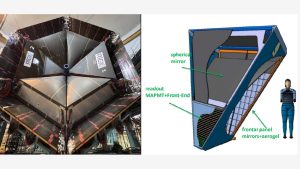

The Ring Imaging Cherenkov (RICH) detector is designed to enhance CLAS12’s particle discrimination for momentums between 3 and 8 GeV/c and replaces two sectors of the existing LTCC detector. Its design integrates an airgel radiator, a visible light photon detector, and a focusing mirror system, reducing the photon detector coverage area to approximately 1 m². Multi-anode photomultiplier tubes (MA-PMTs) provide the necessary spatial resolution and are optimized for the airgel Cherenkov optical spectrum in the visible and near-UV regions. For forward-scattered particles with momentums between 3 and 8 GeV/c (θ < 13°), a close-in imaging technique using a thin (2 cm) airgel and direct Cerenkov light detection is employed. For particles with larger angles of incidence (13° < θ < 25°) and momentums of 3–6 GeV/c, Cerenkov light is generated in a thick airgel (6 cm), focused by a spherical mirror, passes through a thin emitter twice, and is reflected by a plane mirror before detection. An example of a Cherenkov ring for direct and reflected light is shown in the figure above.
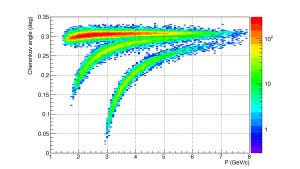
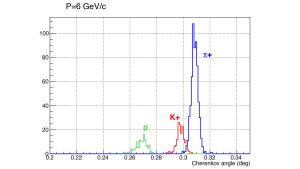
The development and characterization of this detector has resulted in numerous publications and is now used to extract physics such as single and dihadron production at SIDIS. This research has yielded preliminary exciting physical results, with final results expected to be published within the next few years.
Acknowledgments: Professor Benmokhtar’s research is supported by National Science Foundation grant number Benmokhtar-2310067. The INFN Group in Italy is supported by the European Union’s Horizon 2020 research and innovation program under grant agreement number 824093 (STRONG2020). We would like to thank the scientists and engineers at Jefferson Lab for their contributions to the RICH project.
References
Contribution to asymmetry violation in strange quark receding angle G0 electron scattering experiments,
https://journals.aps.org/prl/abstract/10.1103/PhysRevLett.104.012001 Jefferson Lab’s CLAS12: https://www.jlab.org/physics/hall-b/clas12 RICH Detector: https://www.jlab.org/Hall-B/clas12-web/specs/rich.pdf Large Area Hybrid Optical CLAS12 RICH: The first years of data acquisition 10.1016/j.nima.2023.168758, https://www.sciencedirect.com/science/article/pii/S0168900223007490
This article will also be published in the quarterly magazine issue 24.
Source link
