
Close Menu
  • Home
  • Identity
  • Inventions
  • Future
  • Science
  • Startups
  • Spanish
What's Hot

AISURU/Kimwolf botnet launches record 31.4 Tbps DDoS attack

Data breach at government tech giant Conduent balloon affects millions more Americans

Eleven Lab CEO: Voice is the next interface for AI

Facebook X (Twitter) Instagram
  • Home
  • About Us
  • Advertise with Us
  • Contact Us
  • DMCA
  • Privacy Policy
  • Terms & Conditions
  • User-Submitted Posts
Facebook X (Twitter) Instagram
Fyself News
  • Home
  • Identity
  • Inventions
  • Future
  • Science
  • Startups
  • Spanish
Fyself News
Home » Two stars spiraling toward catastrophe test Einstein’s gravity
Science

Two stars spiraling toward catastrophe test Einstein’s gravity

userBy userNovember 25, 2025No Comments3 Mins Read
Share Facebook Twitter Pinterest Telegram LinkedIn Tumblr Email Copy Link
Follow Us
Google News Flipboard
Share
Facebook Twitter LinkedIn Pinterest Email Copy Link

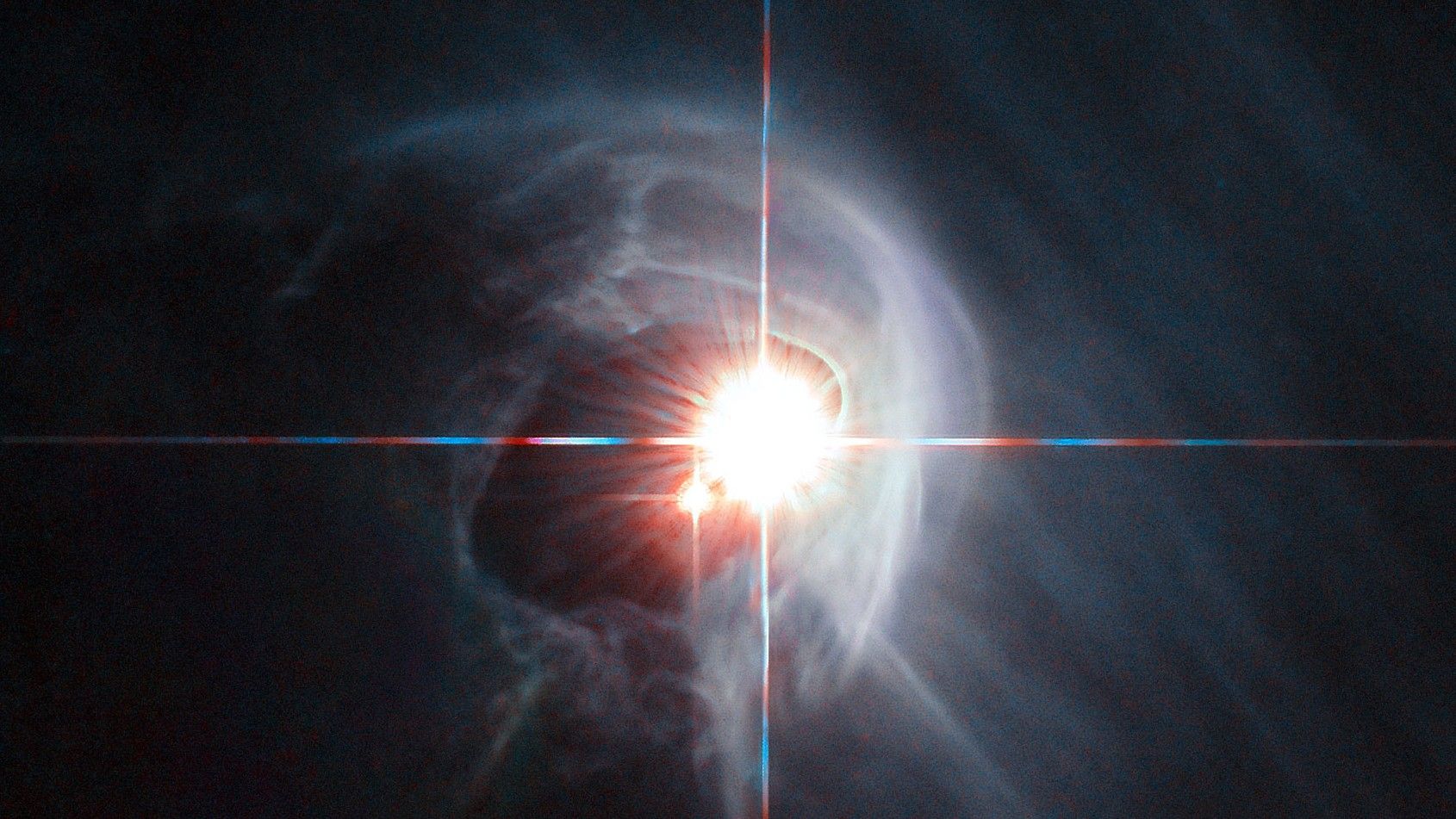
Astronomers have observed a pair of stars trapped in a death spiral, and their dance of destruction reveals more about how gravity works.

The system, called ZTF J2130, is located about 4,000 light years away. Astronomers have known about this system for some time, but this is the first time they’ve seen it so clearly.

The two stars that make up this system will soon merge. Their spiral motion is consistent with theoretical predictions, meaning that as future observations become more sophisticated, researchers will be able to use the system to test their understanding of gravity, the authors say in a study submitted for publication in the journal Astronomy & Astrophysics in October.

you may like

This is a very old system. One of the stars is a white dwarf, the white, hot remnant core of a star like our Sun. The other is known as a subdwarf, a small star near the end of its life. The two stars are so close that they orbit once in less than 40 minutes. In fact, they have already started kissing. Their mutual gravity is so strong that they are stretched and distorted, causing material from the subdwarf to flow into its white dwarf companion.

Stars are so massive and moving so fast that they emit gravitational waves, ripples in the fabric of space-time that were first predicted by Albert Einstein and confirmed to exist in 2015. This emission of gravitational waves robs the system of energy, bringing the two stars closer each year.

Astronomers took painstaking efforts to measure the orbital period as accurately as possible, combining data from the Oskar Luening telescope at Germany’s Hamburg Observatory and Spain’s CAHA observatory in Germany and Spain. They found that the orbit was slowly decaying. Every second that passes, the orbital period decreases by about two trillionths of a second.

This is consistent with calculations based on current theoretical understanding of gravity. But scientists have been eager to overcome Einstein’s theory of general relativity for more than a century, so any chance to test it is immediately appealing.

Get the world’s most fascinating discoveries delivered straight to your inbox.

Astronomers have discovered that the upcoming gravitational-wave observatory, known as the Laser Interferometer Space Antenna (LISA), should be able to directly measure gravitational waves emanating from the system. The European Space Agency plans to launch LISA in the 2030s, so this great pair will be around for another decade.

When the stars finally merge, they create a supernova-level explosion that is bright enough to be seen with the naked eye. In the meantime, you should test gravity before enjoying the fireworks show.


Source link

#Biotechnology #ClimateScience #Health #Science #ScientificAdvances #ScientificResearch
Follow on Google News Follow on Flipboard
Share. Facebook Twitter Pinterest LinkedIn Tumblr Email Copy Link
Previous ArticleThe Future of Digital Twins in Healthcare: From Virtual Replicas to Personalized Medical Models
Next Article Why “hold forever” investors catch venture capital “zombies”
user
  • Website

Related Posts

Genetically unique group from southern Greece can trace paternal ancestry to the Bronze Age

February 4, 2026

‘Nitrogen-fixing’ trees could help restore tropical forests, research suggests

February 4, 2026

Diagnostic dilemma: autopsy reveals unexpected ‘boomerang’ structure in man’s heart

February 4, 2026
Add A Comment
Leave A Reply Cancel Reply

Latest Posts

AISURU/Kimwolf botnet launches record 31.4 Tbps DDoS attack

Data breach at government tech giant Conduent balloon affects millions more Americans

Eleven Lab CEO: Voice is the next interface for AI

Codespaces RCE, AsyncRAT C2, BYOVD Abuse, AI Cloud Intrusions & 15+ Stories

Trending Posts

Subscribe to News

Subscribe to our newsletter and never miss our latest news

Please enable JavaScript in your browser to complete this form.
Loading

Welcome to Fyself News, your go-to platform for the latest in tech, startups, inventions, sustainability, and fintech! We are a passionate team of enthusiasts committed to bringing you timely, insightful, and accurate information on the most pressing developments across these industries. Whether you’re an entrepreneur, investor, or just someone curious about the future of technology and innovation, Fyself News has something for you.

Castilla-La Mancha Ignites Innovation: fiveclmsummit Redefines Tech Future

Local Power, Health Innovation: Alcolea de Calatrava Boosts FiveCLM PoC with Community Engagement

The Future of Digital Twins in Healthcare: From Virtual Replicas to Personalized Medical Models

Human Digital Twins: The Next Tech Frontier Set to Transform Healthcare and Beyond

Facebook X (Twitter) Instagram Pinterest YouTube
  • Home
  • About Us
  • Advertise with Us
  • Contact Us
  • DMCA
  • Privacy Policy
  • Terms & Conditions
  • User-Submitted Posts
© 2026 news.fyself. Designed by by fyself.

Type above and press Enter to search. Press Esc to cancel.