

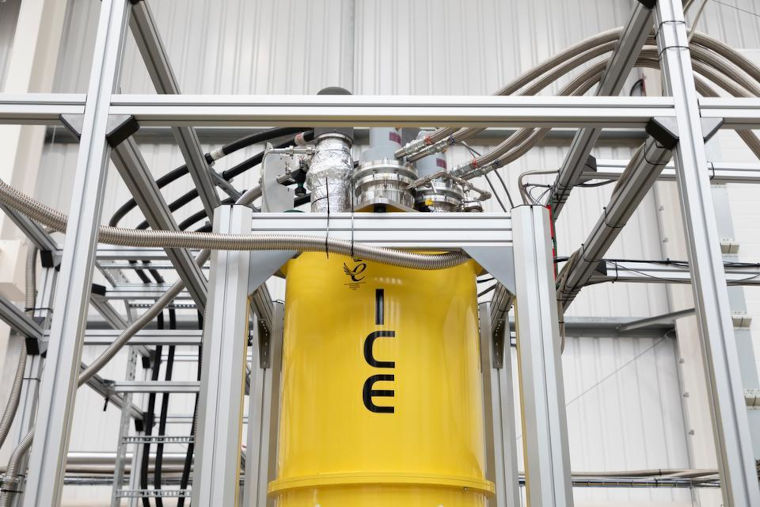
UKAEA has announced a new fusion machine, ELSA, which uses extreme temperatures to inform engineering and design under fusion-related plant conditions.
Located at the Fusion Technology Facility (FTF) in South Yorkshire, ELSA produces temperatures on the cryogenic scale of 20 to 70 Kelvin (-253.15 to -203.15 degrees Celsius).
This allows the machine to simulate the operating temperatures of high-temperature superconducting (HTS) magnets.
Professor Matt Stevenson, Director of UKAEA’s Fusion Technology Facility, said: in the supply of commercially viable fusion energy.
“Our team works diligently to test and deliver accurate results that inform the best environments and materials for durable power plant designs.”
Reduce energy usage and reduce costs
HTS coils are critical to confining and forming plasma within a fusion machine by generating high magnetic fields with minimal resistive losses.
UKAEA engineers aim to achieve one millionth of the resistance found in household appliances.
Reducing temperatures to obtain the strongest magnetic fields minimizes the required energy usage, reduces operating costs, and supports the commercialization of fusion energy.
ELSA tests reinstallable joint for future fusion power plants
The ELSA fusion machine is currently testing a new “Refittable Joint” (RMJ) component that features very low electrical resistance and will be essential for efficient maintenance of future fusion power plants.
The RMJ is part of the fusion machine’s toroidal magnetic field coil that confines the plasma. These are mounted around the tokamak’s magnetic cage, allowing quick access for maintenance during plant operation.
This novel RMJ design is a key part of the UK’s STEP programme, a prototype fusion energy power station to be built in Westburton, North Nottinghamshire, with the aim of commissioning in 2040.
“Reattachable joints and other aspects of high temperature superconducting magnet technology require cryogenic facilities like ELSA to test different aspects of the technology, but these are few and far between,” explained Chris Lamb, Reattachable Joints Engineering Manager at UKIFS.
“It is great to have the ELSA facility operating at the Fusion Technology facility, which is located in close proximity to both STEP’s West Burton site and the Advanced Manufacturing Park’s rich veins of manufacturing capacity, helping our engineers get up close and personal in bringing these important HTS technologies to fruition.”
Development and testing of the fusion machine that drives STEP
A recent report published by Amion on behalf of local authorities in the region estimates that the STEP project will create 6,500 jobs on site once the power plant is fully operational, and even more during the construction phase.
The STEP campus is expected to become a world-class center for fusion research and development, working with local education providers to pave the way for fusion-related jobs.
If STEP is successful in demonstrating this commercial feasibility, it will pave the way for the development of fusion power plants around the world.
Dr James Cowan, STEP Program Director at UKIFS, concluded: “Harnessing the power of the stars to generate clean, sustainable energy on Earth requires meaningful collaboration across science, engineering, and construction.
“UKIFS is committed to bringing together the best people and organizations to deliver STEP, and the ELSA Fusion Machine is a perfect example of this approach in action.”
Source link
