

Plasma Blue addresses growing concerns about PFAS contamination by using plasma technology to effectively degrade these harmful chemicals, providing a cost-effective solution to the growing regulatory pressures and health risks associated with “forever chemicals.”
Research by the U.S. National Institute of Environmental Health Sciences, the European Commission, the U.S. Environmental Protection Agency (EPA), and university systems such as Oxford and Harvard shows the reality of per- and polyfluoroalkyl substances (PFAS) in everyday products and the impact that PFAS have on human and animal health.
With more discussion and awareness than ever before, regulatory bodies around the world are working to enact new regulations to remove PFAS from consumer goods and food manufacturing processes. Achieving this will require intentional efforts by thousands of local governments and public enterprises to deploy technologies that integrate and disrupt. There are also advances in regulating the release of legacy PFAS, which enter the environment and drinking water through many sources, including landfills and treated water.
The scientific community must agree with regulators on which of the more than 8,000 PFAS are of most concern. These will drive further innovation and the emergence of cost-effective solutions.
Plasma Blue provides a timely and cost-effective solution to this emerging problem.

“PFAS issues are a growing concern for consumers around the world,” said Plasma Blue CEO Tom Slunecka. “How do we destroy substances that we know are harmful to us, but are almost impossible to break down? By harnessing the power of plasma, we can break down both short- and long-chain PFAS and convert them into harmless elements.”
What are PFAS?
PFAS are a group of synthetic man-made chemicals that are resistant to heat, water, and oil, and are also known as “forever chemicals” because they do not break down in the environment. PFOA and PFOS are the two most common and widely studied types of PFAS.
These are produced using electrochemical fluorination (ECF) and fluorotelomerization. This process uses heat and pressure to bond or create carbon and fluorine bonds.
Widespread use in combination with PFAS, which are not easily degraded in the environment, has led to widespread contamination of soil and water. PFAS can accumulate in the environment and in living organisms.
PFAS are used in everyday products including clothing, carpeting, cookware, food packaging, firefighting foam, and more. Although these “forever chemicals” are highly effective for their intended uses, the unintended consequences are significant. PFAS have been found in drinking water, food, and even human and animal blood. This widespread presence raises concerns about possible long-term health effects on people.
Exposure to PFAS has been associated with a variety of adverse health effects, including:
Increased cholesterol levels. Effects on the immune system. Hormone disturbance. Increased risk of certain cancers (such as kidney cancer and testicular cancer). Fetal and infant developmental problems.
“Regulatory agencies around the world are considering how best to set standards for levels of PFAS chemicals and which PFAS chemicals are most harmful to humans and the environment,” Srnecka said. “Many of these regulations regarding legacy PFAS have been delayed due to the enormous cost of destruction.”
New destructive technology
Currently, PFAS destruction technology is still under development. While progress is being made every day, without solutions, more pollution will be consumed and spread.

Most technologies on the market or currently in development use extreme pressure and/or temperature to degrade PFAS compounds. Many of these require the addition of chemicals to accelerate the reaction, so they must be treated before being released. While some of these systems are effective in destroying PFAS, the purchase price of this complex equipment is too high for most locations, as well as the complexity of operating the equipment, which operates at temperatures between 650 and 5,000°F and pressures up to 3,500 psi. These are out of reach as widespread solutions.
These costs are being considered by regulators and public leaders alike. But one small startup has found a solution.
“Plasma is a well-known technology that has been used in many fields for decades. We’ve all seen or used plasma to produce light inside standard fluorescent light bulbs used in homes and offices. Plasma is also used in neon lamps and industrial equipment such as plasma arc cutters. But PFAS in liquid streams “Plasma has never been used to destroy anything before,” Srnecka said. “Plasma Blue’s unique design is the key to harnessing the power of non-thermal or cold plasma to destroy PFAS.”
Plasma Blue is the only remediation method that utilizes cold (non-thermal) plasma, where concentrated plasma is created in a continuous stream of PFAS-contaminated water. Continuous flow increases the amount of liquid processed and reduces operating costs.
There are several destructive forces at work inside the reaction. UV light, microwaves, and even H and O radicals are all produced and activated for short periods of time. Most of these activities last only 1 millisecond, while the remaining activities become inactive when exposed to the air used in the system.
All chemicals, including PFAS, are created when elements share electrons. In plasma conditions, these shared electrons are given enough energy to break down, leaving only the basic elements from which PFAS are made: fluorine and carbon.

In plasma blue technology, the energy harnessed to create this level of electronic excitation remains very low, as other systems require heating both atoms and electrons to achieve similar results. Plasma affects only electrons. When both atoms and electrons need to be heated, plasma blue technology requires only a fraction of the energy. For reference, electrons are about 2,000 amu lighter than atoms.
As a result, the Plasma Blue system stays cool at less than 160°F during operation and stays below 130 psi as the system operates at atmospheric pressure. At the minimum energy required to produce electronic excitation, the reactor output requires approximately 4 amperes.
“Cold plasma allows for cost savings,” says Slunecka. “We demonstrated 99.8% destruction of very high levels of PFOA at just a few cents per liter of contaminated water.”
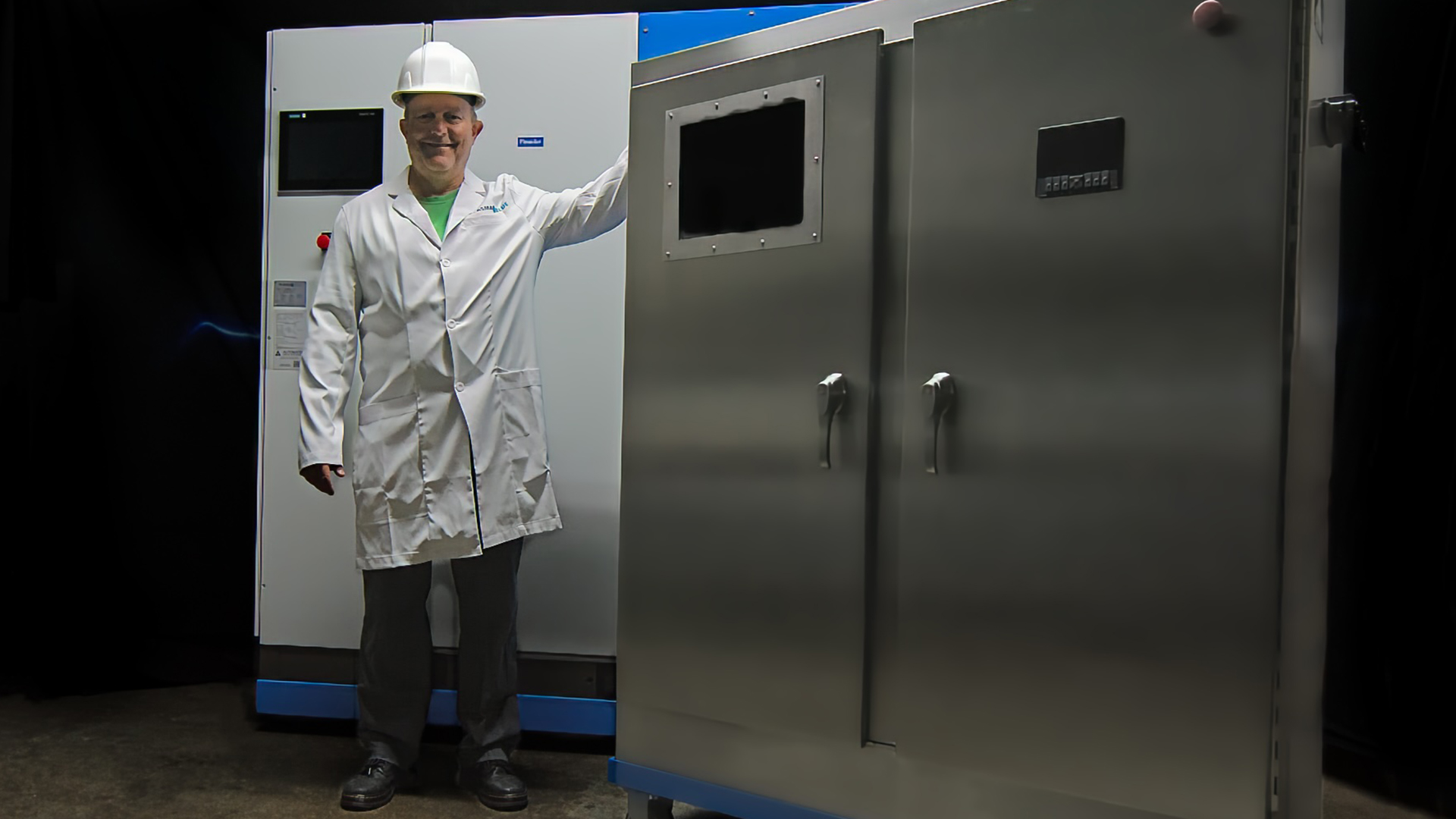
plasma blue unit
Plasma Blue offers customized modular systems that adapt the technology to different scales, from research units to industrial applications. The Plasma Blue system’s simplicity and small footprint keep the purchase price low.
All Plasma Blue units are customized to the client’s needs. These units have a small footprint, making them easy to transport. They are easy to install because they use standard electrical service, and work well in conjunction with enrichment technology because they work on high concentrations of PFAS, completing the work of enrichment technology by destroying PFAS on-site.

This option also allows you to reduce the capital cost of your plasma unit by reducing the overall unit capacity to match the amount of concentrate your existing system produces.
Plasma Blue technology is the only technology that can achieve this level of PFAS destruction with such low capital and operational expenditures.
“PlasmaBlue’s patented design is the key to harnessing the power of non-thermal plasma to convert PFAS back into elements,” Srnecka said. “The design is simple, compact, and easy to operate, and it is the only system known to achieve all of these simultaneously.”
About plasma blue
Plasma Blue is a Minnesota-based company specializing in advanced water treatment solutions using plasma technology. Plasma Blue focuses on harnessing the power of plasma to destroy contaminants and effectively disinfect water.
For more information, please visit Plasma-blue.com.
Please note: This is a commercial profile
This article will be published in the upcoming PFAS Special Focus Publication in April.
Source link
