


For more than a century and a half, life expectancy has steadily increased in the richest countries. In the 20th century, remarkable increases in life expectancy have been noted, correlating with declines in infectious diseases and advances in cardiovascular medicine.
But for several years, experts have been puzzled by one question: when does this clever mechanism malfunction? In some Western countries, increases in life expectancy are so small that they are virtually non-existent.
you may like
You can’t make a decision just by looking at national numbers. Behind the country’s life expectancy is a very contrasting and region-specific reality. This is what our research recently published in Nature Communications reveals. It analyzes data collected between 1992 and 2019 and focuses on 450 regions in Western Europe, home to approximately 400 million inhabitants.
European research on an unprecedented scale
To complete the research project, we collected mortality and demographic data from the national statistical offices of 13 Western European countries, including Spain, Denmark, Portugal, and Switzerland.
We started by harmonizing the original data. This work proved important because the regions vary in size and provide different amounts of data detail for each country.
We then recalculated the annual growth in life expectancy at birth for each region from 1992 to 2019. This is a measure that reflects mortality rates across all ages. Sophisticated statistical methods have allowed us to extract key underlying trends, regardless of short-term fluctuations caused by, for example, the 2003 heatwave or the 2014-2015 virulent seasonal influenza epidemic. We use 2019 as the deadline for our analysis, as it is still too early to know whether the coronavirus pandemic will have a long-term impact on these trends or whether they are limited to 2020-2022.
Our results provide an unprecedented panorama of regional longevity trajectories across Europe over almost 30 years, from which we make three findings.
First discovery: Human lifespan has not reached its limit.
The first message to emerge from this study is that we have not yet reached the limits of human lifespan. If we look at the regions that are champions in life expectancy (shown in blue in the chart below), we see that progress shows no signs of slowing.
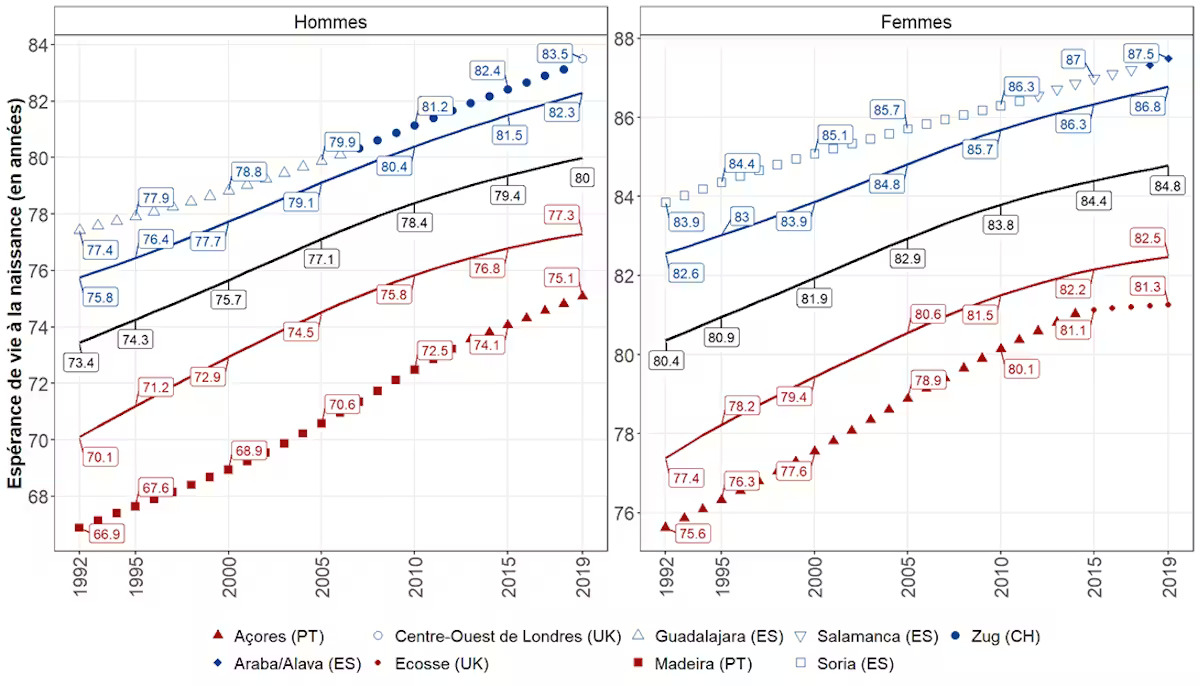
These regions continue to show that average life expectancy for men has increased by about 2.5 months and for women by about 1.5 months per year, at rates comparable to those observed in previous decades. In 2019, this includes regions of Northern Italy, Switzerland, and some Spanish states.
you may like
It will be featured alongside France, Paris and the surrounding Hauts-de-Seine or Yvelines regions (applicable to both men and women), Anjou and the Swiss border region (applicable only to women). In 2019, the average life expectancy reached 83 years for men and 87 years for women.
In other words, despite repeated concerns, there is currently no indication that lifespan advances have reached a glass ceiling. It is possible to extend life expectancy. This is a fundamental result, contradicts a blanket and alarming statement, and leaves room for improvement.
Second finding: regional diversity since the mid-2000s.
The picture looks murkier when you consider regions that are “laggard” in life expectancy rates, shown in red on the graph. During the 1990s and early 2000s, life expectancy increased rapidly in these regions. Progress has been much faster here than anywhere else, leading to convergence in regional life expectancy across Europe.
This golden age in Europe, when life expectancy rose rapidly and regional disparities narrowed, came to an end towards 2005. Life expectancy growth in the most difficult regions, such as East Germany, Belgium’s Wallonia, and parts of the United Kingdom, has declined so much that it has effectively stalled. For women, no French regions were included, but for men, several departments of Hauts-de-France were included.
Europe’s long-lived countries will eventually split into vanguard regions that continue to advance, on the one hand, and laggard regions, where power relations stall or even reverse, on the other. In contrast to the catch-up momentum of the 1990s, we are experiencing regional disparities.
Third finding: the decisive role of mortality at ages 55-74
Why such a shift? We sought to better understand this remarkable change by looking beyond age-specific life expectancy and analyzing how mortality rates have changed for each age group.
Regional disparities cannot be explained either by increases in infant mortality rates (which are still very small) or by increases in mortality rates for people aged 75 and over (which continue to slow everywhere). It is mainly due to deaths around the age of 65.
In the 1990s, this rate declined rapidly, thanks to access to cardiovascular treatments and changes in risk-taking behavior. However, since the 2000s, this upward trend has slowed. As shown in the map below, the risk of death for people aged 55 to 74 has increased in some areas in recent years.
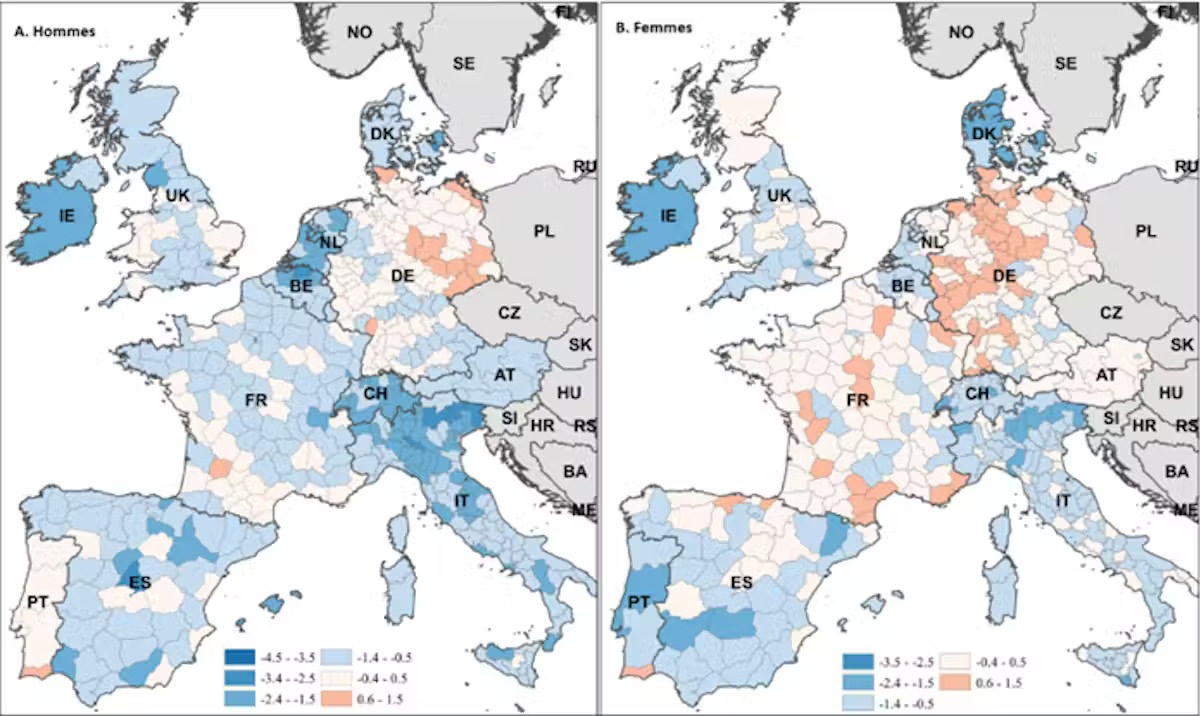
This is especially true for women living in the Mediterranean region of France (shown in light pink). The same is true in most parts of Germany. However, these intermediate ages are very important for the dynamics of life expectancy growth, as a large number of deaths occur here. A stagnation or jump in mortality rates from ages 55 to 74 is enough to break the overall trend.
Although our research was unable to pinpoint the exact cause explaining these disturbing advances, recent documentation provides some clues that should be scientifically tested in the future. These include risk-taking behaviors, especially smoking, drinking alcohol, poor nutrition, and lack of exercise, all of which are factors that emerge at this age.
Incidentally, the economic collapse of 2008 sharpened regional differences across Europe. While some regions continued to suffer permanently as the health of the population deteriorated, others recorded further growth with high concentrations of highly qualified employment. These factors remind us that longevity is not just about medical advances. It can also be explained by social and economic factors.
What’s next?
Our report provides a dual message. Yes, it is possible to extend your lifespan. Europe’s regional champions are proof of this, continuing their steady growth with no signs of plateauing. However, this progress is not for everyone. For 15 years, parts of Europe have lagged behind, largely due to rising mortality rates around the age of 65.
Even today, the future of human longevity appears to depend more on our collective ability to narrow the gap in life expectancy than on the existence of a hypothetical biological upper limit. Recent trends suggest that Europe is likely to end up with a two-tier system that distinguishes a few regions that continue to push the boundaries of longevity, and a large majority of regions that see diminishing returns.
In fact, the question is not only how much life expectancy can be increased, but also which parts of Europe.
This edited article is republished from The Conversation under a Creative Commons license. Read the original article.
Source link
