

The Roman Empire is famous for arenas like the Colosseum, where gladiators engaged in bloody skirmishes. But were any of these gladiators women?
Some evidence, including historical records and artistic depictions, suggests that female gladiators existed in the Roman Empire, but female gladiators were much rarer than male gladiators.
you may like
Who were the female gladiators?
In Rome, women tended to be excluded from politics and were not allowed to serve in the military. However, they had some freedom, and some even ran their own businesses or worked as doctors. They could own property and enter into contracts.
However, not much is known about female gladiators, so it can be difficult to know who they were and how they fought.
That said, the majority of male gladiators are enslaved people, and this probably applies to female gladiators as well. There were many ways a person could become a slave. After the war, people were sometimes enslaved as punishment for crimes, unpaid debts, or for other reasons.
“I believe that female gladiators were primarily slaves who committed crimes,” Anna Mieczewska, a lecturer at Maria Curie Skłodowska University in Poland who has researched and written extensively about female gladiators, told Live Science in an email. She pointed out that another source of female gladiators could be heavily indebted free women who sold their freedom to gladiator schools.
However, there were exceptions. The small number of male gladiators included members of the upper echelons of society. Perhaps the most famous is the Roman Emperor Commodus (ruled from 176 to 192 AD), who dressed up as the god Mercury and had the Senate watch his victorious battles to send a message about his power. Similarly, ancient texts suggest that several women from the upper classes also competed as gladiators.
The ancient Roman writer Tacitus (lived from about 56 to about 120 AD) wrote that in 63 AD during Nero’s reign, a great gladiator show was held by the emperor, during which “many eminent ladies and senators were humiliated in the arena.” (Translated by Mary Lefkowitz and Maureen Fant)
How did female gladiators compete?
Male gladiators tended to wear helmets and sometimes other forms of armor. They competed as specialized fighters such as retiarius, who fought using nets and tridents. Gladiators did this after some training, perhaps at gladiator school. Although some male gladiator fights end with the loser being killed, this is not always the case, and the death of a gladiator can be costly for those tasked with putting on a spectacle.
you may like

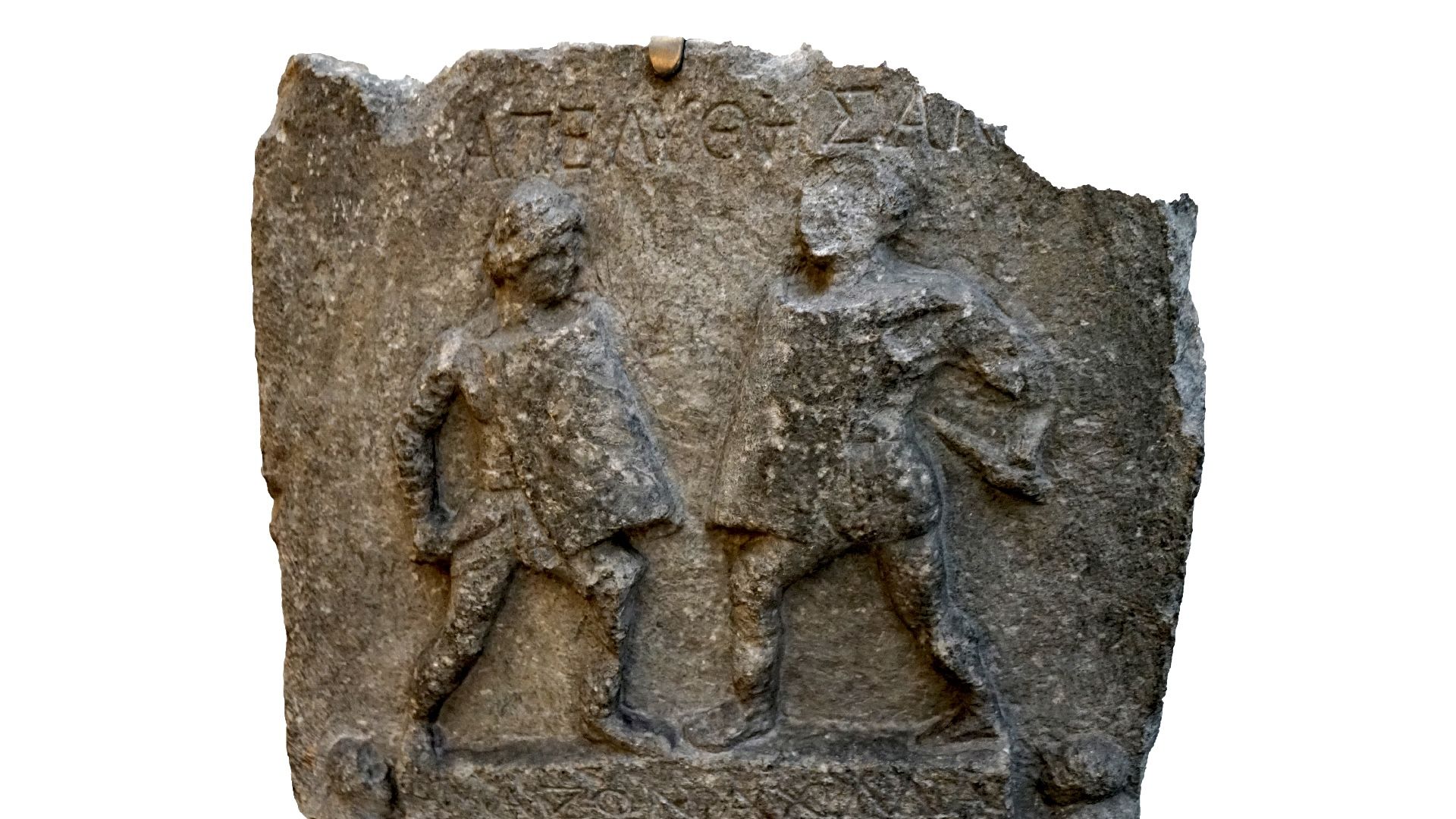
There is much uncertainty about how female gladiators competed and how they were selected and trained. A relief at Halicarnassus, in modern-day Turkey, depicts two female gladiators with shields and swords, and is given the stage name (probably mythological) Amazons vs. Achillea.
Stephen Brunette, professor emeritus of classics at the University of New Hampshire, noted that in a chapter of his book A Companion to Sport and Spectacle in Greco-Roman Antiquity (Wiley, 2013), two women are shown wearing armor associated with “provocateurs,” a type of gladiator similar to Roman soldiers. And, like many male gladiators, women are also depicted fighting with their breasts exposed. The women do not appear to be wearing helmets, but Brunet wrote that the artists may not have been wearing one. The inscription states that the women were “released standing” and that neither was killed.
The other is a statuette of a female gladiator. This work depicts a female gladiator holding a short, curved dagger called a shika, a type of weapon used by a type of gladiator called a “slaex.” However, just like in the relief, the female gladiator does not wear a helmet, only a loincloth and a scroll wrapped around her knees.

How were female gladiators selected?
Alfonso Mañas, a researcher at the University of California at Berkeley who identified the statuette as a female gladiator in 2011, told Live Science in an email that appearance may have played a large role in the selection of the female gladiator. Manyas pointed out that one of the earliest sources mentioning female gladiators is Nicholas of Damascus (lived from about 64 BC to 4 AD), who wrote that the women chosen to fight were not the strongest or most skilled, but rather “the most beautiful.” This document shows that the person who organized the gladiator contest had considerable influence over which women fought.
Mañas said textual references often refer to female gladiators performing in shows sponsored by Roman emperors. He said the use of female gladiators would likely be “a very expensive and exclusive show, with strong ties to the emperor, and therefore very few opportunities to be offered.”
Mañas said the female gladiators were likely told not to wear helmets so their faces could be seen by spectators. He also points out that there is no mention in the literature of female gladiators dying, and suspects that they were forbidden to fight to the death. Furthermore, although more than 1,000 tombstones of male gladiators have been recorded, no tombstones of female gladiators have yet been discovered.
Mañas said, “No one in Rome expected women to be skilled in the handling of weapons, to be brave in battle, or to have to face death in battle.” Mañas noted that the rules and perhaps the weapons likely have changed somewhat to reduce the risk of death.
Virginia Campbell, a lecturer at Britain’s Open University who has extensively researched gladiators, believes that physical strength probably plays a role in the selection of female gladiators. “Gladiators are expensive to train and maintain, so the selection of women and men will depend, at least in part, on physical strength and fighting ability,” Campbell told Live Science via email. “At the end of the day, gladiators are for fun, not for dying, so it would be in the best interest of the nation.” [owner] To make smart choices when choosing [fighters]. ”
Even though their beauty was emphasized, some viewers were moved by their fighting style. The poet Statius (who lived between 45 and 96 AD) wrote of the female gladiators fighting in a show: “You would think that a band of Amazons were fighting on the banks of the Tanais River…” (translation by Mary Lefkowitz and Maureen Fant).
Source link
