

We advance artificial intelligence (AI) solutions in the energy sector through our test and laboratory facilities across Europe.
As the energy landscape has changed significantly in recent years, the evolving energy sector is increasingly seeking AI solutions. Rapid advances in digitalization and AI are accelerating this change, requiring stakeholders to strengthen their capabilities and embed AI into their operations and services. As organizations undertake this digital transformation, the demand for trusted AI expertise continues to grow. EnerTEF responds by developing a data space-compliant, centralized access marketplace that integrates multiple thematic nodes across Europe, enabling the co-creation of reliable and validated AI solutions and bridging the gap between energy stakeholders and AI experts.
EnerTEF central platform
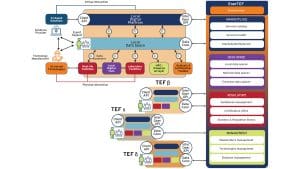
Within the project, a central platform will serve as a one-stop shop connecting energy stakeholders and AI experts. Energy stakeholders are publishing detailed descriptions of the required services, along with physical and digital assets available for experimentation, so AI providers can access relevant data, information, and existing tools to develop solutions. Through federated nodes, AI providers will have access to high-performance computing resources and AI workbenches to design, run, and evaluate experiments within the platform. All data is accessed through a dedicated data space, ensuring secure and transparent exchange and governance. In this way, EnerTEF establishes a complete energy and AI ecosystem where stakeholders can connect, define collaborations and transactions, express business needs and validate AI services, laying the foundation for a centralized European energy market.
nodes and satellites
EnerTEF will be implemented in stages, starting with an initial operational network that demonstrates the platform’s capabilities in real-world conditions. The first phase will focus on validating approaches, processes, and services with core facilities and stakeholder groups. The results will support broader commercial deployment of the platform and onboarding of additional participants. In this initial deployment, EnerTEF is configured around the following TEF nodes and satellites:
Tefless
Leveraging sites in Greece and Portugal, the TEF RES node focuses on leveraging diverse datasets from renewable energy facilities. These include hydroelectric power plants, solar farms, wind farms, and marine renewable energy, including wave power. Asset owners use nodes to express needs that AI providers can address, such as power generation forecasting, predictive maintenance, fault detection, monitoring, and operational optimization. To accelerate this effort, existing solutions and assets originating from previous EU projects, such as AI-based forecasting and time series analysis tools, will be integrated into the EnerTEF Marketplace to support experimentation and help validate and compare service results.
Teff EV
Based in Luxembourg’s energy community, EV Node develops and validates services centered around a network of electric vehicle (EV) chargers. EVs are becoming an important asset within the energy community as they support regional balance, introduce flexibility that can reduce peaking and increase the use of locally produced renewable energy. This community also integrates complementary assets such as solar power systems, wind farms, and battery storage, enabling integrated scenarios. Priority services include EV flexibility, renewable generation and charging optimization for available battery capacity, AI-enhanced multi-agent systems for vehicle-to-grid applications, EV-driven demand forecasting, and more.
Tef Tso
The TEF TSO node, hosted in Slovenia, aims to enhance the utilization of existing equipment and resources by enabling structured collaboration with AI experts. Its physical and virtual backbone is the ELES Diagnostics and Analytics Center, which integrates big data capabilities, advanced analytics, and strong technical expertise. ELES and Elektro Gorenjska will act as end users on behalf of TSO and DSO, respectively, and will actively contribute to the validation, demonstration and fine-tuning of the developed AI services. The priority services of this node focus on power management, fault detection and identification, and grid stability assessment.
TEF DSO
TEF DSO nodes are focused on developing AI solutions that support power distribution grid services for monitoring, control, and automation. The Germany-based company leverages a real-time digital simulation environment that can generate high-quality synthetic data, enabling rapid development, testing, and validation of services even when field data access is limited. This setup supports use cases such as grid condition estimation and anomaly detection, fault localization, predictive maintenance, and operational optimization, and helps DSOs evaluate AI tools in a controlled and repeatable setting.
teff build
Greece’s TEF BUILD node supports the city of Athens’ digitalization and energy transition by leveraging building information, energy data, and local assets such as solar power systems and EV chargers. The focus is on enabling smarter, decarbonized cities and empowering facility managers to make better decisions that deliver measurable energy and financial savings. The most needed services include AI-powered building consumption optimization, monitoring and fault detection, predictive maintenance, and building self-consumption maximization.
Hydrogen, industrial and district heating network satellite
The three small satellite nodes, based in France, Greece, and Spain, focus on AI services for hydrogen energy systems, industry, and district heating and cooling networks, respectively.
The TEF Hydrogen Node supports the development of AI-driven energy management, control, and predictive maintenance services, with a focus on applications in fuel cell hybrid electric vehicles and hydrogen-enabled microgrids. The TEF Industry node targets AI solutions for process planning optimization and sustainable supply chains, including improved production scheduling and manufacturing process modeling. TEF district heating network nodes prioritize demand forecasting, energy consumption optimization, and operational decision support, building on existing DHN physical infrastructure and digital twins that provide the virtual environment and data needed for experimentation and validation.
Impact on the energy sector
EnerTEF accelerates Europe’s energy transition by turning real stakeholder needs into trusted and verified AI services. Accelerate time-to-deployment, enhance interoperability and cybersecurity, enable cross-border collaboration, and enable AI solutions to scale across the energy value chain. It also creates a repeatable path toward broader adoption by integrating new stakeholders, nodes, and market-enabled services over time.
This article will also be published in the quarterly magazine issue 25.
Source link
