


The AI browser wars are coming to a desktop near you and you should start worrying about security challenges.
For the past 20 years, whether you’re using Chrome, Edge, or Firefox, the basic paradigm has remained the same. That is, it is a passive window through which human users view and interact with the Internet.
Those days are over. We are currently witnessing a change that makes the old OS-centric browser debate irrelevant. The new battleground is the agent AI browser, and for security professionals, this represents a frightening reversal of the traditional threat landscape.
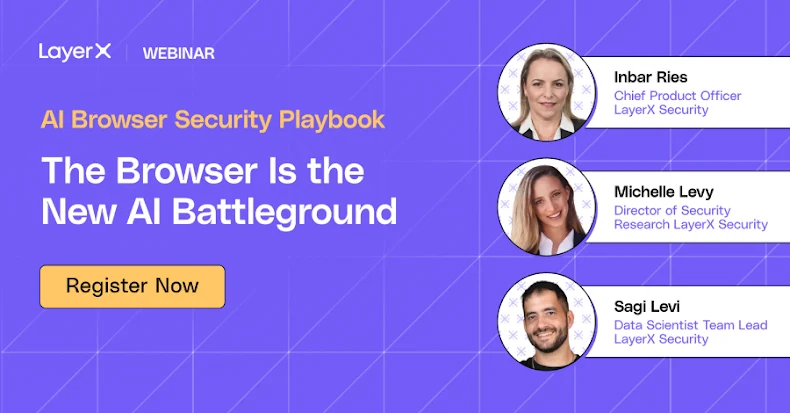
A new webinar details the AI browser issue, its risks, and how security teams can address it.
Browsers are still the primary interface for AI usage. This is where most users access AI assistants like ChatGPT and Gemini, use AI-enabled SaaS applications, and work with AI agents.
AI providers were the first to realize this, and recent months have seen a flurry of new “agent” AI browsers released and AI vendors such as OpenAI releasing their own browsers. They were the first to understand that the browser is no longer a passive window for browsing the internet, but an active battleground where AI wars will be won or lost.
While previous generations of browsers were tools that focused users on vendor-preferred search engines and productivity suites, new generations of AI browsers focus users on their respective AI ecosystems. And this is where the browser is transforming from a neutral, passive observer to an active, autonomous AI agent.
From read-only to read/write: the agent leap forward
To understand risk, you need to understand changes in functionality. Until now, even “AI-enhanced” browsers with built-in AI assistants and AI chat sidebars were primarily read-only. They can summarize the page you’re viewing or answer your questions, but they can’t take any actions on your behalf. They were passive observers.
The new generation of browsers, like OpenAI’s ChatGPT Atlas, are more than passive viewing tools. they are autonomous. Designed to bridge the gap between thought and action. Instead of statically displaying information for a user to manually book a flight, you can give them the command, “Book the cheapest flight to New York next Tuesday.”
The browser then autonomously navigates the Document Object Model (DOM), interprets the UI, enters data, and performs financial transactions. It’s no longer a tool. It’s a digital employee.
Security Paradox: Must Be Vulnerable to Work
There’s a counterintuitive reality here that goes against conventional security wisdom. Traditional security models protect systems by restricting privileges (the principle of least privilege). However, agenttic browsers require maximum privileges to realize their value proposition.
AI agents cannot be outsiders booking flights, navigating paywalls, or completing visa applications on your behalf. You must hold the keys to your digital IDs, such as session cookies, saved credentials, and credit card details.
This creates an unprecedentedly large attack surface. We are effectively removing the primary safeguard against context-based attacks: human interaction.
Increased authority and autonomy create a deadly trifecta
The white paper identifies a particular convergence of factors that make this architecture uniquely risky for enterprises.
Access to sensitive data: The agent retains the user’s authentication token and PII. Exposure to untrusted content: Agents autonomously ingest data from random websites, social feeds, and emails in order to function. External communication: Agents can run APIs, fill out forms, and submit data.
The risk here is not just that the AI will “hallucinate.” The risk is immediate injection. A malicious attacker could hide text on a web page that is invisible to humans but readable to AI, instructing the browser to ignore previous instructions and leak the user’s last email to this server.
Because the agent operates within an authenticated user session, standard controls such as multi-factor authentication (MFA) are bypassed. The bank or email server sees a valid user request, but has no idea that the “user” is actually a compromised script running at machine speed.
Blind Spots: Why Your Current Stack Fails
Most CISOs rely on network logs and endpoint detection to monitor threats. However, the Agentic browser also works effectively with “session gaps.” The agent interacts directly with the DOM, so certain actions (clicking a button, copying a field) occur locally. Network logs only show encrypted traffic to the AI provider, completely hiding any malicious activity that occurs within the browser window.
A new strategy for defense
The integration of AI into the browser stack is inevitable. The productivity gains are too large to ignore. However, security leaders should treat agentic browsers as a separate class of endpoint risk separate from standard web surfing.
To protect the environment, organizations must immediately move to:
Audit and Discovery: You can’t protect what you can’t see. Scan endpoints dedicated to “shadow” AI browsers, such as ChatGPT Atlas. Enforce allow/block lists: Restrict AI browser access to sensitive internal resources (HR portals, code repositories) until the browser’s security maturity is proven. Increased protection: Relying on native browser security is currently a failed strategy. Third-party anti-phishing layers and browser security layers are no longer optional, but the only thing standing between prompt injection and data leakage.
Browsers are no longer neutral windows. It’s actively participating in your network. It’s time to make sure it stays that way.
To help security leaders navigate this paradigm shift, LayerX is hosting an exclusive webinar that goes beyond the headlines. In this session, we take a deep technical dive into the architecture of Agentic AI and uncover certain blind spots that traditional security tools miss, from “session gaps” to indirect prompt injection mechanisms. Beyond the theoretical risks, participants will have a clear, practical framework for detecting AI browsers in their environment, understanding security gaps, and implementing the controls needed to future-proof their agents.
Source link
