

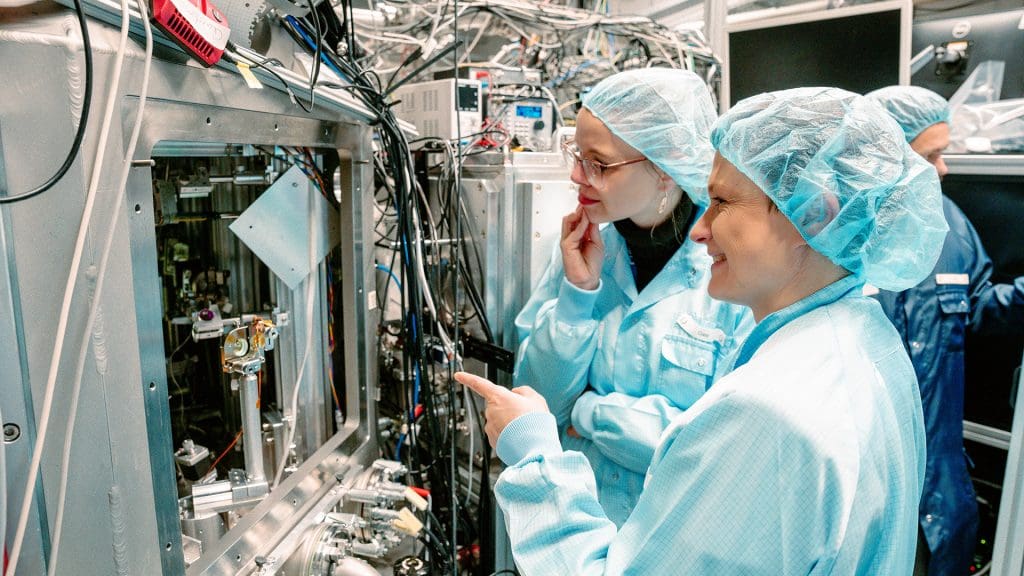
SAXFUSION connects research institutes with Saxony’s traditional industry to develop commercial opportunities in fusion energy technology.
Nuclear fusion has long captivated human imagination. It’s the ultimate clean energy promise. It is the power of the stars that falls on the earth. In an era defined by climate urgency, geopolitical instability, and accelerating global demand for reliable energy, nuclear fusion is no longer just a scientific aspiration. It is increasingly seen as an industrial and strategic necessity. The same reactions that fuel the sun offer the prospect of abundant carbon-free and inherently safe sources of energy, but only if we can translate today’s scientific advances into tomorrow’s industrial capabilities.
That translation does not happen in isolation. Convergence requires an ecosystem, a place where research excellence, industrial strength and political foresight come together with a common purpose. And Saxony, in the heart of Europe, aims to become just that kind of ecosystem.
Pioneering fusion research and development in Saxony
SAXFUSION is the state’s coordinated response to the fusion challenge. It is envisioned as a specialized competence network for fusion technology in Saxony, uniting the region’s leading research institutes, universities and industrial partners under one strategic roof. Rather than waiting for fusion to emerge as a finished technology, SAXFUSION is creating the conditions that will allow Saxony, and by extension Germany and Europe, to play a decisive role in the global fusion economy.
At the core of this network stands Helmholtz Zentrum Dresden Rossendorf. With the internationally recognized Radiation Physics Laboratory and its high-power laser systems DRACO and PENELOPE, the European XFEL Helmholtz beamline for extreme fields, and the CASUS Center for Advanced Systems Understanding, HZDR provides the scientific backbone for SAXFUSION. Its researchers work at the forefront of plasma-matter interactions, high-power laser experiments, and artificial intelligence-driven modeling. Their expertise goes beyond simply advancing fusion science. It enables the technology needed for future nuclear reactors.
Translating this scientific capability into industrial reality is the mission of the Fraunhofer Institute for Materials and Beam Technology IWS. Fraunhofer IWS, known for its strengths in advanced manufacturing and technology transfer, brings an important dimension to the network: expansion capabilities. This ensures that innovations emerging from the lab can be adapted, designed and ultimately produced for the industrial market.
Fraunhofer IFAM complements this strength with deep expertise in powder metallurgy, additive manufacturing, and the development of alloys designed to withstand extreme thermal and mechanical stresses. Fusion systems will operate under some of the harshest conditions ever designed, so IFAM’s work is critical to developing materials that can withstand and function reliably in such environments. Existing expertise in hydrogen technology provides a strong foundation for making significant contributions to fuel supply and processing.
The Dresden University of Technology is one of Europe’s most reputed institutions and offers academic depth in the fields of nuclear science, fusion neutronics, laser-based high-performance materials and molten salt technology. Utilizing both the AKR-2 training reactor and the DT neutron generator, the university is not only advancing technological knowledge, but also training the next generation of engineers and physicists who will build and operate future fusion power plants.
The network’s technological prowess is further enriched by two prominent Leibniz institutes. The Leibniz Institute for Solid State Materials, IFW Dresden, focuses on the development and characterization of advanced structural materials, while the Leibniz Institute for Surface Engineering, IOM Leipzig, offers cutting-edge knowledge in surface engineering and precision optical finishing. These areas are not peripheral to fusion, but fundamental to ensuring reactor longevity and system efficiency.
These institutions will work together to create a comprehensive converged ecosystem across plasma science, materials research, optics, manufacturing, and digital simulation. It is this breadth, this integration, that gives SAXFUSION its unique character and strategic value.
intensive activity program
During its three-year development phase, SAXFUSION is focused on four key technology pillars: Laser and optical technologies are formed first, as high-energy laser systems are essential for starting and controlling fusion plasmas. The second pillar focuses on the development of fuel capsules and fusion targets. This field is particularly relevant to the concept of inertial confinement fusion. The third pillar addresses reactor materials that must withstand intense radiation and heat loads. And the fourth pillar is simulation, artificial intelligence and data management, and analytics for convergence. Here, leadership in the region is already internationally recognized, with high-performance codes such as PIConGPU and ISHTAR enabling advanced multiscale modeling of fusion plasma and material behavior.
The emphasis on simulation is more than an academic benefit. This will enable SAXFUSION to create digital twins of fusion research infrastructure and future power plants, dramatically accelerating design cycles and improving system reliability. For complex technologies like convergence, digital capabilities are the basis for industrial readiness.
What makes SAXFUSION particularly appealing is its relevance to today’s industry. Although commercial fusion reactors are still under development, global fusion programs and commercial fusion companies are already defining future manufacturing and materials requirements. Companies that establish themselves early can become essential partners within the global fusion supply chain.
However, for many small and medium-sized businesses, convergence remains a difficult area to access. Technical limits are high and the strategic outlook can appear uncertain. SAXFUSION lowers these barriers. It provides structured access to knowledge, partners and innovation pathways to help companies assess their capabilities, identify market potential and develop long-term engagement strategies.
Beyond consulting and competency mapping, SAXFUSION also serves as a platform for visibility and collaboration. Companies and institutions become part of a living network that shares information, hosts events, and fosters exchanges between science, industry, and policy makers. In doing so, SAXFUSION fosters not only technology development but also the transparent, fact-based public dialogue that is essential for widespread societal acceptance of fusion energy.
Regionally, this initiative will strengthen Saxony’s innovation environment and ensure the retention and expansion of local talent and expertise. Nationally, Saxony ranks as a major contributor to Germany’s high-tech energy plans. Internationally, it connects the region with European and global convergence networks and strengthens its role as a competitive and forward-looking technology hub.
This strategic ambition is backed by long-term funding. With support from the European Regional Development Fund (EFRE) and the Free State of Saxony, SAXFUSION benefits from the political and economic efforts necessary to create a sustainable structure for both fusion research and industry.
Building a foundation that enables fusion
After all, fusion isn’t just about the energy of the future. It’s about the industries, skills and infrastructure we build today to enable that future.
SAXFUSION embodies this philosophy. It brings together Saxony’s scientific excellence, industrial capabilities and academic leadership to form a powerful and coordinated engine for fusion innovation. It strengthens dialogue, opens new markets and prepares the region to play its role in the next generation of global energy technologies.
SAXFUSION represents a step towards the future, cooperation and Saxony’s determination into the era of fusion energy.
Please note: This is a commercial profile
This article will also be published in the quarterly magazine issue 25.
Source link
