
The first results from the world’s largest neutrino detector have just been published, revealing the most accurate measurements of neutrino parameters to date.
After operating the detector at the Jiangmen Underground Neutrino Observatory (JUNO) in southern China for just under two months, researchers were able to measure the parameters of different types, or “flavors,” of neutrinos with unprecedented precision.
you may like
“Before switching on JUNO, these parameters were obtained from a long series of experiments…The numbers for these two parameters encapsulate half a century of effort,” JUNO deputy spokesperson Gioacchino Ranucci told Live Science. “In 59 days, we have overcome 50 years of measurements, which shows you how powerful measurements can be. [JUNO] teeth. “
The ghostly mystery of neutrinos

Neutrinos are perhaps the most mysterious of all known particles. Trillions of them pass through your body every second. But they rarely interact with you or other matter, and they weigh almost nothing, giving them the nickname “ghost particles.” This makes neutrinos one of the most difficult particles to study, as most particles pass through detectors without leaving a trace.
But physicists are eager to learn more about neutrinos. This is because neutrinos may be able to break the standard model of particle physics, which best explains the world of elementary particles. This is an incredibly successful theory, but it’s not perfect. And it could not be predicted that neutrinos have mass.
The discovery that ghost particles actually have mass (winner of the 2015 Nobel Prize in Physics) is due to something called neutrino oscillations. There are three types of neutrinos (electrons, muons, and tau), and these properties switch as they move through time and space. The reason for this strange phenomenon is still not fully understood, but it may hold the key to exciting new physics.
“The oscillation phenomenon means that neutrinos are so far the only particles with properties not predicted by the Standard Model,” Ranucci said. “So neutrinos are the only gateway to physics beyond the Standard Model.”
To study the properties of neutrinos and explore beyond the Standard Model, scientists have built large detectors deep underground. Here, while the Earth’s crust forms a natural shield from most other particles, ghost particles have a chance to pass through and make their presence known in the detector.
you may like
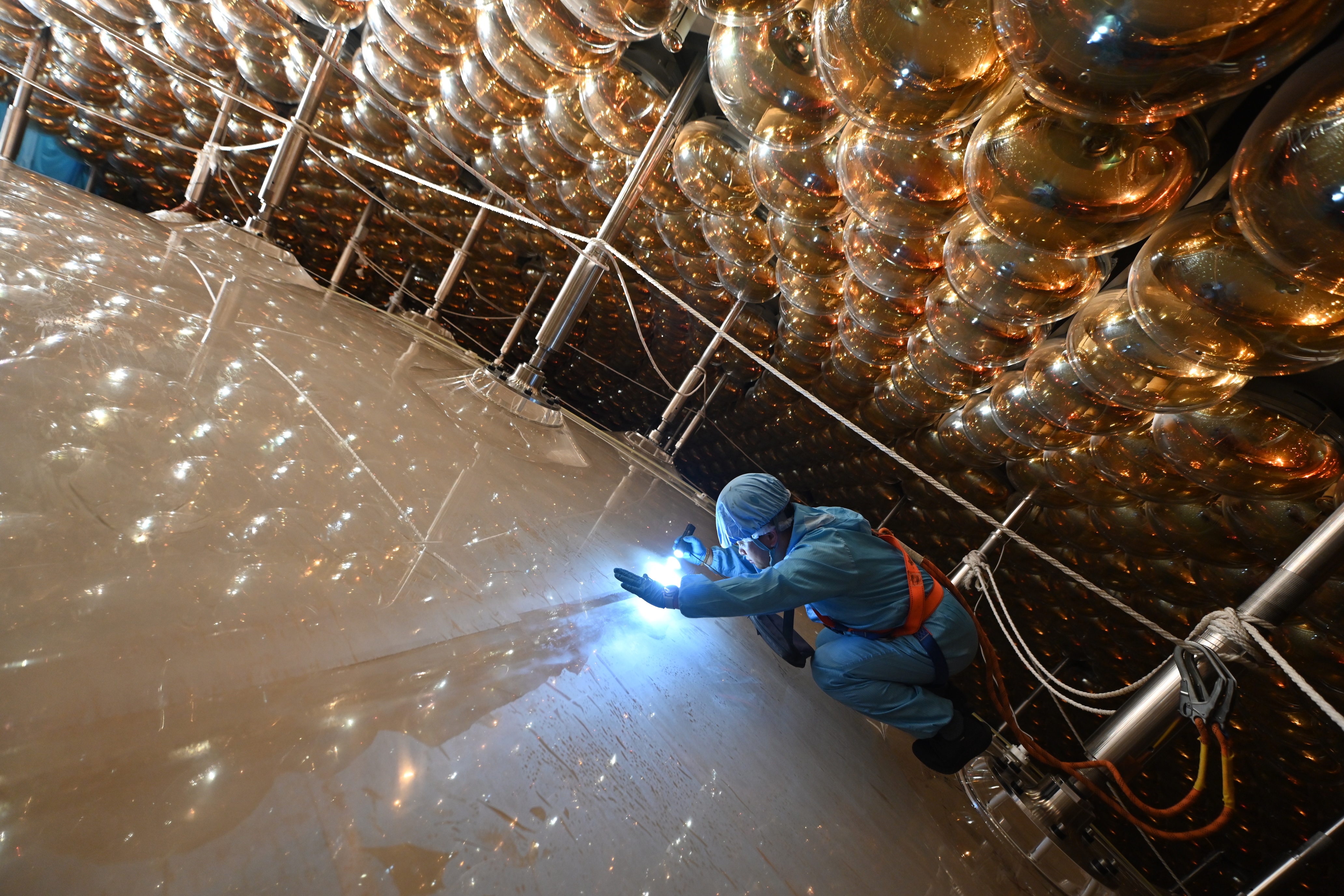
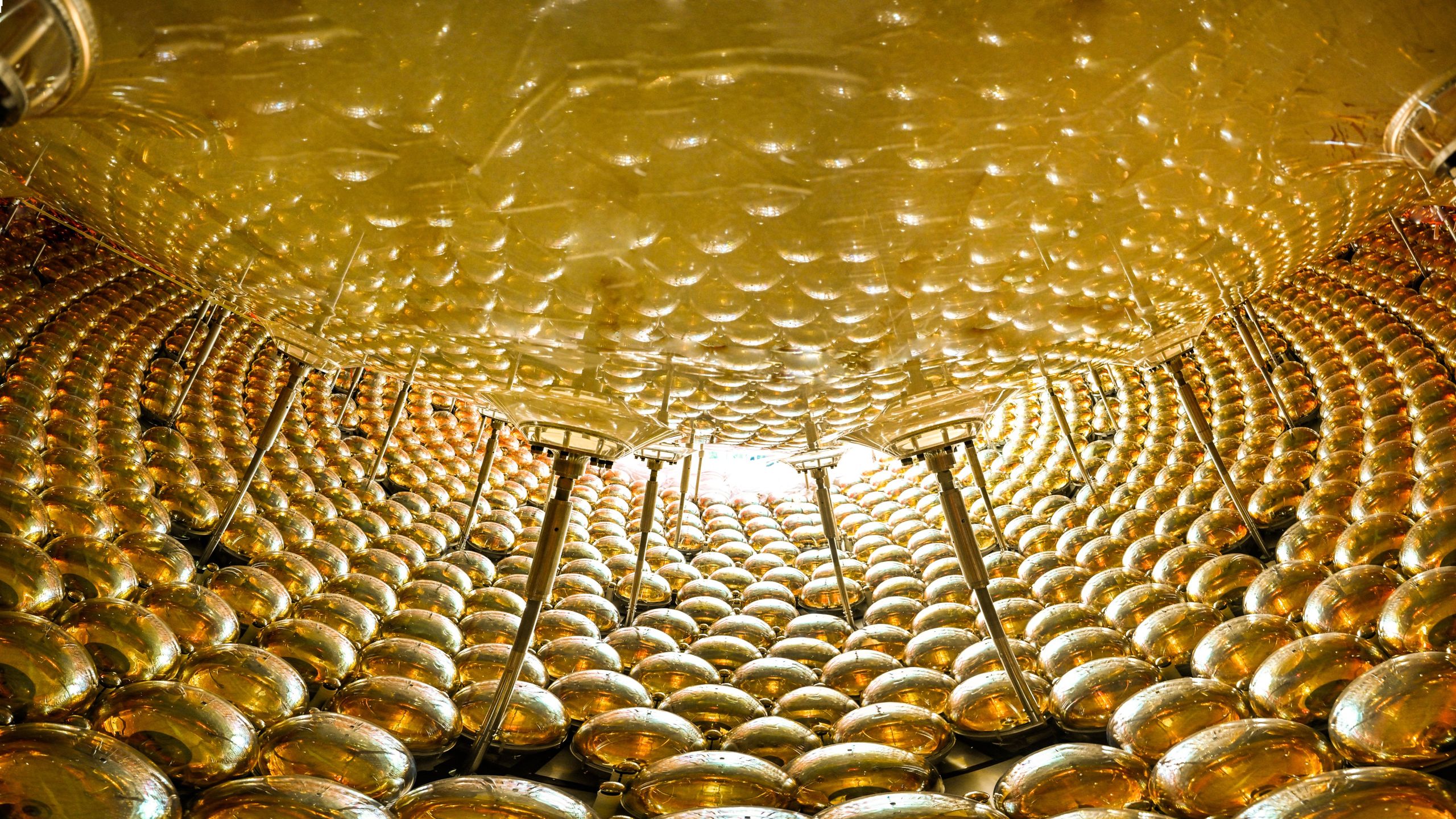
JUNO is the newest and largest of these neutrino detectors. It is a 115-foot (35-meter) wide sphere that holds 19,700 tons (20,000 tons) of liquid scintillator. This liquid is specially formulated to interact with neutrinos to produce a flash of light. Around the edge of the tank are sensors that can pinpoint the location of the flash and provide useful information about the neutrinos that caused it.
Previous neutrino detectors worked on the same principle. JUNO is simply big. This included 20 times more liquid scintillators than previous experiments, greatly increasing JUNO’s sensitivity to neutrinos. The researchers say this allows physicists to measure parameters that describe the oscillations between different neutrino flavors with unprecedented precision.
Exploration of new physics
The JUNO team has high ambitions for the future and these first results show they are on track to achieve that goal. The researchers hope to use more time and more data to achieve even higher accuracy on these vibration parameters.
Over its lifetime, JUNO may be able to solve some of the oldest mysteries in physics. Physicists hope to be able to order the mass states of neutrinos from heaviest to lightest, and perhaps even find clues as to why there isn’t as much antimatter as matter in the universe.
For now, these ghostly particles offer fascinating whispers of physics beyond current theory. With the advent of larger and better neutrino detectors, our understanding of the universe is becoming clearer.
