


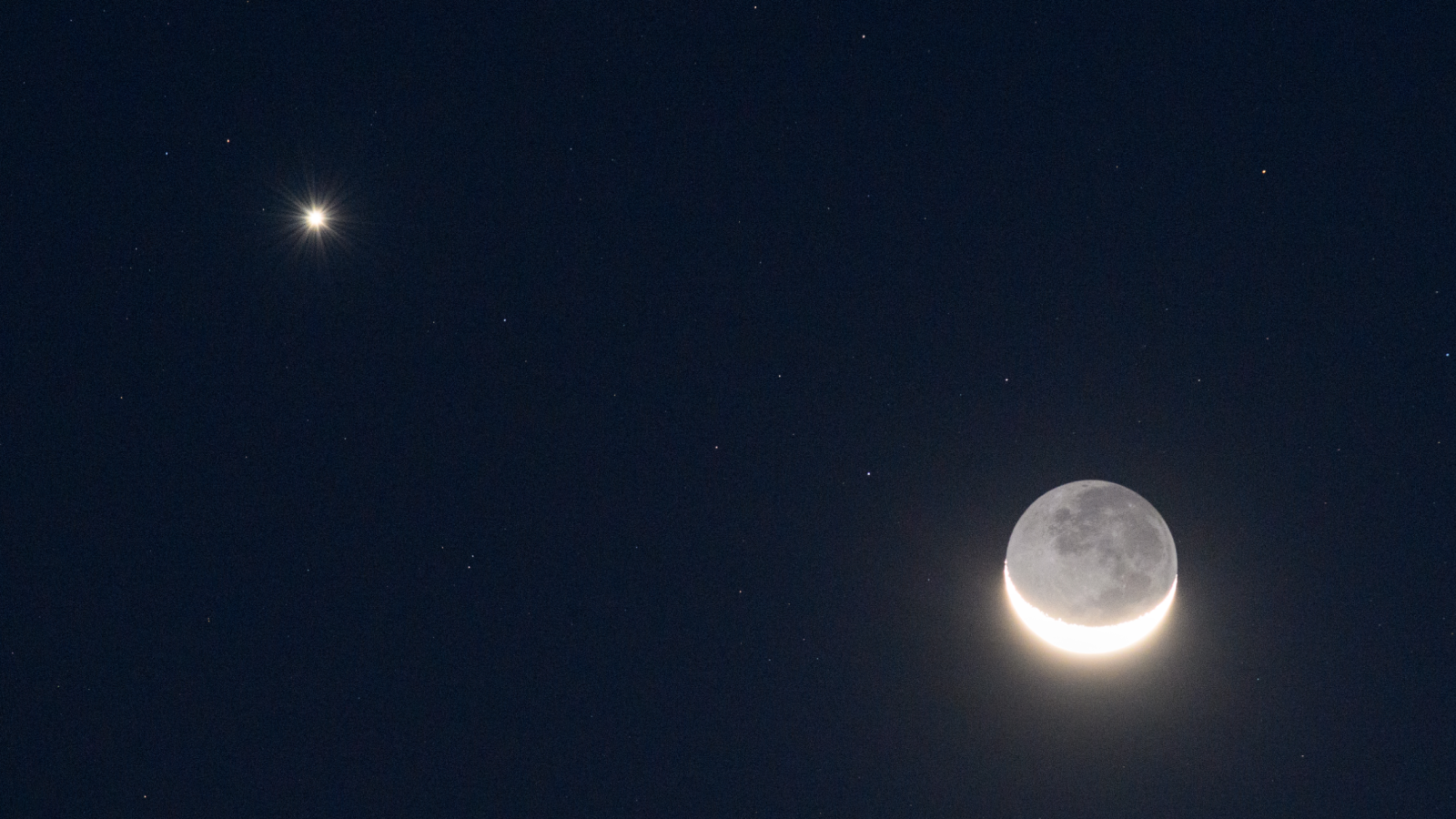
If you look up at the sky at dawn or dusk when there is not a single cloud in the sky, you will easily spot Venus. Appearing as a bright, steady, glowing speck, it is the second brightest object in the night sky, after the moon.
“This planet is about 100 times brighter than a first-magnitude star,” Anthony Malama, a researcher at the IAU’s Dark and Quiet Sky Conservation Center, told LiveScience in an email. A first magnitude star is the brightest star visible in the night sky. For example, looking at the average brightness, the first magnitude star Sirius is -1.47 and Venus is -4.14 (dimmer objects have more positive magnitudes on the scale used by astronomers).
you may like
reflective cloud cover
Venus’ brilliance is primarily due to the planet’s high albedo, or the amount of light reflected from its surface. Venus has an albedo of 0.76, meaning Venus scatters about 76% of the sunlight it receives into space, said Sanjay Limay, a distinguished scientist at the University of Wisconsin-Madison’s Center for Space Science and Engineering. In contrast, a perfect mirror reflects 100%, the Earth reflects 30%, and the Moon has a low albedo, reflecting only 7% of the light that hits it.
Venus’ high albedo results from its thick all-encompassing cloak of clouds. A 2018 review of data from space missions to Venus in the 1970s and 1980s found that these cloud layers, which extend from 30 miles to 43.5 miles (48 to 70 kilometers) above Venus’s surface, have cushions between layers of haze, most of which are suspended droplets of sulfuric acid. Limaye pointed out that such droplets are very small, most about the size of bacteria. Together, the water droplets and the haze layer scatter sunlight very efficiently.

However, Venus is not the brightest object in the solar system. A 2010 study found that Saturn’s icy moon Enceladus has a high albedo of about 0.8. But when viewed from Earth, this space object appears much dimmer than Venus. Because it is far from the sun. Earth’s “morning star” is 67 million miles (108 million km) from the Sun, but Enceladus is at least 13 times further away. The inverse square law shows that Venus receives 176 times more light as a result compared to Enceladus, giving Venus a significant advantage.
distance from earth
Venus’s proximity to Earth also affects its brightness. The average distance between Venus and Earth is 105.6 million miles (170 million km). In some cases, Mercury is the closest planet to Earth at an average distance of 96.6 million miles (155.5 million km), but Venus appears brighter because it is 7,521 miles (12,104 km) larger compared to Mercury.
However, the distance of Venus from our planet, and as a result its apparent brightness, is not fixed. At its closest approach, when Venus is directly between Earth and the sun, it will be only 24 million miles (about 38 million km) away, according to NASA. However, according to the National Astronomical Observatory of Japan, it is actually very dark at this point, called the lower alignment.
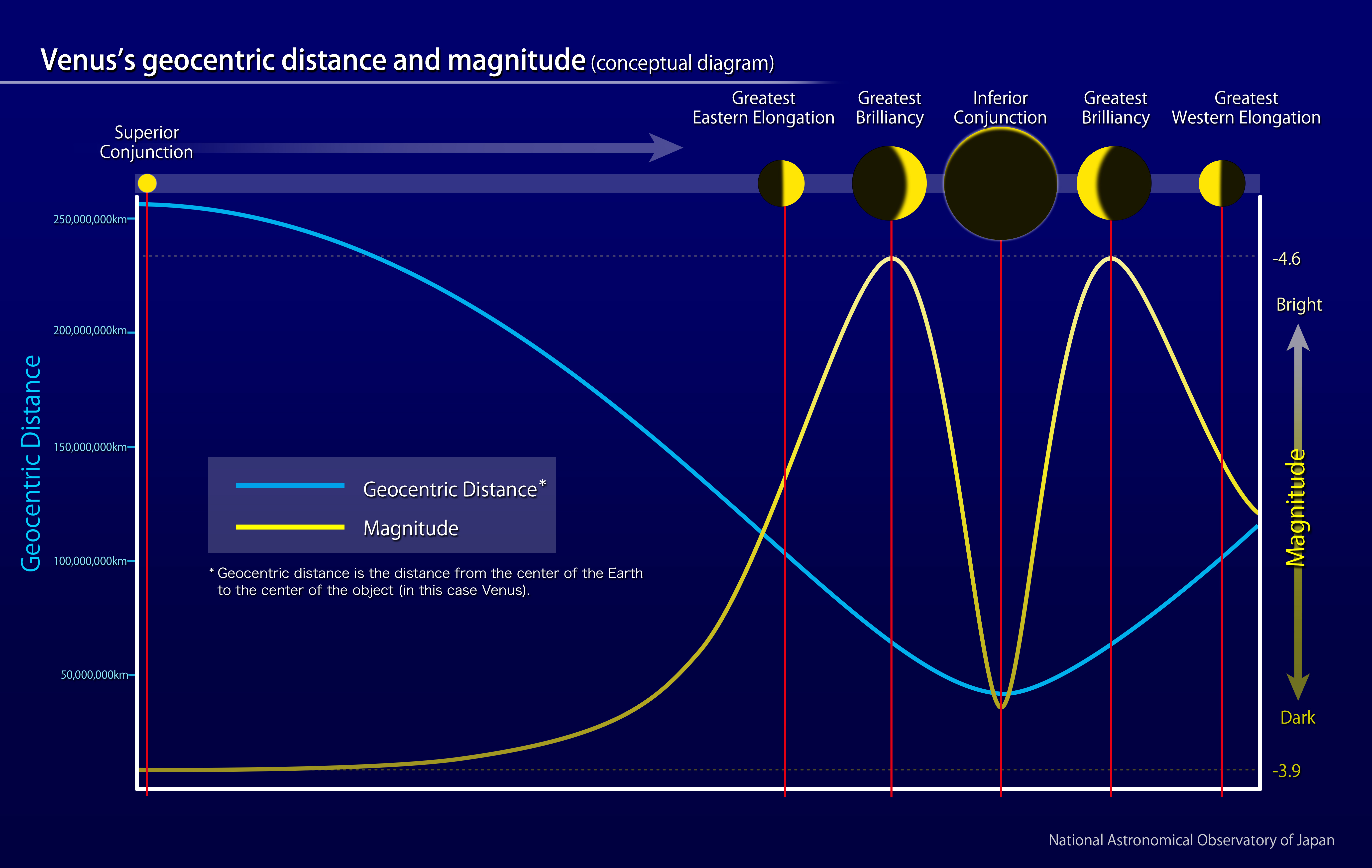
This happens because the inner planet exhibits a moon-like phase when viewed from Earth, Limae said. At the inferior conjunction, Venus’ illuminated surface is completely invisible from Earth. In contrast, most of Venus’ illuminated surface is only visible when Earth and Venus are on opposite sides of the Sun, in a position called superior conjunction. However, at this point Venus is the smallest and very far from Earth, so it is very faint.
rainbow-like phenomenon
Venus is at its brightest when only a crescent-shaped sliver of its sunlit surface is visible. This point, called the point of maximum brilliance, usually occurs one month before or after the Infair conjunction. A 2006 study co-authored by Marama suggested that at this stage Venus’ suspended sulfuric acid droplets are scattering sunlight back toward Earth. “This phenomenon is called glory and is part of the same family of optical effects that includes rainbows,” Marama explained.
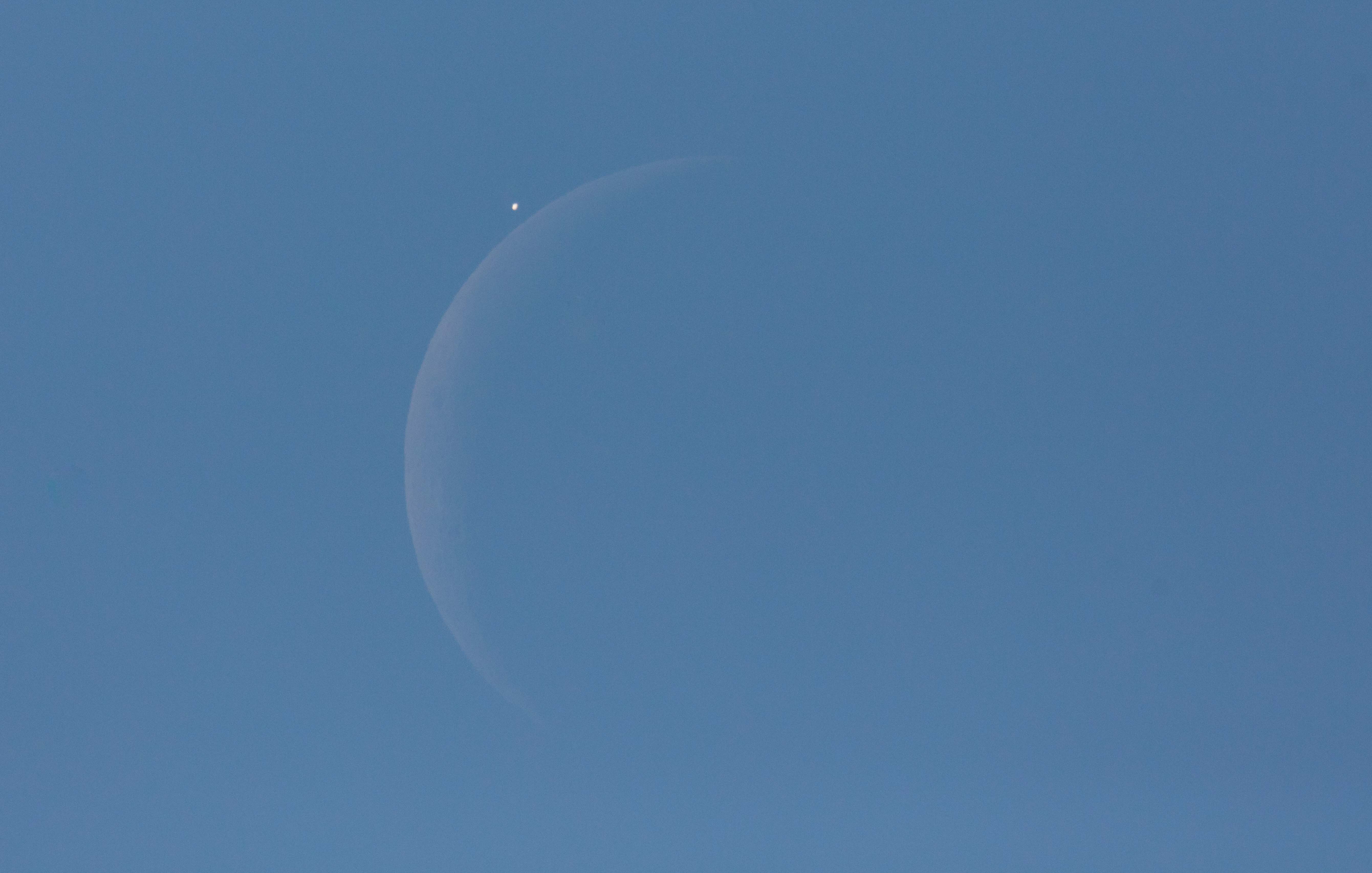
A 2018 study found that changes in albedo, distance from Earth and the Sun, and phase relative to Earth can all combine to cause Venus’ brightness to vary from -4.92 to -2.98. However, it is still bright enough that Venus can be observed for most of the year even from urban areas.