Close Menu
  • Home
  • Identity
  • Inventions
  • Future
  • Science
  • Startups
  • Spanish
What's Hot

Unmasking new TOAD attacks hidden in legitimate infrastructure

Fortinet patches CVE-2026-24858 after active FortiOS SSO exploit detected

Everything you need to know about the viral personal AI assistant Clawdbot (now Moltbot)

Facebook X (Twitter) Instagram
  • Home
  • About Us
  • Advertise with Us
  • Contact Us
  • DMCA
  • Privacy Policy
  • Terms & Conditions
  • User-Submitted Posts
Facebook X (Twitter) Instagram
Fyself News
  • Home
  • Identity
  • Inventions
  • Future
  • Science
  • Startups
  • Spanish
Fyself News
Home » James Webb Telescope discovers ‘Dawn Goddess’ supernova just 1 billion years after Big Bang
Science

James Webb Telescope discovers ‘Dawn Goddess’ supernova just 1 billion years after Big Bang

userBy userJanuary 20, 2026No Comments3 Mins Read
Share Facebook Twitter Pinterest Telegram LinkedIn Tumblr Email Copy Link
Follow Us
Google News Flipboard
Share
Facebook Twitter LinkedIn Pinterest Email Copy Link

Scientists have discovered a distant supernova caused by a collapsing star just a billion years after the universe’s birth.

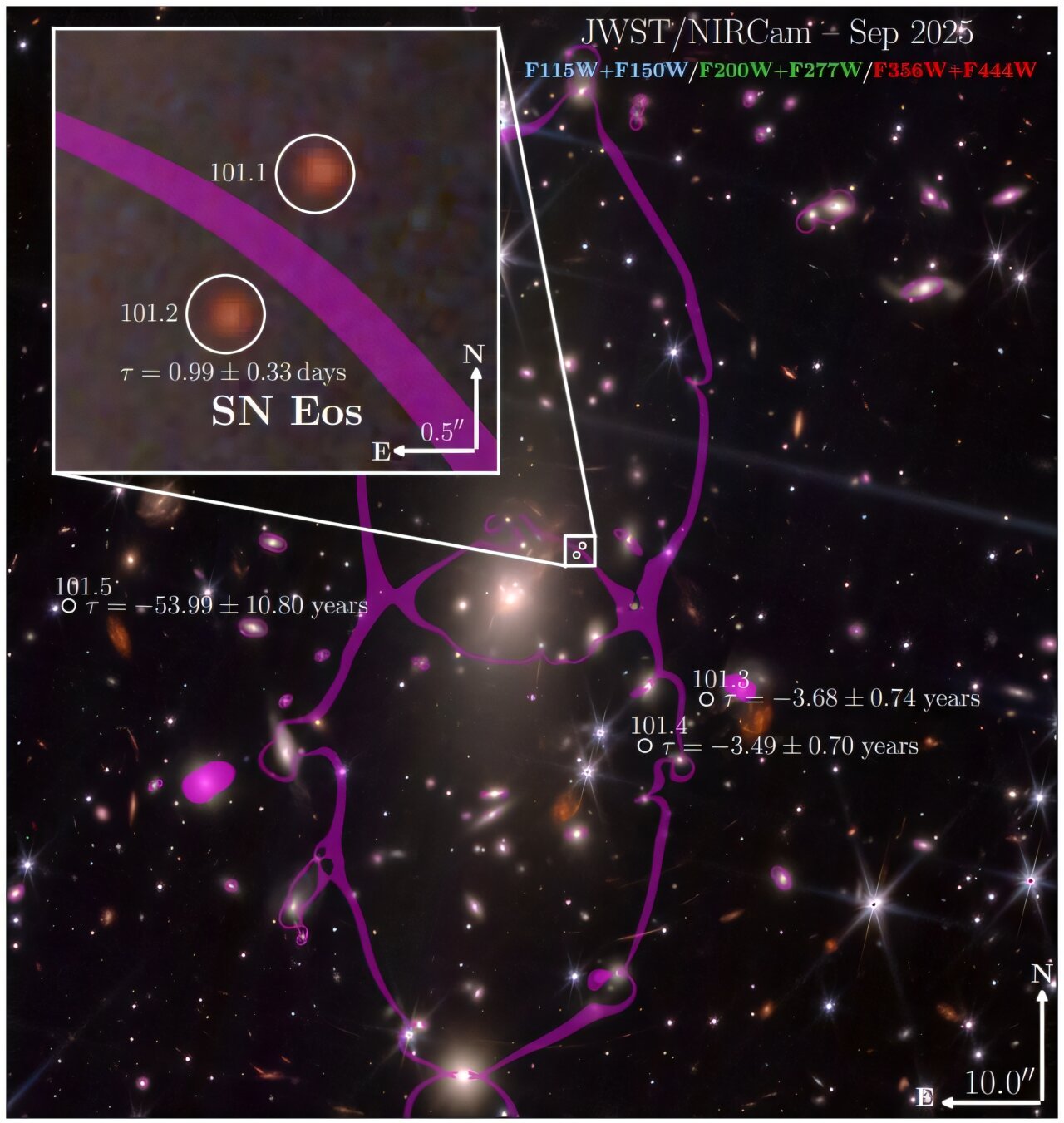
The James Webb Space Telescope (JWST) captured images of a Type II supernova on September 1 and October 8, 2025. The supernova, called Eos after Titan, the Greek goddess of the dawn, could help scientists understand how stars and galaxies evolve over billions of years, researchers reported on the preprint server arXiv on January 7.

A better understanding of early stars could help astronomers figure out how they formed and distributed heavy elements, including those needed for life, to their surroundings. However, observing individual stars in the early universe is not easy.

you may like

“Due to their extreme distances, opportunities to study such stars remain quite limited,” the researchers wrote in the study, which has not yet been peer-reviewed. “However, the explosive death of a massive star as a core-collapse supernova can outshine the total emission of its host galaxy, making it possible to study the final stages of stellar evolution.”

death of the oldest star

Supernova shines in the early universe

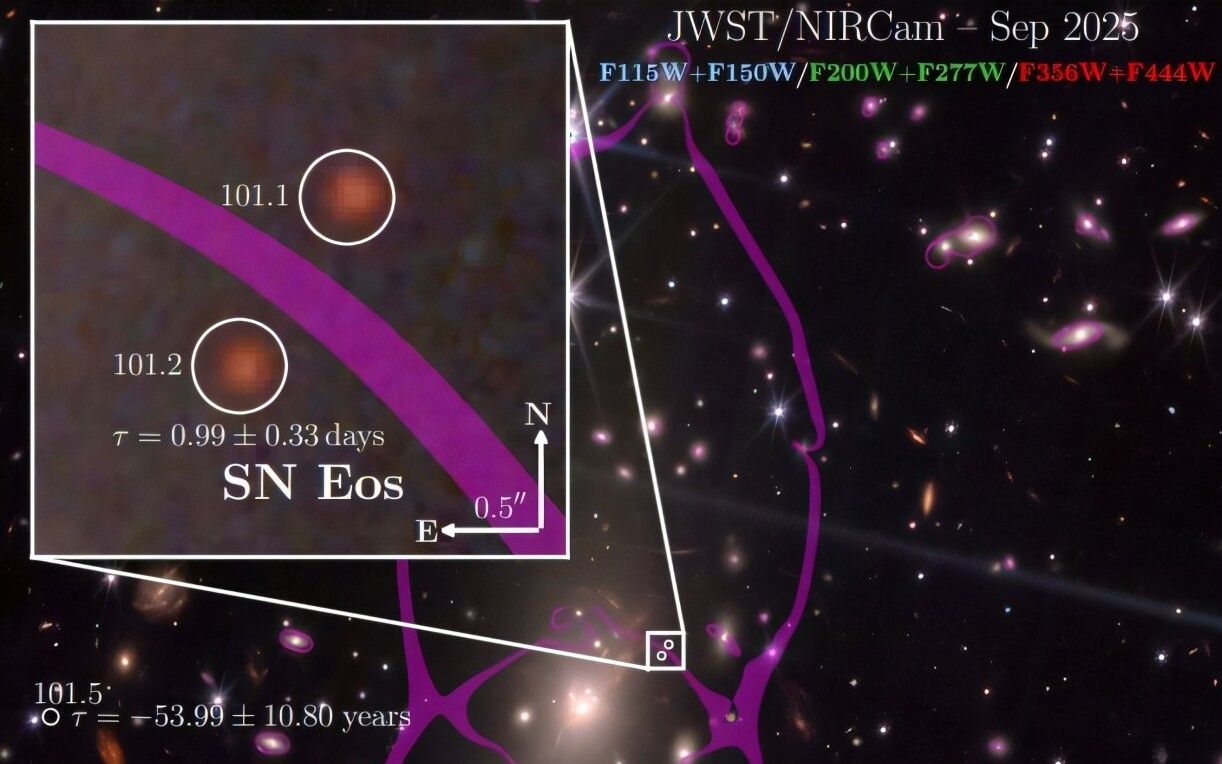
Supernova SN Eos was discovered within the galaxy cluster MACS 1931.8-2635 seen here. The magenta region outlines the region that is being expanded by the cluster’s gravity. The supernova appears twice (marked 101.1 and 101.2) due to the effect of gravitational lensing. (Image credit: Coulter et al. / JWST)

A supernova occurs when a massive star explodes at the end of its life. Type I supernovae include supernovae that do not contain hydrogen in their spectra, while type II supernovae have some evidence of hydrogen. Regardless of type, supernovae are much less common. In a galaxy the size of the Milky Way, only two or three occur per century.

In a new study, scientists used a phenomenon known as gravitational lensing to capture images of distant supernovae. Gravitational lensing occurs when light passes through regions of space-time that are distorted by the enormous gravity of massive objects such as black holes or galaxy clusters. The distortion magnifies the light, allowing scientists to see objects that would otherwise be too dim to see.

Supernovae are hydrogen-rich, and the star exploded in an environment with very low concentrations of elements heavier than hydrogen. In fact, the researchers found that the ancestral star likely contained less than 10% of elements heavier than our Sun. This apparent lack of heavy elements is further evidence that supernovae were at a very early stage, since stellar nuclear fusion had not yet filled the universe with abundant heavy elements.

Get the world’s most fascinating discoveries delivered straight to your inbox.

By analyzing the ultraviolet light from the burst, researchers determined that Eos was a Type II-P supernova. The light from a type II-P supernova remains bright for a while after reaching its peak, and then slowly fades away. (In contrast, type II-L supernovae steadily dim over time.) Eos is likely nearing the end of its brightness plateau, the researchers found.

Scientists need to observe even earlier supernovae to see if Eos’ properties are typical of massive stars and supernovae of this age. But these discoveries could help scientists chart the evolution of stars and galaxies from the early universe to today.

“The discovery of SN Eos represents an important step toward achieving JWST’s core mission goals of understanding the life and death of the first stars, the origin of elements, and the assembly and evolution of the youngest galaxies,” the researchers wrote.


Source link

#Biotechnology #ClimateScience #Health #Science #ScientificAdvances #ScientificResearch
Follow on Google News Follow on Flipboard
Share. Facebook Twitter Pinterest LinkedIn Tumblr Email Copy Link
Previous ArticleEarth is hit by the first solar radiation storm in 23 years, causing auroras as far as Southern California
Next Article ICE becomes one of the most blocked accounts on Bluesky after verification
user
  • Website

Related Posts

Shark attacks in Hawaii spiked in October, and scientists think they know why.

January 27, 2026

In vitro fertilization hormones could one day be administered via painless ‘microneedle’ patches, early research suggests

January 27, 2026

A 1,400-year-old Zapotec tomb discovered in Mexico has a giant owl sculpture symbolizing death

January 26, 2026
Add A Comment
Leave A Reply Cancel Reply

Latest Posts

Unmasking new TOAD attacks hidden in legitimate infrastructure

Fortinet patches CVE-2026-24858 after active FortiOS SSO exploit detected

Everything you need to know about the viral personal AI assistant Clawdbot (now Moltbot)

Anduril has invented a novel drone flying contest where work is the prize

Trending Posts

Subscribe to News

Subscribe to our newsletter and never miss our latest news

Please enable JavaScript in your browser to complete this form.
Loading

Welcome to Fyself News, your go-to platform for the latest in tech, startups, inventions, sustainability, and fintech! We are a passionate team of enthusiasts committed to bringing you timely, insightful, and accurate information on the most pressing developments across these industries. Whether you’re an entrepreneur, investor, or just someone curious about the future of technology and innovation, Fyself News has something for you.

Castilla-La Mancha Ignites Innovation: fiveclmsummit Redefines Tech Future

Local Power, Health Innovation: Alcolea de Calatrava Boosts FiveCLM PoC with Community Engagement

The Future of Digital Twins in Healthcare: From Virtual Replicas to Personalized Medical Models

Human Digital Twins: The Next Tech Frontier Set to Transform Healthcare and Beyond

Facebook X (Twitter) Instagram Pinterest YouTube
  • Home
  • About Us
  • Advertise with Us
  • Contact Us
  • DMCA
  • Privacy Policy
  • Terms & Conditions
  • User-Submitted Posts
© 2026 news.fyself. Designed by by fyself.

Type above and press Enter to search. Press Esc to cancel.