
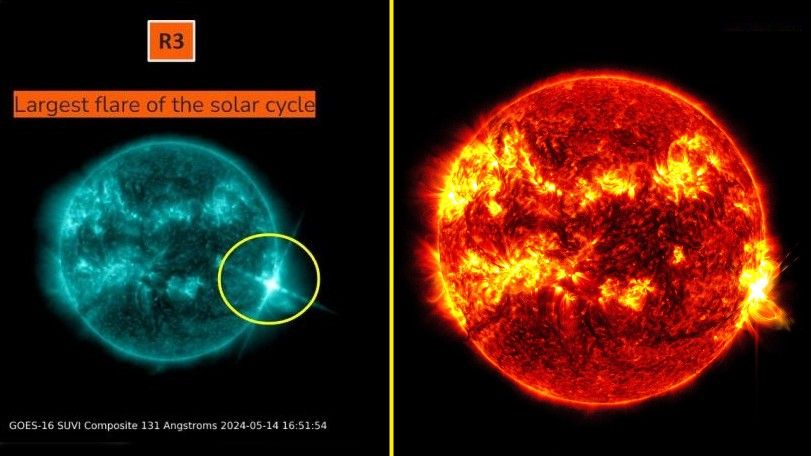
The sun just released the most intense solar flare of the current solar cycle, which began in 2019, according to a preliminary report from the National Oceanic and Atmospheric Administration’s (NOAA) Space Weather Prediction Center.
The monster flare, a category X8.7, was significantly more powerful than the X2.2 flare that erupted from the sun last week, causing radio interference and causing widespread aurora borealis across the globe, visible as far south as Mexico.
you may like
Even if a flare produces a coronal mass ejection (CME) – a huge, high-velocity plume of electrically charged solar particles – it is unlikely to directly impact Earth, as was the case with last weekend’s vivid auroral display.
That said, the same giant group of sunspots, called Active Sunspot Region 3664 and more than 15 Earths wide, is responsible for both last week’s X2.2 flare and today’s X8.7 flare, NOAA reported. This group has spewed out numerous other X-class flares over the past few days, but will soon be completely invisible from Earth.
RELATED: No, we didn’t see a solar flare during the total solar eclipse, but we might have seen something just as special
Solar flares are powerful bursts of electromagnetic radiation caused by magnetic disturbances in the Sun. These occur when the magnetic field lines in the Sun’s atmosphere become entangled or break, releasing large amounts of excess energy, including powerful X-rays and ultraviolet radiation. These twisted lines emerge from sunspots, dark, cold regions on the Sun’s surface that form when magnetic fields from deep within the star are forced up to the surface.
Correction to previous post: Flare magnitude is 8.7, not 8.8. pic.twitter.com/NSdmhTWIYHMay 14, 2024
Solar flares can also launch CMEs into space, hitting planets, satellites, and other objects in their path. If a CME hits the Earth, it will trigger a magnetic storm that could cause auroras as well as negative effects such as power grid failures and satellite failures.
All of these extreme solar events (solar flares, sunspots, CMEs) become more common during the peak of the sun’s 11-year activity cycle, known as solar maximum. The current cycle, Solar Cycle 25, began in 2019, and scientists believe that the Sun may soon enter solar maximum, if not yet. Only after the solar maximum ends and solar activity subsides again will scientists be able to tell exactly when solar activity peaked.
According to spaceweatherlive.com, the sun hasn’t spewed out a flare more powerful than X8.7 since September 2017, when it released flares X11.8 and X13.3 within days of each other.
