


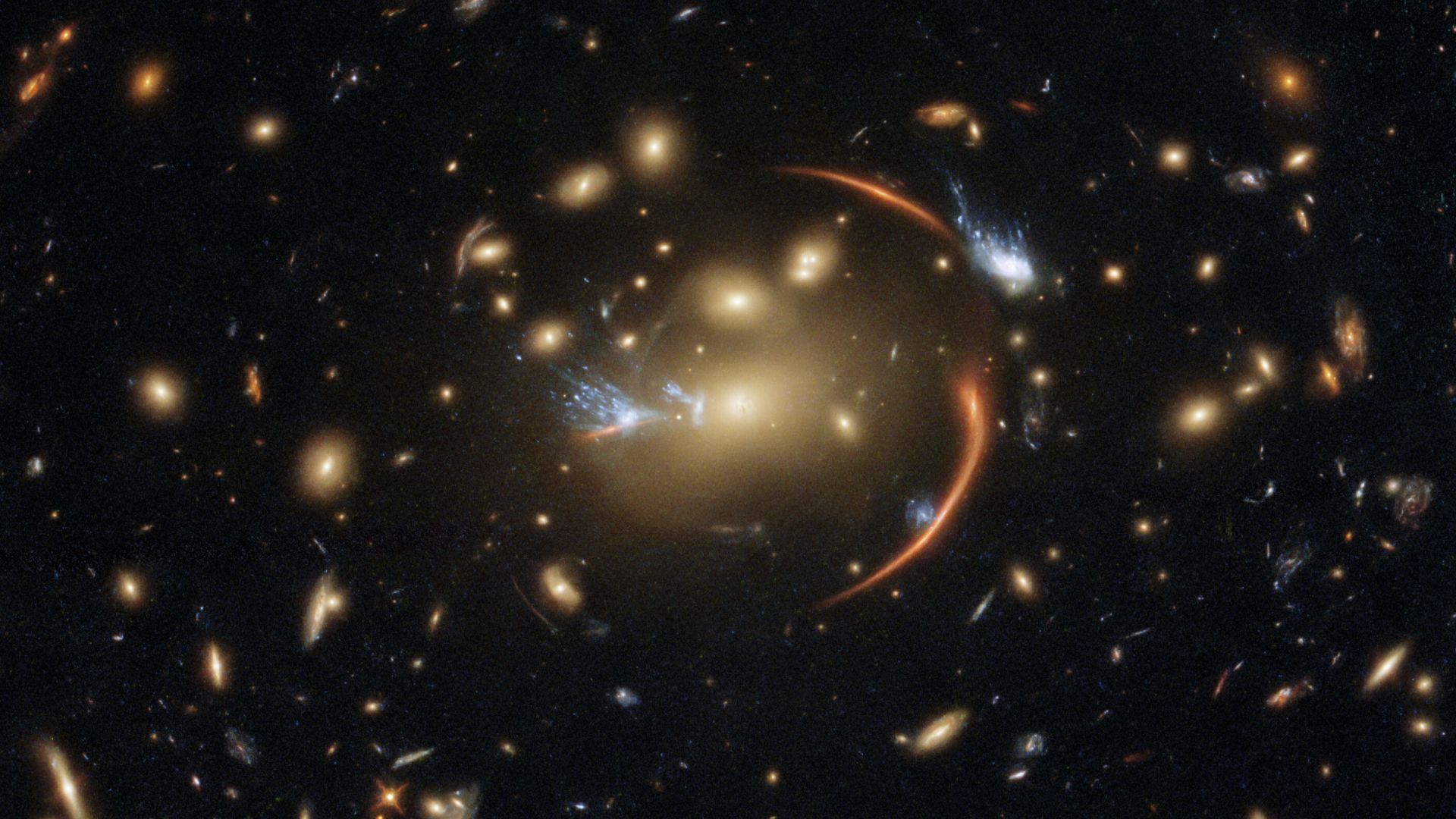
Physicists’ main theories about the nature of the universe may be wrong, new research into strangely distorted light suggests.
A new study investigated three major theories about dark matter, the invisible matter that makes up much of the universe and provides structure to most galaxies, but we still don’t know exactly what it is.
you may like
To further investigate the nature of dark matter, scientists observe curved starlight from distant galaxies. This is a process called gravitational lensing that uncovers important clues about hidden structures. And a new paper published on January 23 on the preprint database arXiv has some interesting findings. This deep lensing analysis definitively dislikes smooth dark matter lensing models and strongly favors fuzzy dark matter (FDM) over both standard CDM and the more exotic self-interacting dark matter model, which proposes that dark matter is slightly stuck to itself.
If supported by more evidence, this discovery could reveal a murkier, more quantum-like reality that underlies everything we know.
taste of darkness
Astronomers often talk about different dark matter “flavors,” and there are three main theories at the top of the list.
In CDM — the leading theory — dark matter acts like a vast, invisible scaffolding of the universe. It is made up of small particles that move slowly. They easily aggregate, forming large invisible structures or “halos” within which countless small clumps are formed. These small clumps are subhalos and act as gravitational anchors for galaxies.
Self-interacting dark matter, on the other hand, suggests that there is some slight stickiness or friction when the CDM’s invisible sand grains hit each other. This additional interaction means that particles can transfer energy within the dense mass. The center of the lump will be smooth. It can also cause different collapses.
The final a la carte model of the universe is fuzzy dark matter. According to this theory, dark matter may not be made up of individual particles, but rather a quantum mist or soup made up of incredibly tiny ultralight waves. Due to the nature of the waves, they cannot form very sharp little clumps like CDM. Instead, it creates a blurry, rippling pattern, like the gentle waves of a pond. They still bend light, but in a more continuous and less noticeable way than solid blobs.

distorted spotlight
This new study, which has not yet been peer-reviewed, is a game-changer. Scientists used gravitational lensing data from 11 galaxies, particularly systems where light bends sharply, to analyze how light bends around massive objects.
you may like
The smooth dark matter lensing model (the one expected from standard CDM) is critically disadvantaged by the way light bends in the new dataset. Instead, the data show a strong preference for fuzzy dark matter over both CDM and self-interacting dark matter. This strong preference for ambiguous dark matter persisted even when researchers made their lensing models more complex and after excluding systems that could be disrupted by microlensing.
If fuzzy dark matter is the answer, it would completely change our understanding of the fundamental building blocks of the universe. That would mean that dark matter is a quantum wave, meaning it is not made of discrete, slowly moving particles. Rather, the invisible scaffolding of space would resemble a vast cosmic ocean with gentle ripples flowing through it.
This dramatically changes the way astronomers think about galaxy formation and the structure of the universe. The current model is primarily based on CDM and needs to be seriously reconsidered. This also raises many new questions. Scientists need to figure out how this fuzzy material interacts with ordinary matter. We also need to know what these exotic particles actually are.
We started this space detective story trying to understand the true nature of the universe, its invisible structure. For a long time, CDM was the main suspect and a solidly reliable theory. But the clues we get from especially curved starlight don’t match up perfectly.
Now, this clever new analysis provides compelling evidence suggesting that the invisible foundations of the universe are far more exotic and quantum than we imagined. It’s a reminder that the universe always has more secrets to uncover.
Hou, S., Xiang, S., Tsai, YS, Yang, D., Shu, Y., Li, N., Dong, J., He, Z., Li, G., and Fan, Y. (January 23, 2026). Anomalies in the cusp quasar’s magnetic flux ratio reveal dark matter beyond the CDM. arXiv.org. https://arxiv.org/abs/2601.16818