


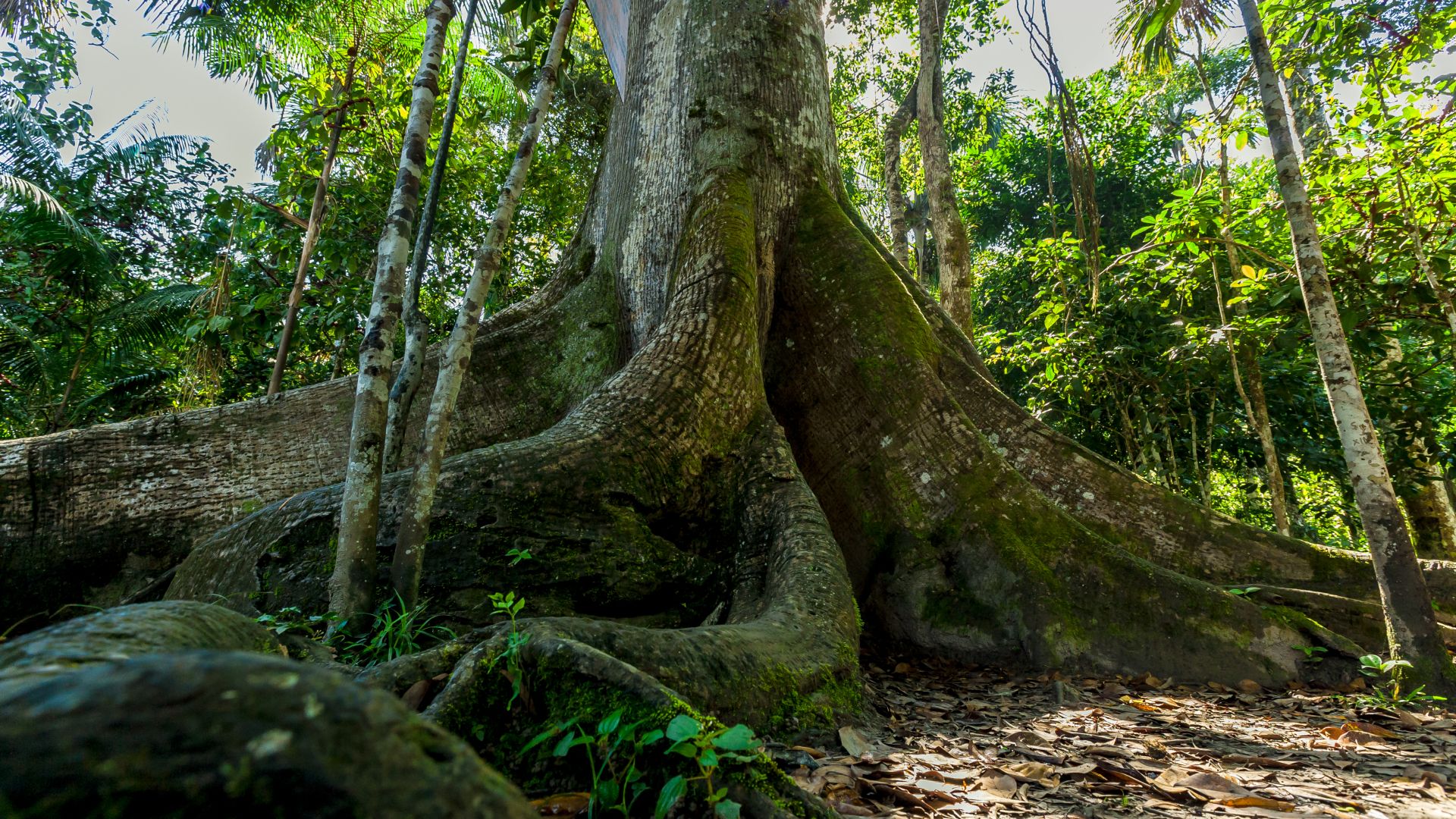
The largest trees in the Peruvian Amazon store disproportionately more carbon than smaller trees, a new study has found. But these large trees are also the ones most likely to be cut down, which means more carbon is released into the atmosphere, thereby reducing the ability of these forests to act as carbon sinks, the researchers say.
Almost 60% of Peru’s land area is covered by forests, most of which are located in the Amazon region, which accounts for about 11% of the total Amazon rainforest. Peru’s current forestry law allows selective cutting of trees when they reach a minimum diameter, which ranges from 16 to 24 inches (41 to 61 centimeters), depending on the tree species. Because the Peruvian Amazon’s terrain makes it difficult to access and harvest trees, forestry companies prefer larger trees because they can harvest more wood and reduce transportation costs, labor, and time. These trees tend to be older and more mature, with denser, harder, and more stable wood.
But these large trees store the most carbon, and removing them sends much of that carbon back into the atmosphere, study co-author Giomar Vallejos Torres, an agronomist at the National University of San Martín in Peru, told Live Science in a translated email.
you may like
To find out how much carbon is stored in these large trees, Vallejos-Torres and colleagues measured hundreds of trees in five forests across the country and recorded variables such as diameter, height, canopy area, and tree density to estimate above- and below-ground biomass and stored carbon.
They found that carbon storage, both above and below ground, increased disproportionately with increasing stem diameter, with 16 inches being a critical threshold. The forests they studied sequestered up to 331 tons/ha (148 US tons/acre) above ground and 47 tons/ha (21 US tons/acre) below ground. Most of that carbon (between 88% and 93%, depending on the species) was concentrated in trees larger than 16 inches in diameter. For example, breadnut trees (Brosimum alicistrum) stored 11.4% of total above-ground carbon in trees smaller than this cutoff point, compared to 88.7% in larger trees.
The study was published on January 25 in the journal Frontiers in Forests and Global Change.
The results show that Peru’s forest policy targets trees that store the most carbon, suggesting the country needs to shift its forest policy to protect them, Vallejos-Torres said.
“Given the urgent need to remove carbon reserves from the atmosphere, we need to conserve trees larger than 41cm,” he said. “This also enables conservation of forest biodiversity and microfauna, buffering the microclimate against future climate change.”
size isn’t everything
But some researchers say tree size isn’t necessarily the most important consideration in carbon sequestration. Wolf Bungen, a professor of environmental systems analysis at the University of Cambridge who was not involved in the study, said the period over which carbon is stored is more relevant.
“The paper doesn’t really talk about tree age, so it ignores the fact that carbon retention times are shorter overall in the tropics,” he told LiveScience.
you may like
But Vallejos-Torres disputed this argument, saying that while the largest trees continue to store carbon for centuries, smaller trees grow too slowly to make up the difference.
“Small tree regeneration is slow, uncertain, and often limited by degradation, disturbance, and microclimate change, so lost carbon is not recovered on timescales relevant to climate mitigation,” he said.
Martin Pérez Lara, director of forest climate solutions impacts and monitoring at the World Wildlife Fund, said the relationship between tree diameter and carbon stocks highlighted in the study was empirically sound and relatively intuitive. However, he added that focusing solely on tree size is not the best way to design climate-friendly forestry systems.
“The bulk of the research shows that well-designed management systems, including selectively harvested forests with trees around 40 centimeters tall, can positively contribute to climate mitigation and degradation risk reduction and support long-term carbon dynamics,” he told Live Science.
Despite the urgent need to protect the Amazon’s carbon sink, Vallejos-Torres has little faith that the necessary changes to Peru’s forest policy will be made anytime soon. “Legislative changes to protect the largest trees will have a direct impact on the economic interests of the timber sector, which relies on the harvest of these highly commercially valuable specimens and weighs heavily in national forestry policy-making,” he said.
Lozano A, Gaona-Jiménez N, Alvarado JW, García-González P, Arévalo AA, Ordonez L, Saavedra-Ramirez J, Tuesta-Hidalgo JC, Villela L, Tuesta-Hidalgo OA, Vacelli-Villanueva JR, Chuchon-Lemon R, Aguila SR-D, Marín C, Vallejos-Torres G (2026) Dominance of large trees in carbon storage in the Peruvian Amazon forest. front. for. Glob. Change 8:1711078. doi: 10.3389/ffgc.2025.1711078