
CERN cools high-brightness LHC magnet system in major upgrade milestone
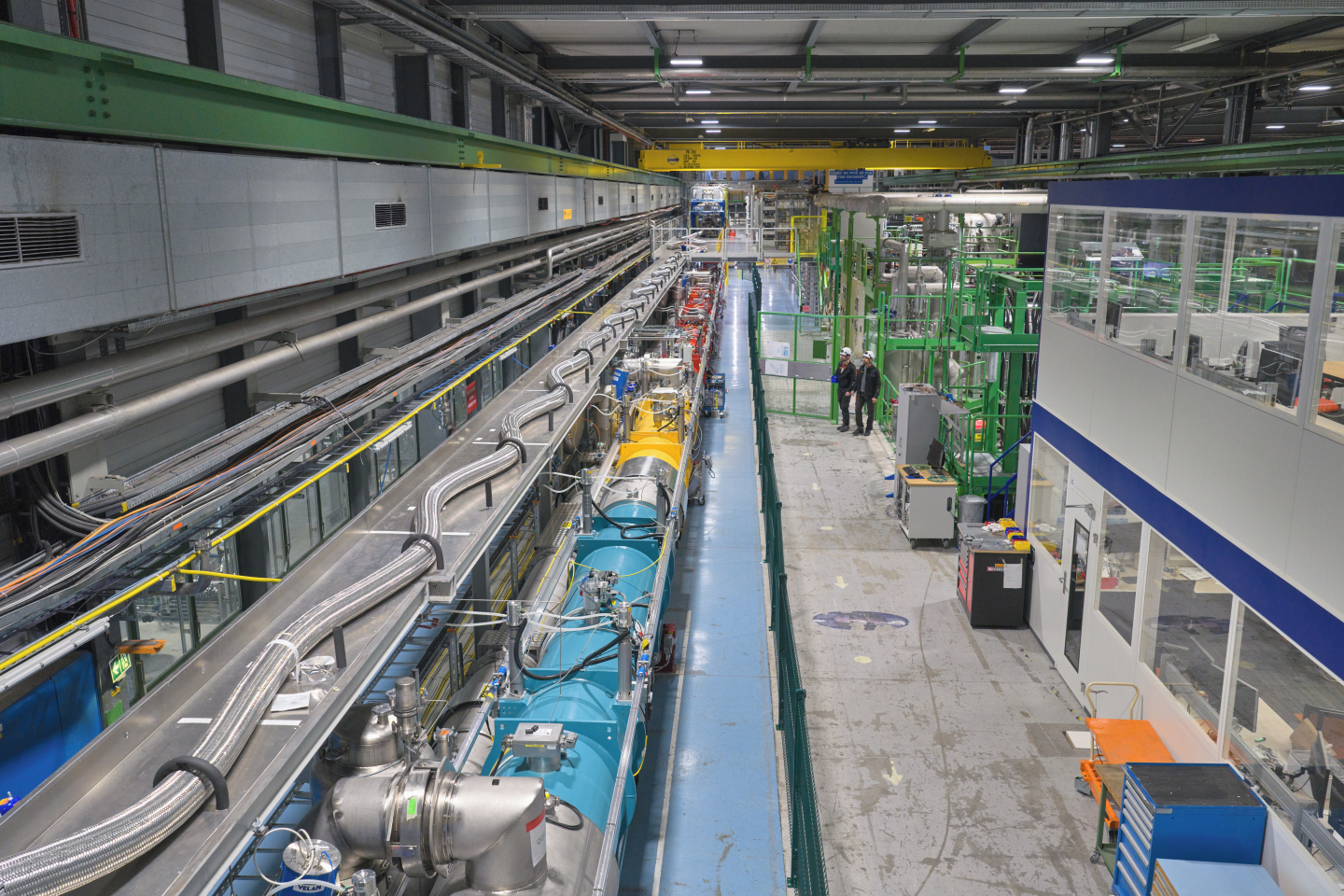
The cryogenic test marks a significant step toward a 10-fold increase in collision data at the world’s most powerful particle accelerator.
CERN has crossed a key technological threshold in its long-running effort to upgrade the Large Hadron Collider (LHC). Engineers began cooling the 95-meter-long test facility to just 1.9 Kelvin, recreating the extreme conditions in which future high-brightness LHCs will operate.
The structure, known as the Inner Triplet String, is a full-scale replica of the device that will eventually be installed deep underground on either side of the collider’s main interaction points.
Its role is simple but extremely important. We will demonstrate that a new generation of superconducting magnets and their support systems can work together reliably before being deployed inside a tunnel.
This testing phase comes ahead of the LHC’s four-year major outage, scheduled to begin this summer, during which the existing machine will be converted to the High Luminosity LHC (often shortened to HiLumi LHC). Once the upgrade is complete, it is expected to be operational around 2030.
Commenting on the upgrade, CERN Director General Mark Thomson said:
“By combining sophisticated new data tools and upgraded detectors, we will be able to understand for the first time how the Higgs boson interacts with itself. This is an important measurement that sheds light on the universe’s first moments and its possible fate.”
“HiLumi LHC also explores uncharted territory and has the potential to reveal something completely new and unexpected. That’s the whole point of exploring the unknown: we don’t know what’s out there.”
How the bright LHC will transform particle physics research
The goal of a high-luminance LHC is to dramatically increase the brightness, and thus the number of particle collisions produced over time. In practice, this means producing up to 10 times more data than the current LHC can provide.
This increase is important because it will allow physicists to study known particles, including the Higgs boson, in more detail and also improve the chances of discovering rare or unexpected phenomena.
More collisions mean better statistics, more precise measurements, and a clearer picture of where the standard model of particle physics begins to break down.
Testing magnets to push technical limits
The centerpiece of the upgrade is a new beam-focusing magnet known as the inner triplet. While the current magnets used in the LHC rely on niobium titanium superconductors, high-brightness LHC magnets are constructed using niobium tin. This material enables extremely strong magnetic fields, which are essential for colliding the particle beams more closely.
These magnets operate at the same temperature as existing LHC magnets (just 1.9 Kelvin, slightly above absolute zero).
Achieving and maintaining these conditions requires complex cryogenic systems using liquid helium and an equally complex power, protection, and conditioning infrastructure.
The Inner Triplet String combines all of these elements into a single above-ground installation, arranged to mirror the layout that will be used underground once the upgrade begins.
Pre-installation integration
“All systems have already been tested individually,” said Oliver Brüning, director of accelerators and technology at CERN. “The goal of the inner triplet string is to validate integration and overall performance under operating conditions.”
By running the complete system as a unit, Brüning said, the team will be able to refine procedures and identify potential problems well before installation work begins in the LHC tunnel. This preparation is expected to reduce risk during Long Shutdown 3 and allow the upgrade to proceed on schedule.
The cooling process itself is expected to take several weeks, reflecting the scale and complexity of the equipment involved.
Upgrades beyond accelerators
The High Luminosity LHC project extends far beyond collider hardware. The two largest experiments, ATLAS and CMS, have undergone significant upgrades of their own to cope with higher collision rates and data volumes.
These efforts involve hundreds of research institutions around the world and include new detectors, electronics, and data processing systems. Improvements are also being made across CERN’s wider accelerator complex to support the demands of the upgraded machine.
With the first full-system cryogenic tests now underway, the High-Luminosity LHC has moved from design and component testing to a definitive integration phase, bringing concrete steps closer to the next chapter in high-energy physics.
Source link

