Close Menu
  • Home
  • Identity
  • Inventions
  • Future
  • Science
  • Startups
  • Spanish
What's Hot

Human CEO stands firm as Pentagon deadline approaches

Aeternum C2 botnet stores encrypted commands on Polygon blockchain to avoid deletion

Read AI launches email-based “digital twin” to help with scheduling and answers

Facebook X (Twitter) Instagram
  • Home
  • About Us
  • Advertise with Us
  • Contact Us
  • DMCA
  • Privacy Policy
  • Terms & Conditions
  • User-Submitted Posts
Facebook X (Twitter) Instagram
Fyself News
  • Home
  • Identity
  • Inventions
  • Future
  • Science
  • Startups
  • Spanish
Fyself News
Home » Largest ever map of the Milky Way galaxy’s center, new ALMA observations reveal ‘unusual and mysterious’ structure
Science

Largest ever map of the Milky Way galaxy’s center, new ALMA observations reveal ‘unusual and mysterious’ structure

userBy userFebruary 25, 2026No Comments5 Mins Read
Share Facebook Twitter Pinterest Telegram LinkedIn Tumblr Email Copy Link
Follow Us
Google News Flipboard
Share
Facebook Twitter LinkedIn Pinterest Email Copy Link

Scientists have released the largest and most detailed map yet of the chaotic gas cloud at the center of our galaxy. Analysis of the resulting images could take years, but they are expected to help solve the mystery of how early stars lived and died shortly after the Big Bang.

The new observations, taken with the Atacama Large Millimeter/Submillimeter Array (ALMA) radio telescope in Chile, cover 650 light-years worth of structure surrounding the Milky Way’s central black hole deep in the constellation Sagittarius. This region is known as the central molecular zone (CMZ) because of its large number of dense clouds of molecular gas, and is thought to closely reflect the dense and chaotic state of the oldest galaxies in the universe.

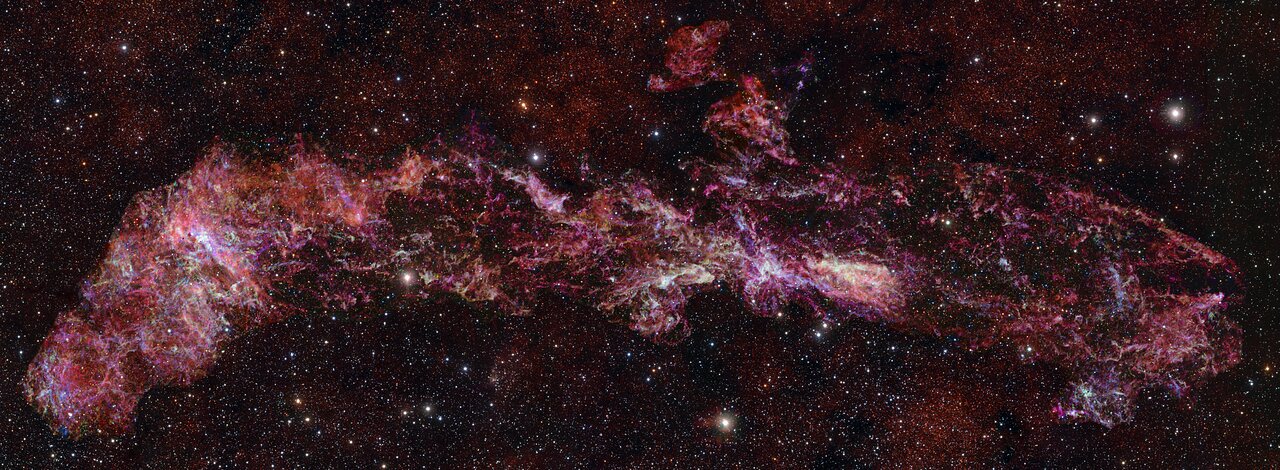
The complete image covers a portion of the sky the size of three full moons and is the largest image ever created by ALMA since it began operations in 2013. The ultra-detailed images include everything from giant clouds of supersonic gas to individual stars hopping around the galaxy’s center, and have already revealed some “rare and mysterious” structures that have no explanation.

you may like

By studying the movement, velocity, and chemical composition of gas within the CMZ, scientists hope to better understand the extreme conditions that drove the evolution of the Milky Way and the ancient galaxies that filled the newborn universe.

“It’s an extreme place, invisible to us, but now revealed in amazing detail,” Ashley Burns, an astronomer at the European Southern Observatory and a member of the research team, said in a statement. And with more powerful telescopes under construction in the region, Burns added, “In many ways, this is just the beginning.”

zone of chaos

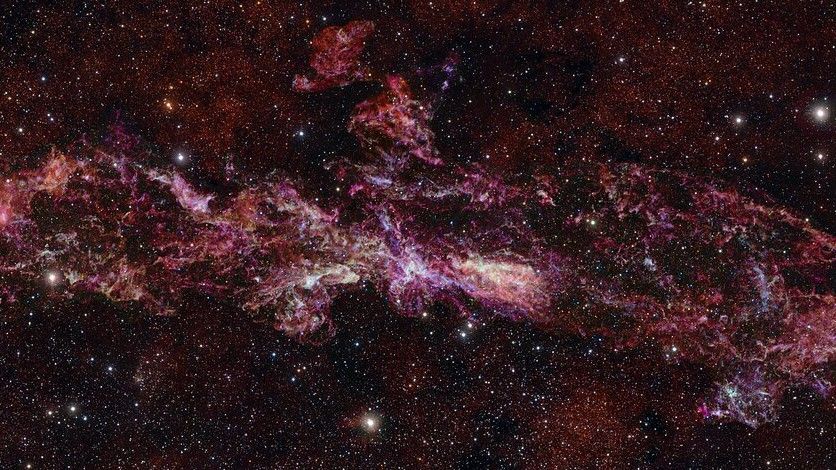
Life-size mosaic of the central molecular belt captured by ALMA

Life-size mosaic of the central molecular belt captured by ALMA (Image credit: ALMA(ESO/NAOJ/NRAO)/S. Longmore et al. Background: ESO/D. Minniti et al.)

The CMZ that snakes around the supermassive black hole Sagittarius A* is a vast collection of colliding clouds, supersonic gas highways, and hyperactive stars that grow rapidly and die young. This region contains most of the galaxy’s dense gas (about 80%, according to Harvard University and the Smithsonian Center for Astrophysics) and is the hottest, densest, and most turbulent region of the Milky Way.

Turbulent flows of molecular gas accelerate star formation in parts of the CMZ, while leaving other regions perplexingly empty. Scientists want to understand how the large-scale processes that push material into the CMZ control the evolution of small-scale objects such as individual stars and gas clouds.

Get the world’s most fascinating discoveries delivered straight to your inbox.

Participate in ACES (ALMA CMZ Exploration Survey). The study brings together more than 160 scientists from 70 institutions around the world to study the mysterious CMZ. In a series of five papers accepted for publication in the Royal Astronomical Society’s monthly journal Monthly Notices, the ACES team shared preliminary findings from the study and how they could advance our understanding of the galactic center in the coming years.

By studying the different wavelengths of light emitted by gas within the CMZ, the researchers noted that they identified more than 70 types of molecules rolling around the center of the galaxy. These include both simple molecules like silicon monoxide and more complex organic molecules like ethanol and methanol, the researchers said.
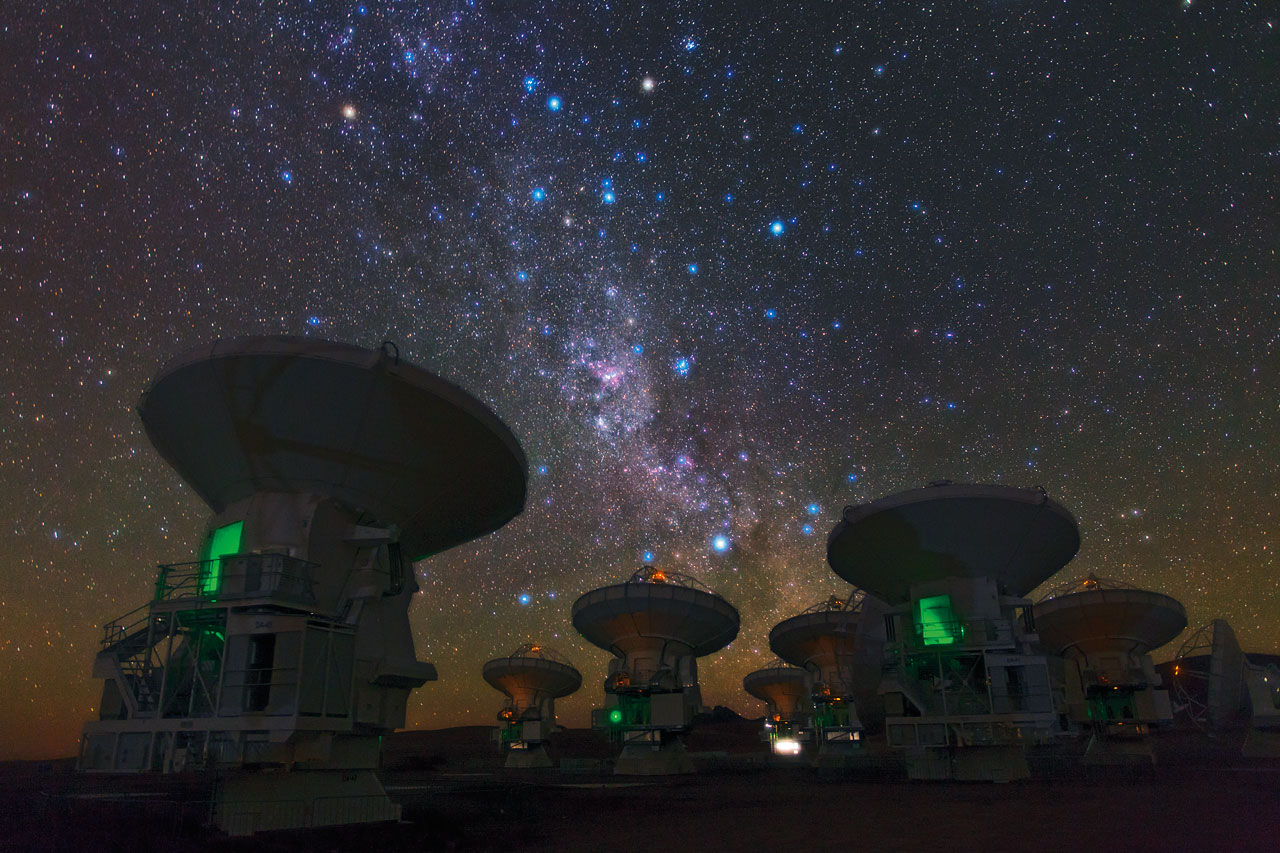
ALMA looks up at the Milky Way from its base in Chile.

ALMA looks up at the Milky Way from its base in Chile. (Image credit: ESO/B. Tafreshi)

By zooming in on specific regions of the image, the researchers were also able to see how specific processes, such as the eruption of shock waves released during collisions of large gas clouds, affect the thermal, kinetic, and chemical composition of different regions within the CMZ. All this will ultimately help scientists build a 3D map of the CMZ, revealing how the various substructures are interconnected and how large-scale material flows lead to star formation and destruction.

you may like

“The CMZ is home to some of the most massive stars known in our galaxy, many of which live early and die young, ending their lives in powerful supernovae or even supernova explosions,” ACES team leader Professor Stephen Longmore, professor of astrophysics at Liverpool John Moores University, said in a statement.

relics and rarities
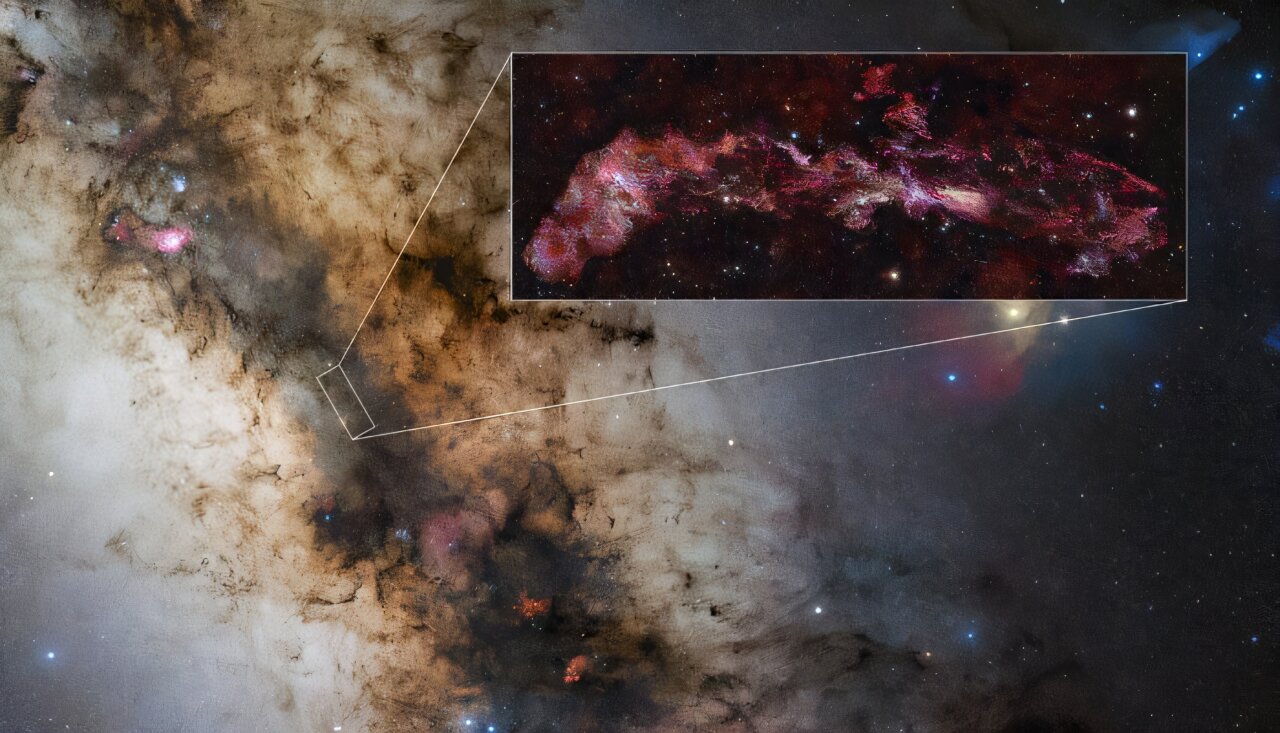
CMZ position relative to the Milky Way

Zoomed-out image showing the location of the CMZ relative to the rest of the Milky Way Galaxy (Image credit: ALMA(ESO/NAOJ/NRAO)/S. Longmore et al. Star in inset: ESO/D. Minniti et al. Milky Way: ESO/S. Guisard)

Preliminary findings also describe some unusual findings. One of the anomalies that the research team briefly noted was a structure called a millimeter-wave ultra-broad line object (MUBLO). This compact, dusty object appears only in millimeter-wavelength light and is otherwise invisible to X-ray, infrared, or radio telescopes.

Filled with fast-moving gas, Mburo exhibits some characteristics similar to the active young stars expected to populate galactic centers, but so far the object’s characteristics do not match any other known structures in the universe, the researchers added.

A closer look at anomalous phenomena like MUBLO and how they fit into the large-scale structure of the CMZ could open new doors to understanding the extreme environments of the ancient universe that are too distant to be directly observed.

“Studying how stars are born in the CMZ also gives us a clearer picture of how galaxies grow and evolve,” Longmore added. “We think this region shares many characteristics with galaxies in the early universe, where stars formed in chaotic, extreme environments.”

Editor’s note: This article was updated on February 25 at 10:30 a.m. to include additional images from CMZ.


Source link

#Biotechnology #ClimateScience #Health #Science #ScientificAdvances #ScientificResearch
Follow on Google News Follow on Flipboard
Share. Facebook Twitter Pinterest LinkedIn Tumblr Email Copy Link
Previous ArticleA malicious NuGet package stole ASP.NET data. Malware with dropped npm packages
Next Article COVID-19 vaccination during pregnancy may reduce risk of preeclampsia
user
  • Website

Related Posts

Kazakhstan plants tens of thousands of trees in major tiger reintroduction effort

February 25, 2026

I found out why my shoes squeak, and it has something to do with miniature lightning bolts.

February 25, 2026

COVID-19 vaccination during pregnancy may reduce risk of preeclampsia

February 25, 2026
Add A Comment
Leave A Reply Cancel Reply

Latest Posts

Human CEO stands firm as Pentagon deadline approaches

Aeternum C2 botnet stores encrypted commands on Polygon blockchain to avoid deletion

Read AI launches email-based “digital twin” to help with scheduling and answers

Bumble adds AI-powered photo feedback and profile guidance tools

Trending Posts

Subscribe to News

Subscribe to our newsletter and never miss our latest news

Please enable JavaScript in your browser to complete this form.
Loading

Welcome to Fyself News, your go-to platform for the latest in tech, startups, inventions, sustainability, and fintech! We are a passionate team of enthusiasts committed to bringing you timely, insightful, and accurate information on the most pressing developments across these industries. Whether you’re an entrepreneur, investor, or just someone curious about the future of technology and innovation, Fyself News has something for you.

Castilla-La Mancha Ignites Innovation: fiveclmsummit Redefines Tech Future

Local Power, Health Innovation: Alcolea de Calatrava Boosts FiveCLM PoC with Community Engagement

The Future of Digital Twins in Healthcare: From Virtual Replicas to Personalized Medical Models

Human Digital Twins: The Next Tech Frontier Set to Transform Healthcare and Beyond

Facebook X (Twitter) Instagram Pinterest YouTube
  • Home
  • About Us
  • Advertise with Us
  • Contact Us
  • DMCA
  • Privacy Policy
  • Terms & Conditions
  • User-Submitted Posts
© 2026 news.fyself. Designed by by fyself.

Type above and press Enter to search. Press Esc to cancel.