


Close Menu
  • Home
  • Identity
  • Inventions
  • Future
  • Science
  • Startups
  • Spanish
What's Hot

AI roadmap, if anyone is willing to listen.

Grammarly’s “Expert Reviews” Just Lacking Actual Experts

Caitlin Kalinowski, head of OpenAI’s robotics division, resigns following agreement with Department of Defense

Facebook X (Twitter) Instagram
  • Home
  • About Us
  • Advertise with Us
  • Contact Us
  • DMCA
  • Privacy Policy
  • Terms & Conditions
  • User-Submitted Posts
Facebook X (Twitter) Instagram
Fyself News
  • Home
  • Identity
  • Inventions
  • Future
  • Science
  • Startups
  • Spanish
Fyself News
Home » OpenAI Codex Security scans 1.2 million commits and finds 10,561 high-severity issues
Identity

OpenAI Codex Security scans 1.2 million commits and finds 10,561 high-severity issues

userBy userMarch 7, 2026No Comments3 Mins Read
Share Facebook Twitter Pinterest Telegram LinkedIn Tumblr Email Copy Link
Follow Us
Google News Flipboard
Share
Facebook Twitter LinkedIn Pinterest Email Copy Link

Rabi LakshmananMarch 7, 2026DevSecOps / Artificial Intelligence

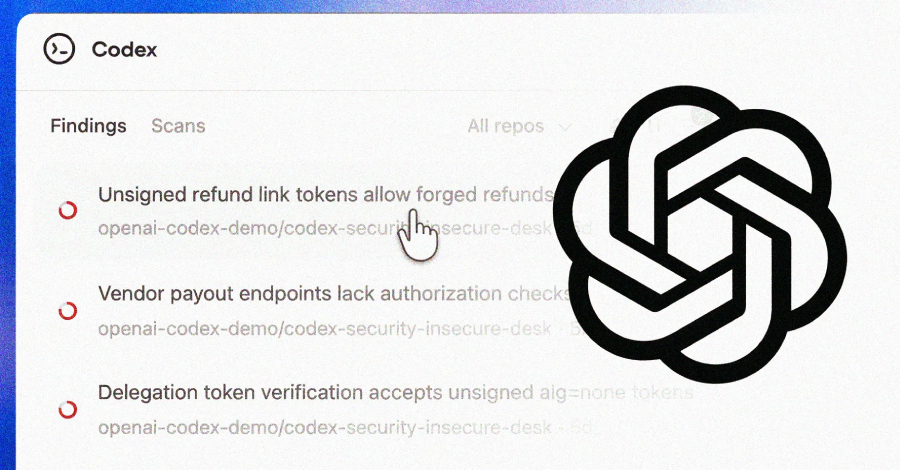
OpenAI on Friday began deploying Codex Security, an artificial intelligence (AI)-powered security agent designed to discover, verify, and suggest fixes for vulnerabilities.

This feature is available as a research preview to ChatGPT Pro, Enterprise, Business, and Edu customers via Codex Web and will be available for free next month.

“It builds deep context about a project to identify complex vulnerabilities that other agent tools miss, uncovering reliable findings with fixes that meaningfully improve system security while protecting users from the noise of unimportant bugs,” the company said.

Codex Security is an evolution of Aardvark⁠, which OpenAI launched in private beta in October 2025 as a way for developers and security teams to detect and fix security vulnerabilities at scale.

Over the past 30 days, Codex Security scanned more than 1.2 million commits across external repositories during the beta period and identified 792 critical findings and 10,561 high-severity findings. These include vulnerabilities in various open source projects such as OpenSSH⁠, GnuTLS⁠, GOGS⁠, Thorium⁠, libssh, PHP, and Chromium. Some of them are listed below –

GnuPG – CVE-2026-24881, CVE-2026-24882 GnuTLS – CVE-2025-32988, CVE-2025-32989 GOGS – CVE-2025-64175, CVE-2026-25242 Thorium – CVE-2025-35430, CVE-2025-35431, CVE-2025-35432, CVE-2025-35433, CVE-2025-35434, CVE-2025-35435, CVE-2025-35436

The latest version of its application security agent leverages the inference capabilities of Frontier models and combines it with automatic validation to minimize the risk of false positives and provide actionable remediation, according to the AI ​​company.

OpenAI scans against the same repositories demonstrated improved accuracy and lower false positive rates over time, with the latter dropping by more than 50% across all repositories.

In a statement shared with The Hacker News, OpenAI said Codex Security is designed to improve signal-to-noise ratio by rooting vulnerability discoveries in the context of the system and validating findings before presenting them to users.

Specifically, the agent works in three steps. This means that it analyzes your repository to understand your project’s security-related system structure and generates an editable threat model that understands its behavior and where it’s most at risk.

Once system context is established, Codex Security uses it as a foundation to identify vulnerabilities and categorize findings based on their real-world impact. Flagged issues are pressure tested and validated in a sandbox environment.

“When Codex Security is configured in a project-tailored environment, potential issues can be directly examined in the context of the running system,” OpenAI said. “That deeper validation further reduces false positives and enables the creation of a working proof of concept, giving security teams stronger evidence and a clearer path to remediation.”

In the final stage, the agent suggests fixes that best match the system’s behavior to reduce regressions and facilitate review and deployment.

The Codex Security news comes weeks after Anthropic launched Claude Code Security to help users scan software codebases for vulnerabilities and suggest patches.


Source link

#BlockchainIdentity #Cybersecurity #DataProtection #DigitalEthics #DigitalIdentity #Privacy
Follow on Google News Follow on Flipboard
Share. Facebook Twitter Pinterest LinkedIn Tumblr Email Copy Link
Previous ArticleAnthropic discovers 22 vulnerabilities in Firefox using Claude Opus 4.6 AI model
Next Article PopSockets founder David Barnett talks building a viral business
user
  • Website

Related Posts

Anthropic discovers 22 vulnerabilities in Firefox using Claude Opus 4.6 AI model

March 7, 2026

Transparent Tribe uses AI to mass produce malware implants in campaign targeting India

March 6, 2026

Multi-stage VOID#GEIST malware that delivers XWorm, AsyncRAT, and Xeno RAT

March 6, 2026
Add A Comment
Leave A Reply Cancel Reply

Latest Posts

AI roadmap, if anyone is willing to listen.

Grammarly’s “Expert Reviews” Just Lacking Actual Experts

Caitlin Kalinowski, head of OpenAI’s robotics division, resigns following agreement with Department of Defense

PopSockets founder David Barnett talks building a viral business

Trending Posts

Subscribe to News

Subscribe to our newsletter and never miss our latest news

Please enable JavaScript in your browser to complete this form.
Loading

Welcome to Fyself News, your go-to platform for the latest in tech, startups, inventions, sustainability, and fintech! We are a passionate team of enthusiasts committed to bringing you timely, insightful, and accurate information on the most pressing developments across these industries. Whether you’re an entrepreneur, investor, or just someone curious about the future of technology and innovation, Fyself News has something for you.

Castilla-La Mancha Ignites Innovation: fiveclmsummit Redefines Tech Future

Local Power, Health Innovation: Alcolea de Calatrava Boosts FiveCLM PoC with Community Engagement

The Future of Digital Twins in Healthcare: From Virtual Replicas to Personalized Medical Models

Human Digital Twins: The Next Tech Frontier Set to Transform Healthcare and Beyond

Facebook X (Twitter) Instagram Pinterest YouTube
  • Home
  • About Us
  • Advertise with Us
  • Contact Us
  • DMCA
  • Privacy Policy
  • Terms & Conditions
  • User-Submitted Posts
© 2026 news.fyself. Designed by by fyself.

Type above and press Enter to search. Press Esc to cancel.