
Children sketch new inventions and eavesdrop on germs at EU science fair in Brussels
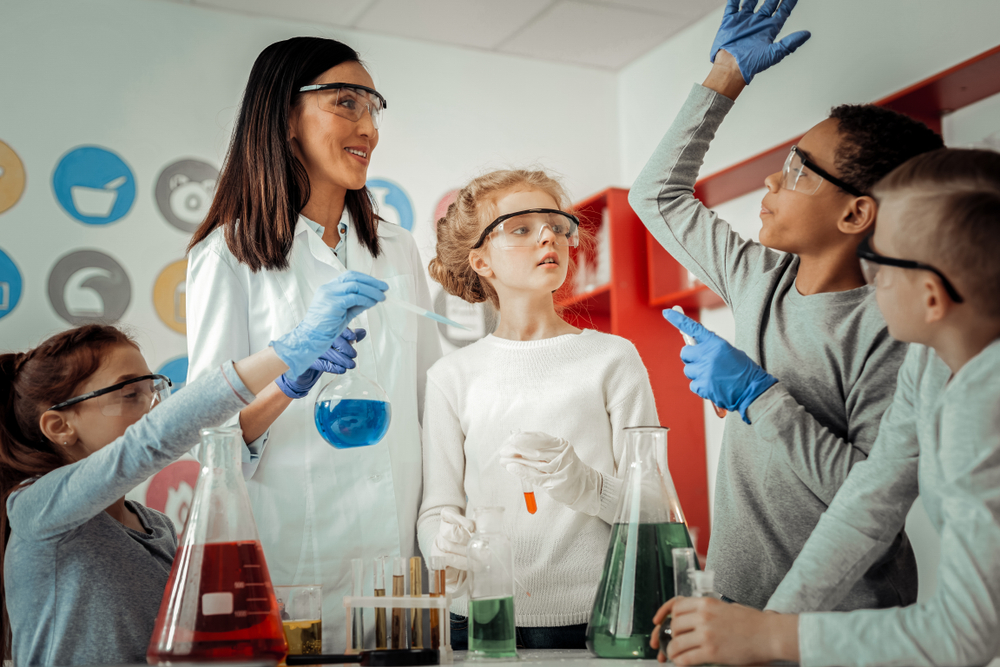
EU science is great! Leading researchers used superheroes, bubbles and dance music to surprise children and inspire tomorrow’s scientists at an exhibition in Brussels.
The auditorium explodes with acoustics as Reel 2 Real’s electronic dance hit “I Like to Move It” blares from the speakers. At the front of the room, a class of 11-year-olds wearing fluorescent vests jump off their own springboards, encouraged by leading European researchers.
Your mission is to help Mr. Fit, a superhero who has fallen ill, get back in shape after he frees himself. He practices this by exercising, eating healthy, and getting enough rest, and the scholars demonstrate this to an eager audience through a series of games.
Fitt, a researcher at the University of Granada in Spain, appeared in a superhero costume for the annual EU-sponsored event Science is Wonderful!
“We are studying children’s habits and analyzing how they affect their later health,” said Cristina Cadenas Sánchez, a professor at the University of Granada and leader of the research team. “We take measurements in schools, for example, to track children’s progress.”
They are currently presenting their PreCaFit research at a science fair in Brussels, where children aged 7 to 18 were able to meet world-class scientists and learn about what they are doing.
More than 150 researchers gathered in 43 booths to talk about everything from earthquake-resistant housing to monkeys to mathematics to malaria.
Most of the research presented at the exhibition was led by Marie Skłodowska-Curie researchers who are part of the EU’s PhD and Postdoctoral Research Training Programme, and several booths were operated by European Research Council grantees.
At the fair, that meant interactive stands, lots of enthusiasm, and sometimes researchers donning superhero costumes. For many, it was a labor of love, driven by a desire to share their passion for science with today’s youth.
“This event is a bridge to the next generation of researchers,” said Sybil Luman, project manager for the 11th event. “This dismantles the myth that science is an ivory tower. From the social sciences to the exact sciences, science can propel us forward and improve our everyday lives.”
bacterial vibration
In another room, a class of younger children huddled around a table as strange robotic-like sounds emanated from the machine.
This was a booth run by Albert Martin Perez and Liga Jaslaneka from Delft University of Technology in the Netherlands. They are working on PROPHOTOM, an EU-funded project to develop ultra-sensitive vibration-based sensors for microscopic organisms such as bacteria.
The challenge here was to transform that invisible world into something that children could see and hear.
“We start by asking what sounds animals like cows, chickens, and dogs make,” says Martín Pérez. “Kids love to shout out that sound. So we ask them what sound bacteria make, and they go silent. In our study, we detected the sound of bacteria.”
“Sound and movement are closely related,” says Martín Pérez. “A guitar string vibrates and makes sound. Of course, you can’t hear the vibrations of bacteria. But our group has built technology that can detect it.”
They explain this to the children by first making sounds with different strings, then moving on to a frequency generator, a machine that vibrates a plate at a specific frequency and makes a sound as it does so. Finally, they show the children the strange humming sounds produced by their technology and the vibrations of the bacteria.
“Explaining everything is intense,” Jaslaneka said. “Sometimes we have two interpreters working at the same time. But once the kids understand that, it’s very powerful.”
dengue fever in europe
Not far away, mosquitoes, assassin bugs, and sandflies took center stage. The Bugbooth was run by Raquel Martins Lana, with the help of Andria Nicodemou from the Barcelona Supercomputing Center and Tatiana Docil from the State University of Rio de Janeiro (UERJ). Martins Lana works on the EU-funded project REGIME on climate-sensitive infectious diseases.
Her research team studies insect-borne diseases such as malaria, dengue fever, and leishmaniasis, and develops computational and statistical models to track their spread.
Martins Lana is on a secondment, or research stay, at the Oswaldo Cruz Foundation’s Climate and Health Observatory in Fiocruz, Rio de Janeiro.
The diseases they are studying extend beyond the tropics. “Climate change is pushing diseases like dengue fever into southern and eastern Europe,” Martins Rana said.
Researchers use games to teach children about these diseases, showing them how they spread and how they can be prevented, from using bed nets and repellents to using vaccines when available and clearing stagnant water.
“Kids take this information home with them,” Martins-Rana says. “Then they start teaching families and become the best helpers we could ask for.”
math like soap
Roberta Marziani, a mathematician at the University of Siena in Italy, used soap bubbles in her booth to explain complex mathematics while illustrating the TopSing project, which explores how surfaces bend, stretch and form minimal shapes.
“I study the plateau problem,” Marziani said. “Here, we’re looking for the smallest surface that spans a given contour in space.” Simply put, it’s about finding the smallest possible surface that crosses a given boundary.
This sounds abstract, but there’s an easy way to express it. It’s a soap bubble. When the metal frame is placed in soapy water, the soap bubbles that form will occupy the least amount of surface possible.
This helps design more efficient electronic devices by keeping wires as short as possible. Architects use similar calculations to figure out the best way to design a roof structure.
“The kids are really impressed with this,” Marziani said. “But they just like playing with bubbles,” she laughed.
Marziani hopes this will spark an interest in mathematics among children. “Math test scores are declining across Europe, and so is student interest,” she says. “I love math, so it’s great to be able to make it more engaging.”
natural connection
In the middle of the hustle and bustle, artist Valentine de Cote had set up a corner. Children gathered around her to see what she was doing on the computer.
“I ask kids two questions: Why do you like science? And what do you want to invent?” she said. “Then I create a live illustration of their invention.”
The wall behind her was covered in her drawings, ranging from the common sense to the downright eccentric. One featured a machine that turned water into soda, and the other featured an owl that could see everything without the need for police.
A boy wanted to invent a device that could make people bigger. A girl wanted a machine that would silence her mother’s voice telling her to clean her room.
“It’s great to hear their ingenuity,” De Corte said. “Painting can be difficult at times, but it always puts a smile on my face.”
This year’s fair attracted more than 4,200 children over three days. But for Luhmann, the real success lay in the connections forged between scientists and children.
“Scientists and children are the best audiences I’ve ever worked with,” she concluded. “You get into academia because you have burning questions and want answers. Kids are very similar. When you bring the two together, there’s a natural connection.”
This article was originally published in Horizon, EU Research and Innovation Magazine.
Source link

