


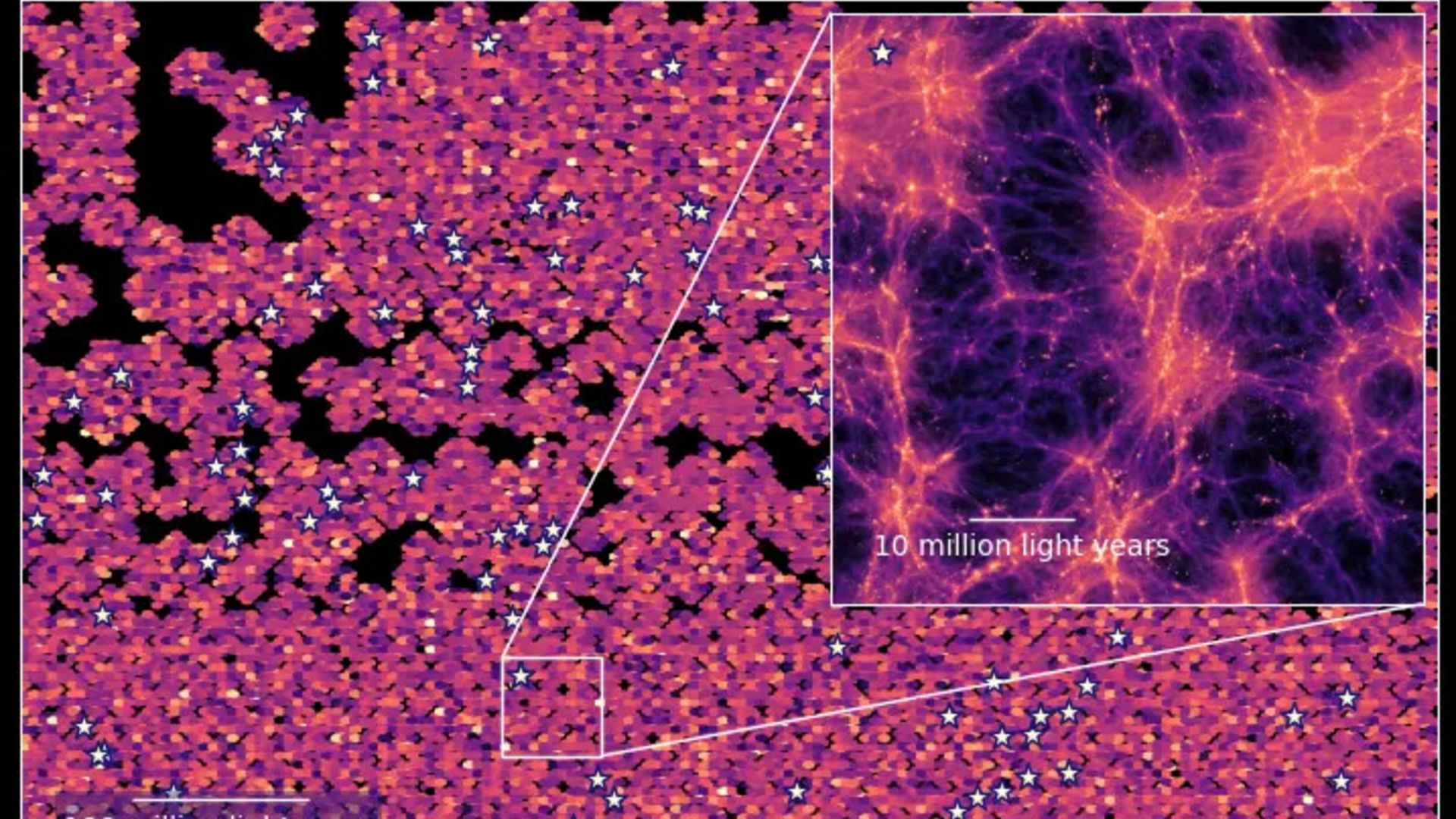
Astronomers have created one of the most accurate and comprehensive maps of the universe ever created, revealing a glorious “ocean of light” that permeated the early universe.
Unlike other universal maps, this 3D representation consists of light emitted by a single element. Hydrogen is the simplest and most abundant element in the universe, and when excited by energy from nearby stars, it emits large amounts of light at specific wavelengths.
you may like
The new research, described in a paper published March 3 in The Astrophysical Journal, is part of the Hobby-Eberly Telescope Dark Energy Experiment (HETDEX), a survey of the sky aimed at revealing how dark energy and gravity shape the universe. Researchers can now compare their simulations with this new data collected by the Hobby-Eberly Telescope at McDonald Observatory in Texas to assess how the cosmological model differs from observations.
An exciting way to see your baby’s universe
When hydrogen atoms are struck by a star’s radiation, they become excited and emit Lyman-alpha light, a specific wavelength in the ultraviolet portion of the electromagnetic spectrum.
Large, bright galaxies are easy to detect, but dimmer galactic structures and the huge interstellar gas clouds that form stars and galaxies have remained largely undetected.
To uncover the ocean of light that permeated the nascent universe, researchers used a technique called line intensity mapping. This technique focuses on the telltale wavelengths, or characteristic spectral emissions, emitted by various elements. Astronomers can therefore use line mapping to chart the concentration and distribution of certain elements across the universe, creating maps of glowing galaxies and glowing gas clouds illuminated by excited hydrogen atoms.
Cosmology is about zooming out
When studying individual galaxies, stars, and other individual objects, astronomers zoom in and analyze their properties. But in cosmology we need to zoom out. Therefore, rather than looking at individual galaxies, the HETDEX survey looks at the combined light from all objects in a given region of the sky. As a result, astronomers will be able to collect integrated data from large numbers of galaxies and intergalactic gas clouds simultaneously.
“Imagine being in an airplane and looking down,” study co-author Julian Muñoz, a theoretical cosmologist at the University of Texas at Austin, said in a statement. “The ‘traditional’ way of doing galaxy surveys is like mapping only the brightest cities. You know where the big population centers are, but you miss all the people living in the suburbs and small towns. Intensity mapping is like looking at the same view through a dirty airplane window. The picture is blurry, but it captures all the light, not just the brightest spots.”
In its quest to understand dark energy and chart more than a million bright galaxies, HETDEX “collected more than 600 million spectra over an area equivalent to more than 2,000 full moons, creating an unprecedented data set,” the researchers said in a separate statement.
What to read next
The Golden Age of Space Mapping
The mapping method enabled by HETDEX provides another way to examine how cosmological driving force and mass are distributed across the universe.
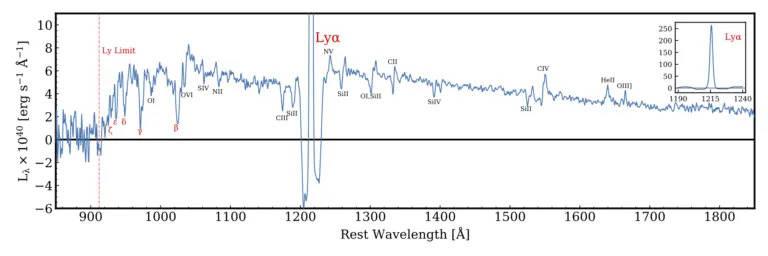
“These new 3D maps will allow us to study how galaxies assemble,” study co-author Karl Gebhardt, a professor of astrophysics at the University of Texas at Austin, told Live Science in an email. “Gravity is what causes galaxies to cluster together, so studying the properties of clustering allows us to understand the properties of gravity and the amount of mass present,” Gebhardt explained.
Viewing the structure of galaxies as a collection is invaluable for measuring large-scale density fluctuations across the universe and exploring the influence of dark energy, a mysterious entity that appears to be accelerating the expansion of the universe.
Of course, detecting signals from ancient galaxies is difficult, but “we have to filter out weak signals from everything else: faint galaxies in the foreground, noise from detectors, artifacts produced by analysis techniques, scattered light sources like the Moon, “It’s even more difficult to filter out all the weak signals, such as weak absorption and emission lines from the air,” said study co-author Robin Ciardullo, professor of astronomy and astrophysics at Penn State University and HETDEX observation manager. He told Live Science via email.
The next step is to improve noise reduction techniques and separate the desired signal from the numerous celestial and terrestrial contaminants. Researchers will be able to use dimmer sources and lower-mass objects as trackers of cosmic evolution to more strongly constrain gravity models.
“Hobie Everly is a pioneering telescope,” Munoz said. “And with new complementary instruments coming online, we are entering a golden age of mapping the universe.”