


Close Menu
  • Home
  • Identity
  • Inventions
  • Future
  • Science
  • Startups
  • Spanish
What's Hot

“Pokémon Pokopia” is a game about repairing a broken world – I love it

FortiGate devices are exploited to infiltrate the network and steal service account credentials

KadNap malware infects over 14,000 edge devices, powering stealth proxy botnet

Facebook X (Twitter) Instagram
  • Home
  • About Us
  • Advertise with Us
  • Contact Us
  • DMCA
  • Privacy Policy
  • Terms & Conditions
  • User-Submitted Posts
Facebook X (Twitter) Instagram
Fyself News
  • Home
  • Identity
  • Inventions
  • Future
  • Science
  • Startups
  • Spanish
Fyself News
Home » The world’s smallest QR code can store thousands of years of data, but you’ll need an electron microscope to see it
Science

The world’s smallest QR code can store thousands of years of data, but you’ll need an electron microscope to see it

userBy userMarch 9, 2026No Comments4 Mins Read
Share Facebook Twitter Pinterest Telegram LinkedIn Tumblr Email Copy Link
Follow Us
Google News Flipboard
Share
Facebook Twitter LinkedIn Pinterest Email Copy Link

Scientists have created the world’s smallest QR code, measuring just 3.07 × 10⁻⁹ square inches (1.98 square micrometers). The data can be stored for thousands of years and is so small that you need an electron microscope to see it.

Each pixel in a QR code is just 49 nanometers in diameter, even smaller than a bacterium, securing its place in the Guinness Book of World Records. It was created by etching a grid into a thin ceramic film using a focused ion beam. This is approximately 37% of the size of previous world record holders and approximately 0.0000004% of the size of a standard 0.8 square inch (2 cm2) QR code.

Codes are too small to be visualized even with a light microscope because the pixels are smaller than the wavelength of visible light and light waves are not scattered by their microscopic parts. Only an electron microscope, which emits an electron beam at picometer-scale (10-11 inch) wavelengths, can solve this problem.

Article continues below

you may like

The creation of such small data storage units opens up the possibility of extremely high storage densities. Scientists at the Vienna University of Technology in Austria, who developed the QR code in collaboration with data storage company Cerabyte, estimate that more than 2 terabytes of data can fit on the surface area of ​​an A4 (8 1/2 x 11) sheet of paper with etched pixels. That’s more data than most consumer laptops can store.

In contrast, the same area covered by a version 1 QR code of 0.8 square inches (2 cm2) can only hold about 2.5 kilobytes, the equivalent of a page of plain text.

QR codes can store thousands of years of data
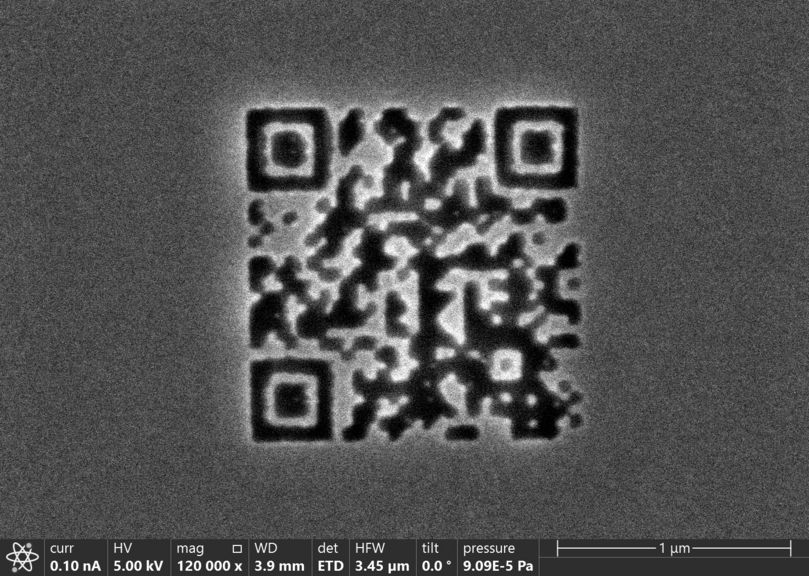
Grayscale microscopy image showing a black and white QR code with a 1 micrometer scale bar at the bottom right for reference.

World’s smallest QR code (Image credit: TU Wien)

Despite their record-breaking size, the QR code is even more durable, the researchers said.

“Structures on the micrometer scale are not uncommon today. It is even possible to create patterns made of individual atoms,” Paul Meyerhofer, head of the Thin Film Materials Science Research Group at the Vienna University of Technology, said in a statement. “But that alone doesn’t give you stable, readable code.”

Get the world’s most fascinating discoveries delivered straight to your inbox.

Magnetic storage solutions like hard drives and solid state drives tend to degrade after about 10 years, while optical media like CDs and DVDs have a lifespan of only 30 years. As a result, all of today’s digital data is at risk of being lost unless a more stable solution is found.

Because of this potential for degradation, the research team decided to create QR codes using a film of chromium nitride, a ceramic compound. Ceramics are used in high-performance cutting tools because they are known to remain stable under extreme conditions. Scientists said that data stored in QR codes can be stored for thousands of years.
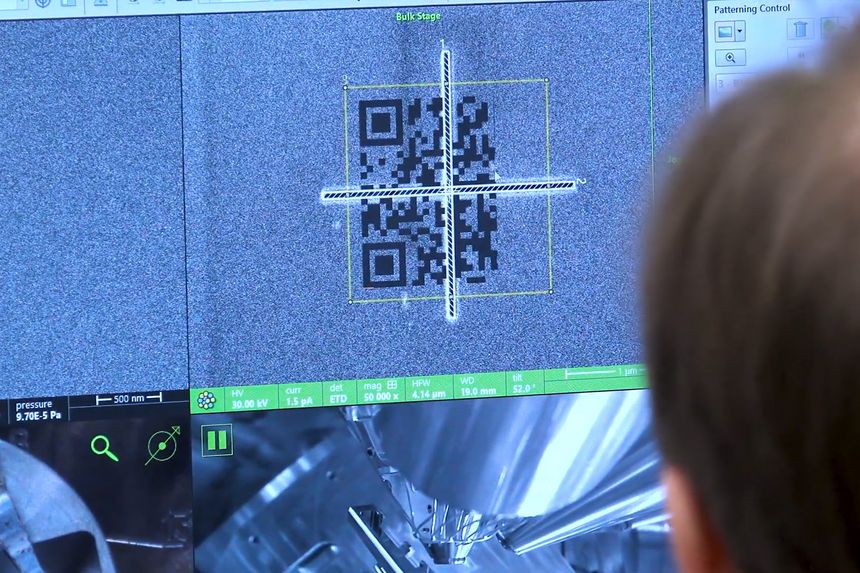
Close-up of a computer monitor showing a grayscale image of a QR code printed on a ceramic surface.

QR code etched on ceramic film. (Image credit: TU Wien)

“With ceramic storage media, we are pursuing an approach similar to ancient cultures, whose inscriptions can still be read today,” Alexander Kirnbauer, senior scientist at the Thin Film Materials Science Research Group at the Vienna University of Technology, said in a statement. “We write information into a stable, inert material that will stand the test of time and be fully accessible to future generations.”

A greener solution to AI dependence

Another advantage of small ceramic QR codes is that they do not require energy input or cooling to store data. In contrast, data centers require constant electricity to power servers and maintain cooling systems to prevent damage from overheating. According to the International Energy Agency, it will account for approximately 1.5% of global electricity consumption in 2024.

There is an urgent need for greener alternatives to the large, carbon-intensive data centers we rely on. Especially as we become increasingly dependent on artificial intelligence (AI) as it rapidly expands. Market research firm IDC predicts that the amount of data the world generates annually will triple from 173.4 zettabytes (173.4 billion TB) in 2024 to 527.5 zb in 2029.

The team is currently looking at other materials for QR codes, techniques to improve writing speeds, and industrial-scale manufacturing methods. We also want to see if data structures more complex than QR codes can be written to and read from ceramic films.


Source link

#Biotechnology #ClimateScience #Health #Science #ScientificAdvances #ScientificResearch
Follow on Google News Follow on Flipboard
Share. Facebook Twitter Pinterest LinkedIn Tumblr Email Copy Link
Previous ArticleUNC4899 Developer compromises encryption company after airdropping Trojanized files onto work devices
Next Article Dutch spies warn of Russian government hackers targeting Sign and WhatsApp users
user
  • Website

Related Posts

California wildfire season is changing, with an increase in fires following traditional high-risk periods, study finds

March 9, 2026

Asante Spider: A rare African sword ornament found on Ghana’s Gold Coast that later helped save a Texas man’s life.

March 9, 2026

Creating a ‘digital twin’ of yourself could revolutionize future surgeries and make medical procedures more personal

March 8, 2026
Add A Comment
Leave A Reply Cancel Reply

Latest Posts

“Pokémon Pokopia” is a game about repairing a broken world – I love it

FortiGate devices are exploited to infiltrate the network and steal service account credentials

KadNap malware infects over 14,000 edge devices, powering stealth proxy botnet

Legora reaches $5.55 billion valuation as AI legal technology boom continues

Trending Posts

Subscribe to News

Subscribe to our newsletter and never miss our latest news

Please enable JavaScript in your browser to complete this form.
Loading

Welcome to Fyself News, your go-to platform for the latest in tech, startups, inventions, sustainability, and fintech! We are a passionate team of enthusiasts committed to bringing you timely, insightful, and accurate information on the most pressing developments across these industries. Whether you’re an entrepreneur, investor, or just someone curious about the future of technology and innovation, Fyself News has something for you.

Castilla-La Mancha Ignites Innovation: fiveclmsummit Redefines Tech Future

Local Power, Health Innovation: Alcolea de Calatrava Boosts FiveCLM PoC with Community Engagement

The Future of Digital Twins in Healthcare: From Virtual Replicas to Personalized Medical Models

Human Digital Twins: The Next Tech Frontier Set to Transform Healthcare and Beyond

Facebook X (Twitter) Instagram Pinterest YouTube
  • Home
  • About Us
  • Advertise with Us
  • Contact Us
  • DMCA
  • Privacy Policy
  • Terms & Conditions
  • User-Submitted Posts
© 2026 news.fyself. Designed by by fyself.

Type above and press Enter to search. Press Esc to cancel.